Baja Divide
February 10
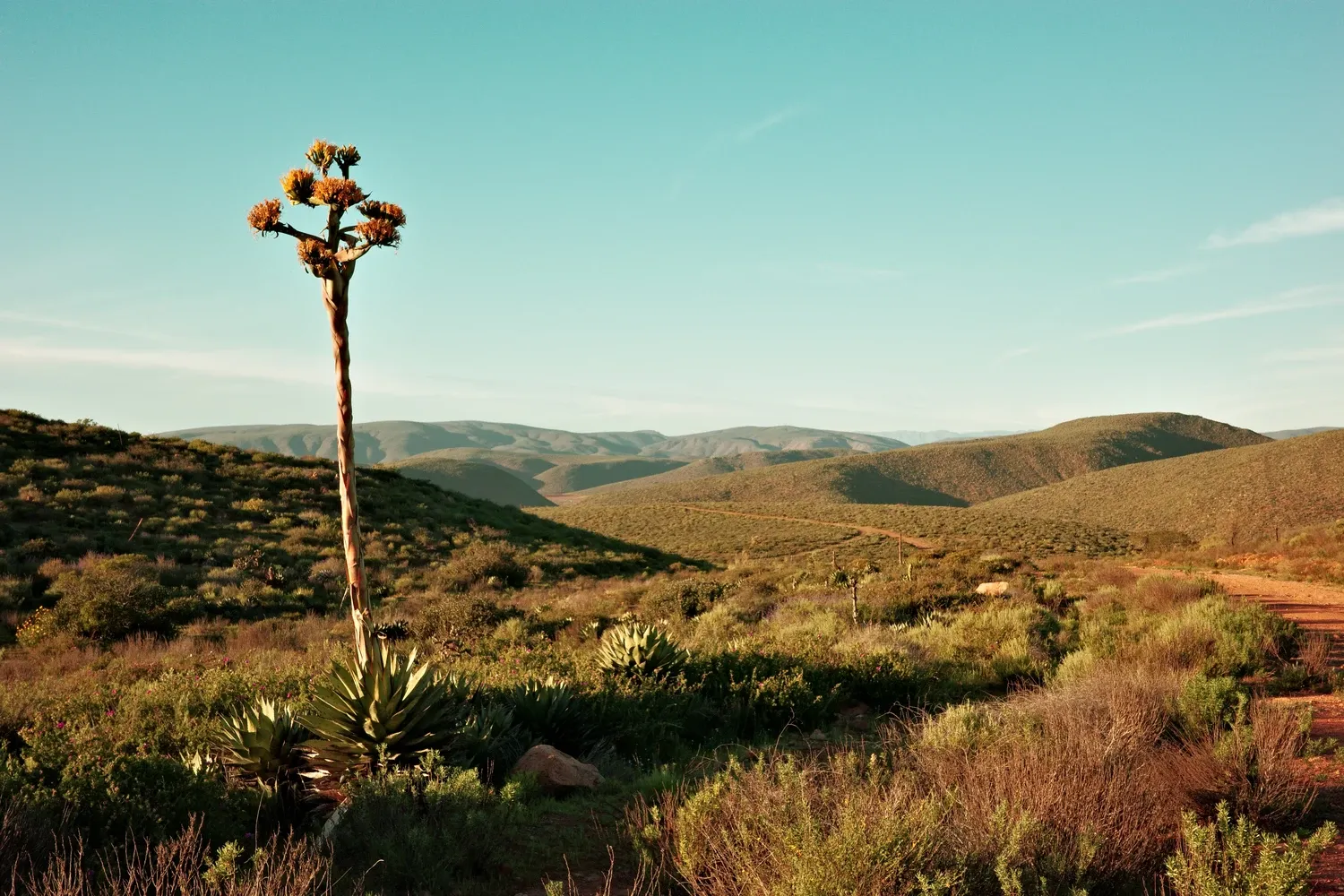
I wake early then snooze. Leah sneaks some sunrise photos without stirring me. I hear the "ha-hahahh" birdsong I noticed yesterday and try to ID it with Merlin, but as soon as I start recording it stops singing (Note: it ends up being a California Quail). I do identify a Western Meadowlark though. Granola and powdered milk for breakfast is tasty. We linger enough for the breeze and sun to dry out the tent, then leave around 9 as usual. After a few miles we pass through Ejido Benito Juarez. It's a small cute village with a lone store - just big enough for water, tortillas, beans, and snacks. At this point in the trip I am supplementing my diet with huge packets of cookies, so I buy some imitation Oreos.
Cacti start to appear: cholla and thin prickly pears. The landscape is beginning to feel like the desert. The road gets progressively sandier and flatter and the farms end (so I think). Soon we're gradually winding our way up a small river valley. We're surprised to see the stream/river flowing. Surprise turns to minor annoyance as we have to cross back and forth over it several times, with varying degrees of difficulty. We both get wet feet, but mine aren't as severe as Leah's, and they dry out during the ride. We hear a constant thrumming noise and wonder what it could be. Water pump? Generator? Finally the road breaks away from the rio and starts upward, just a hair steeper. We get a view of the source of the noise - a tractor. This seems like a long way out to be planting a small field, but what do I know?
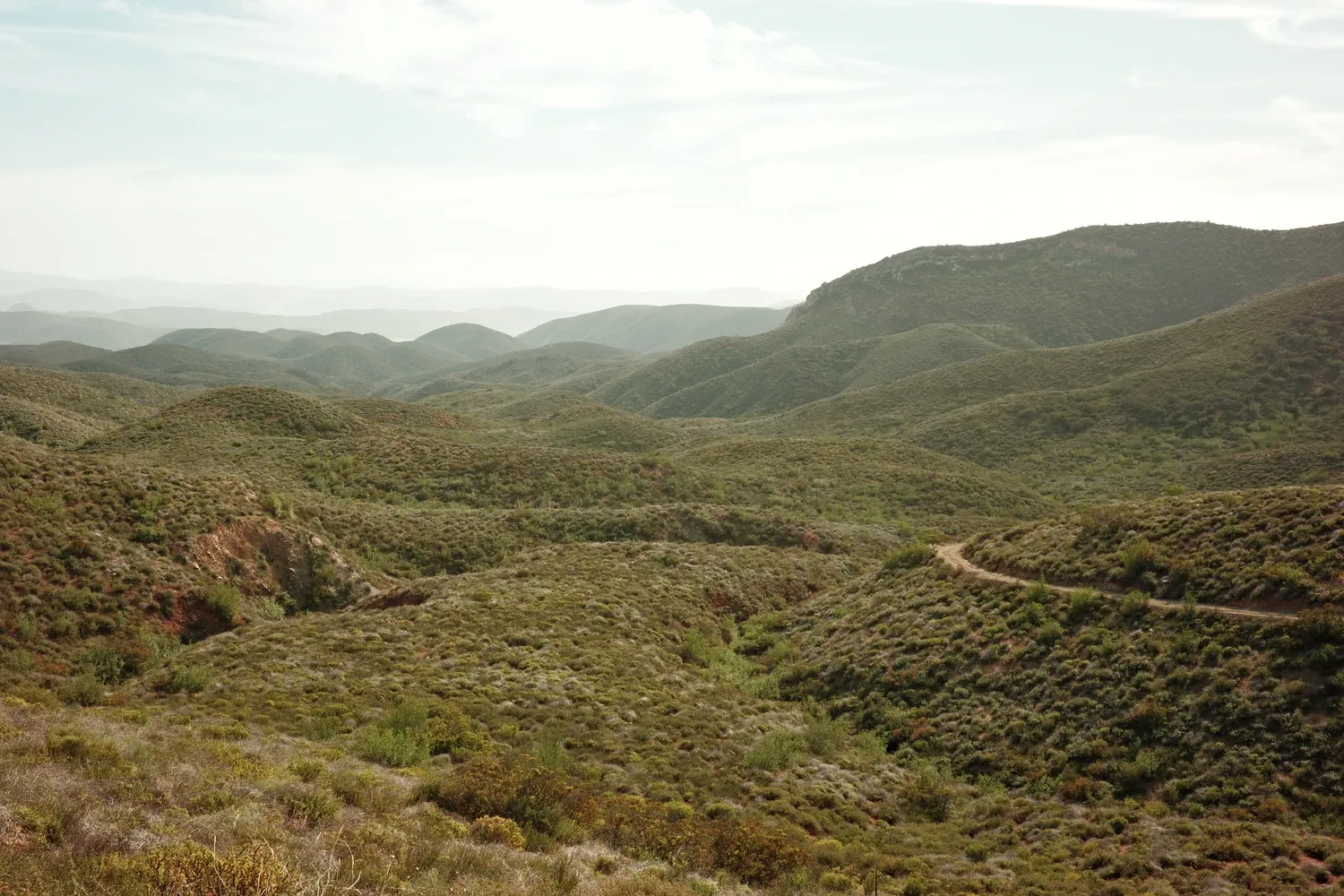
The road climbs first gradually, then, after lunch, very steeply up a couple of miles of double track. I see lots of California Quail, running around on the ground, bolt upright. They seem like a slightly more dignified Roadrunner. At the top of the ridge we get amazing views in every direction. Hills beyond hills, and mountains beyond those. It's quite a change from the salty beach scenery we had yesterday. There is a big yellow road grader parked at up here, and an unfinished motel-ish structure. Seems like someone's got all they need for a good business up here.
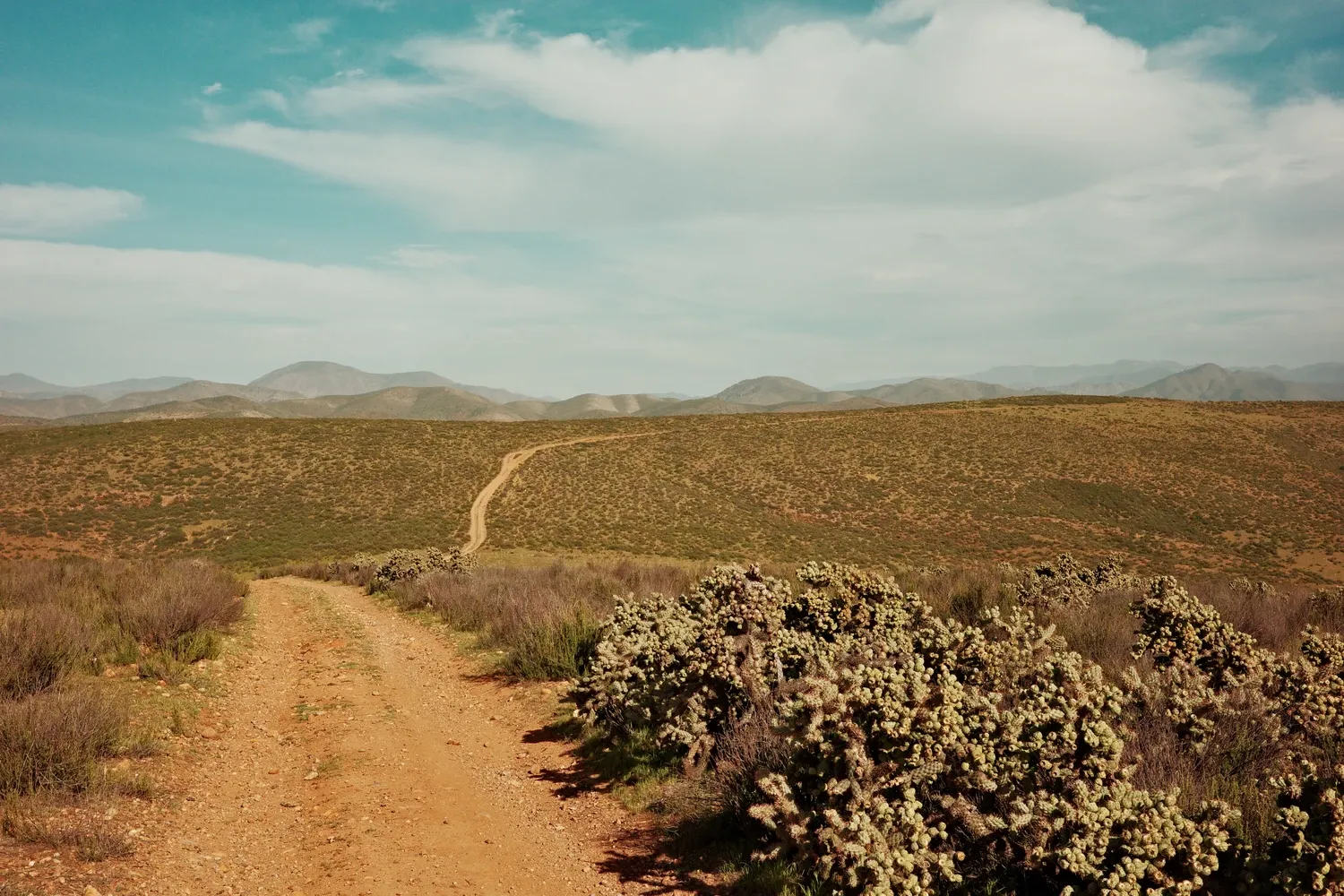
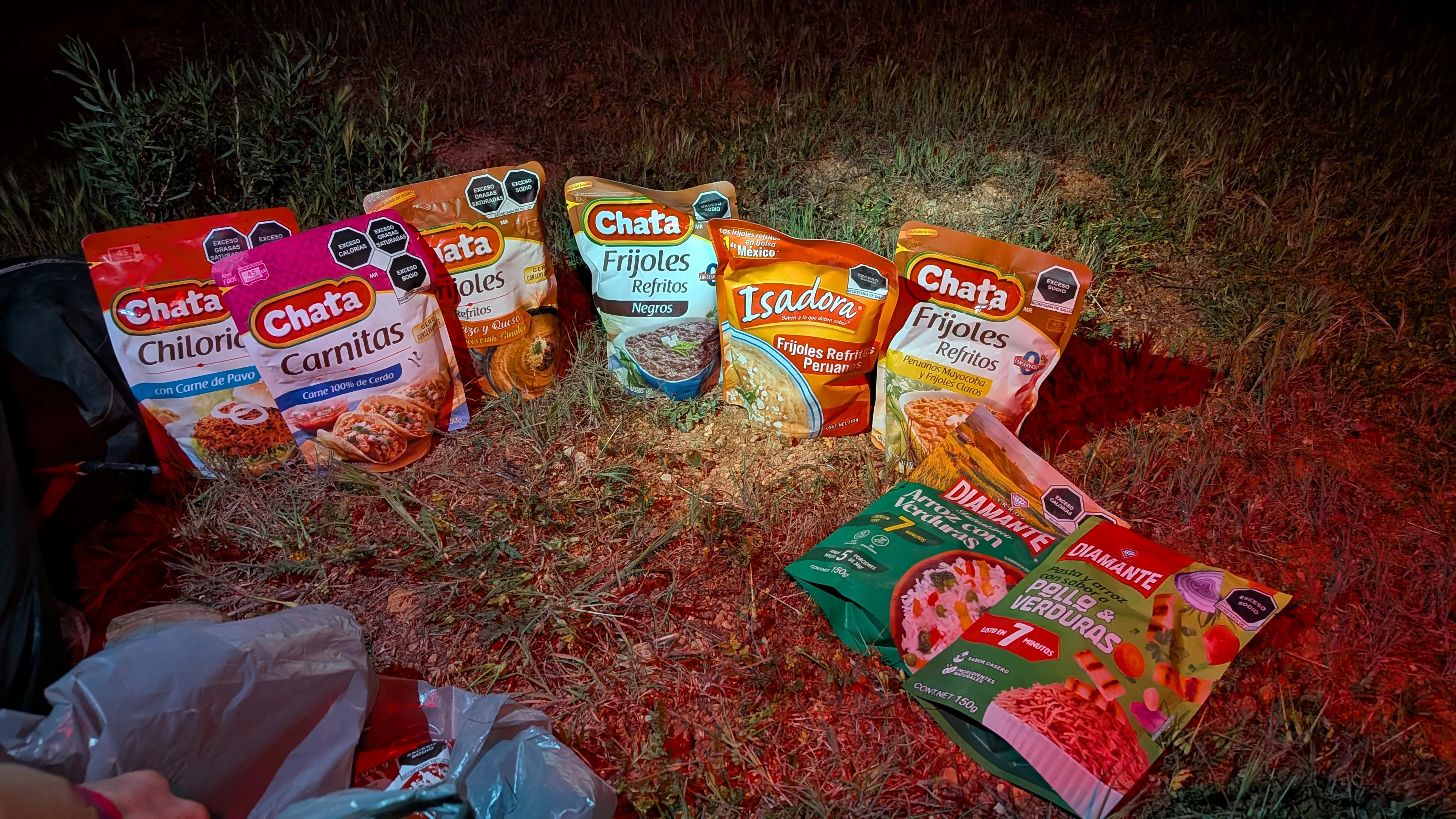
The road follows along the ridgetop for several miles, with the same breathtaking views all around. I watch a bird floating on the thermals, effortlessly, and get a bit jealous. Leah explains that you can tell a hawk from a vulture because a vulture soars with its wings slightly bent up, so they make a "V" shape (for vulture). The road drops and turns to more rolling red dirt doubletrack with some short tough climbs, then a last push (literally) before we arrive at El Coyote ranch. We startle two cows drinking at a trough with our arrival, and they take off sprinting. The first one attempts to jump the barbed wire fence along the road to escape, but catches its legs, crashing to the ground (unscathed of course, because cows are very durable) and crushing the fence. The second cow has an easier time fleeing over the now-flattened fence. A nice bit of drama for our arrival. We finally find the entrance to the ranch (around the corner, up the road) and pet their cute old cattle dog, then poke our heads in to ask about camping. We don't have enough cash for the $20/person meals; only camping. We shower together in the women's bathroom despite my half-hearted pleas for rule-following and modesty, then do some minor laundry in the outdoor sink. Dinner is Chata peruanos mayocoba y frijoles claros (kinda plain) with arroz and pollo and zucchini.
February 11
Dandelions catch the sunlight in the field for a moment while everything else is still dim. The sun retreats into the clouds, and sunrise is more of a "gradualening of light." We wake early and chat in the tent, then get to it. I prepare granola while Leah uses the bathroom, a minute later she texts me from the stall asking for TP. There's a single dispenser on the wall outside all the stalls, so you need to remember to grab some before entering. We eat and watch the goats staring at the ranch cats, which are in turn pouncing in the grass, perhaps stalking insects. I identify some more birds (Cassin’s Kingbird, Red-naped Sapsucker, California Towhee, more Eurasian Collared Doves). We go to the office and pay the young guys working the ranch, and sign the Baja Divide rider guest book that they have. We almost forget to fill up on water until one of them offers. The five miles to Rancho Meling are mostly fast, smooth downhill that goes by in a flash. On the way out two more cows try to jump over a fence but plow through it. Is this a thing here? There are open views of the large mountain range directly to our east. According to the map the high points are 30 miles away and 9000 feet tall, but they feel much closer and smaller than that. Maybe because they're so big.
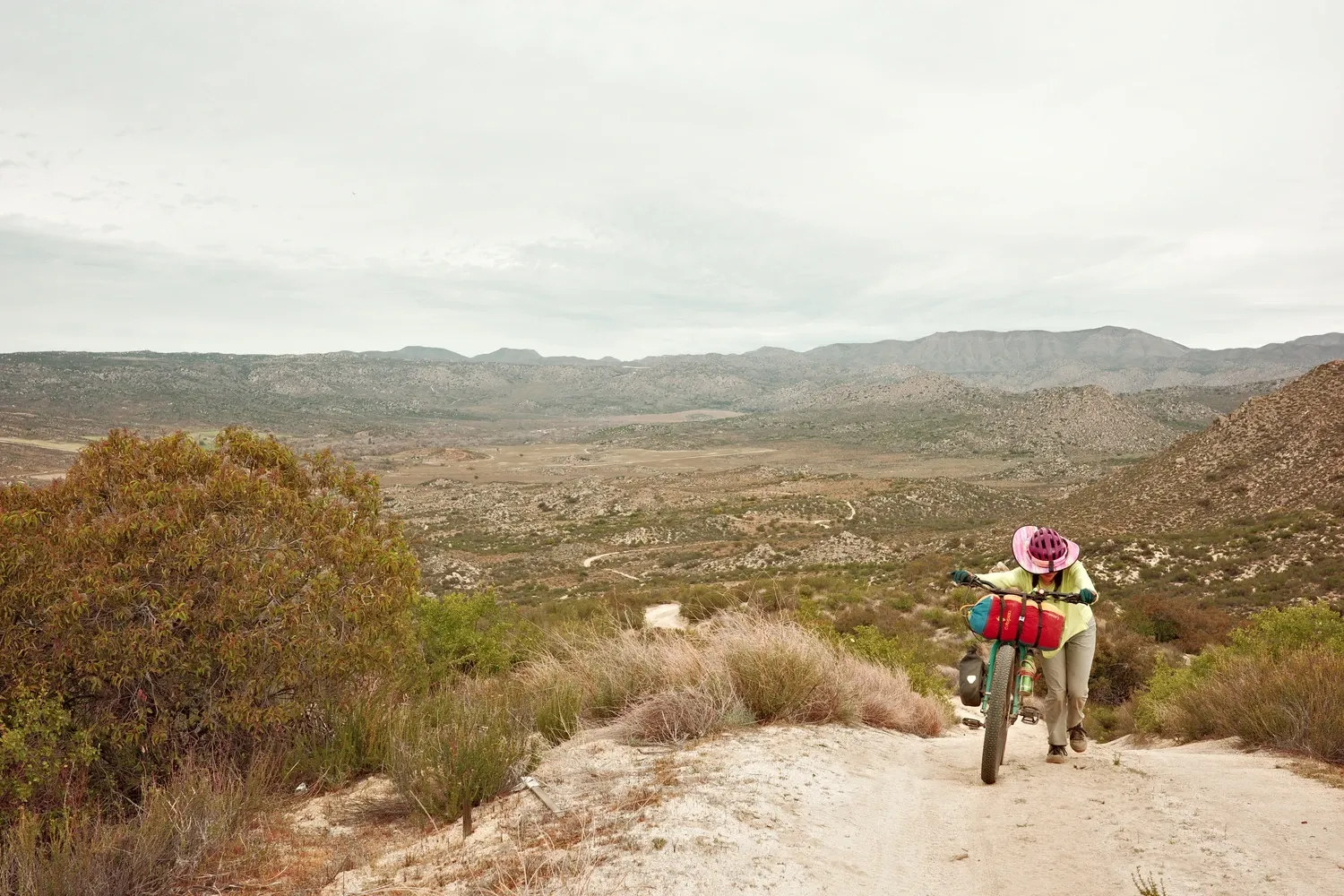
At Rancho Meling we putter through the main entry and parking lot. The workers don't give us much notice, presumably accustomed to the occasional biker, since the owners have given permission to for the route to pass through their private property for the next several miles. We go through a series of wire gates and a mucky water crossing. As we climb out the other side and up the hill, we have amazing views of the quaint ranch and river valley. We soon lose our enthusiasm, as the road becomes VERY steep and rutted. We push our bikes up 50-100 meter sections that are so loose and steep we slide backward with every other step, our bikes threatening to topple down on top of us. Not fun. This continues for a couple of miles. Then the stretches in between hills lengthen, with some fun downhill, but the hike-a-bike parts remain. The day feels like an endless cycle of dismounting, pushing up a chunky steep hill, hopping on and coasting down, then arriving at the next one before we can get any flow. For me it's the most frustrating riding of the trip by far.
In my haste, I hurtle too hard into a dry wash in an attempt to carry speed up the other side, and a few minutes later feel the dreaded mushy steering that indicates a flat tire. I pump it up, find a nice gash in my front tire, and plug it. Leah backtracks to find me as I'm finishing up. A few miles later one of my gear straps gets caught in my rear brake rotor, and chewed up a bit. Rawr. Despite the challenges of the day, it's a large net downhill, and we have beautiful views of rolling hills and valleys all day, along with the ridge of the mountains to the east. We come across a pair of mule deer (?) prancing along and across the road, all four legs extended at once as they bounce along. They bound down the road for a bit before finally turning into the brush and leaving us. By late afternoon we pass into low green plains full of cacti, yellow and purple flowers, then finally agriculture, as we pop out on a paved road.
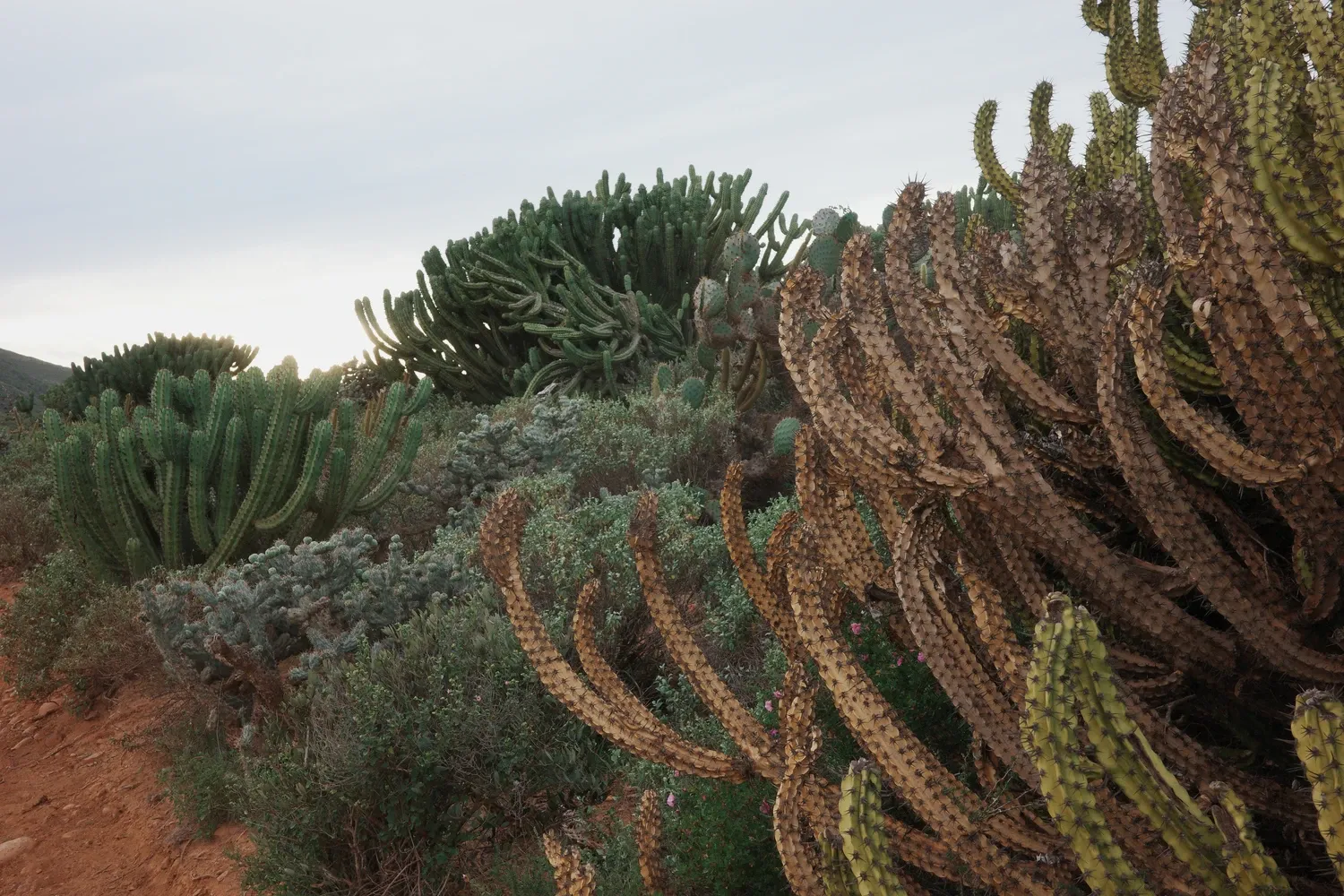
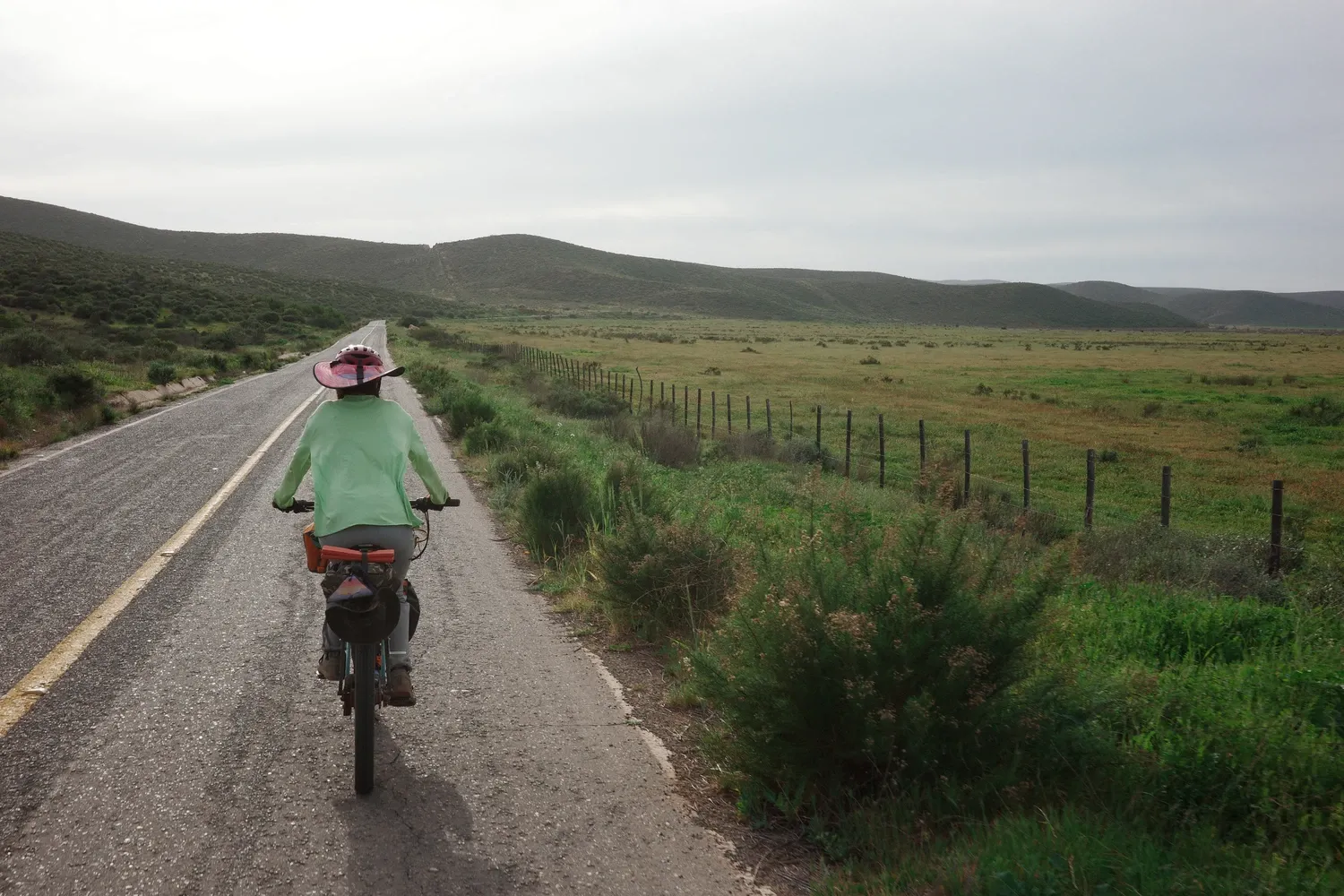
The six mile ride to Hacienda Sinaloa is stunning. The low sun shines on a perfectly flat, wide valley of fields and tree windbreaks. We make great time on the smooth pavement and drop into the cute town around 4:30 PM. The schools and sports fields look new, the houses fairly ramshackle. There are a lot of people out and about, walking, talking, some kids playing. It seems like a nice community. We get a few snacks at a Bienestar store to supplement our dinner and to get us through to Vicente Guerrero tomorrow. A mile out of town we turn after a cute log cabin with immense agave plants lining the driveway. More cacti line our dirt road to the hills, and we stop to take photos of them, and the town and fields as dusk approaches. The upcoming climb is 2.5 miles and 800 feet, so it's not happening before dark. We find a flat spot just off the dirt road behind the field. At this point I realize Leah's face is covered in dead gnats and dirt and grease smudges, which I hope was quite the spectacle for the shop owner in town.
The bag of totopos I got is a nice addition to our dinner of beans + salsa + chilorio + cheese. We entertain ourselves by scooping the stringy melting cheesy concoction into our mouths. Or onto our pants, as is my case.
February 12
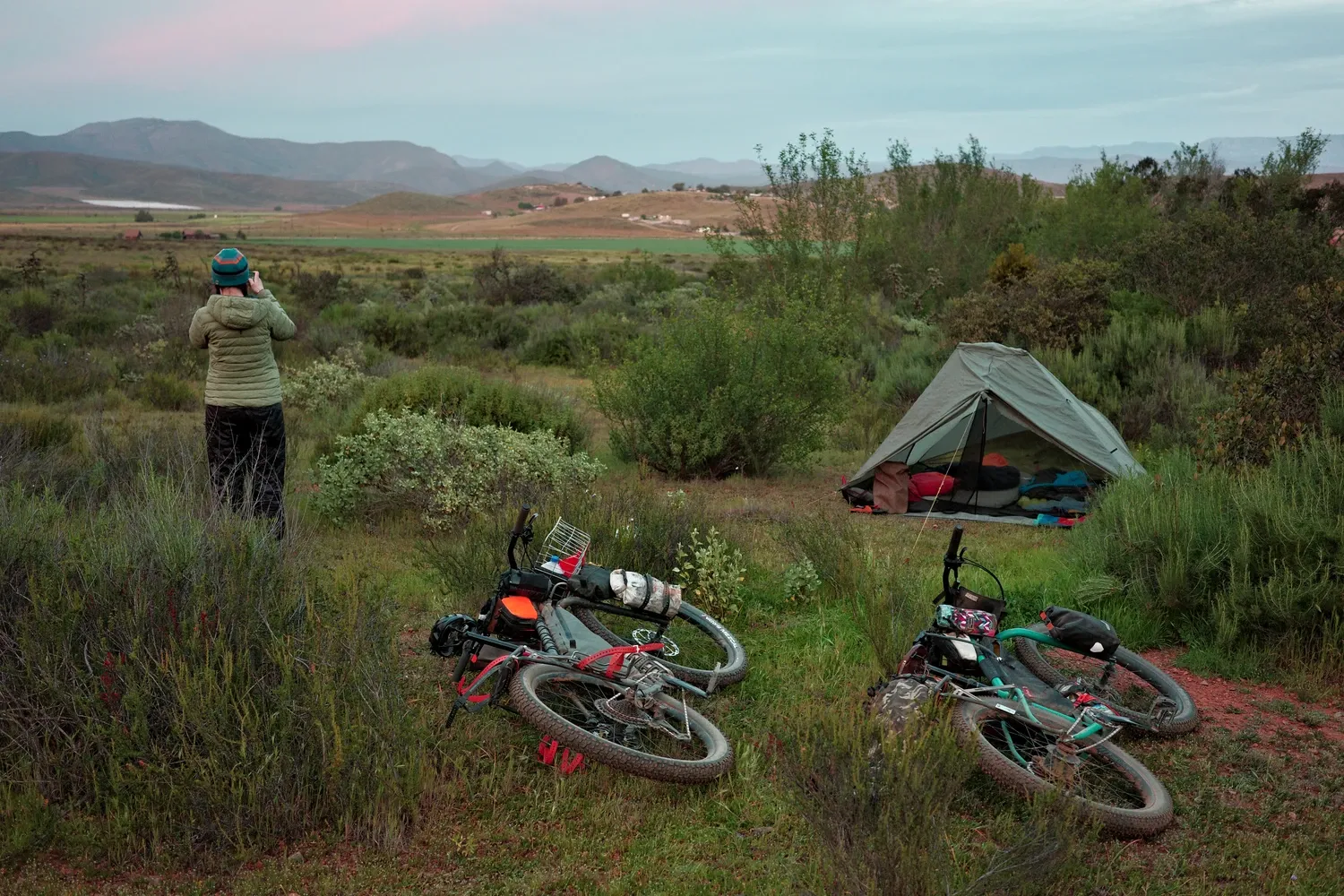
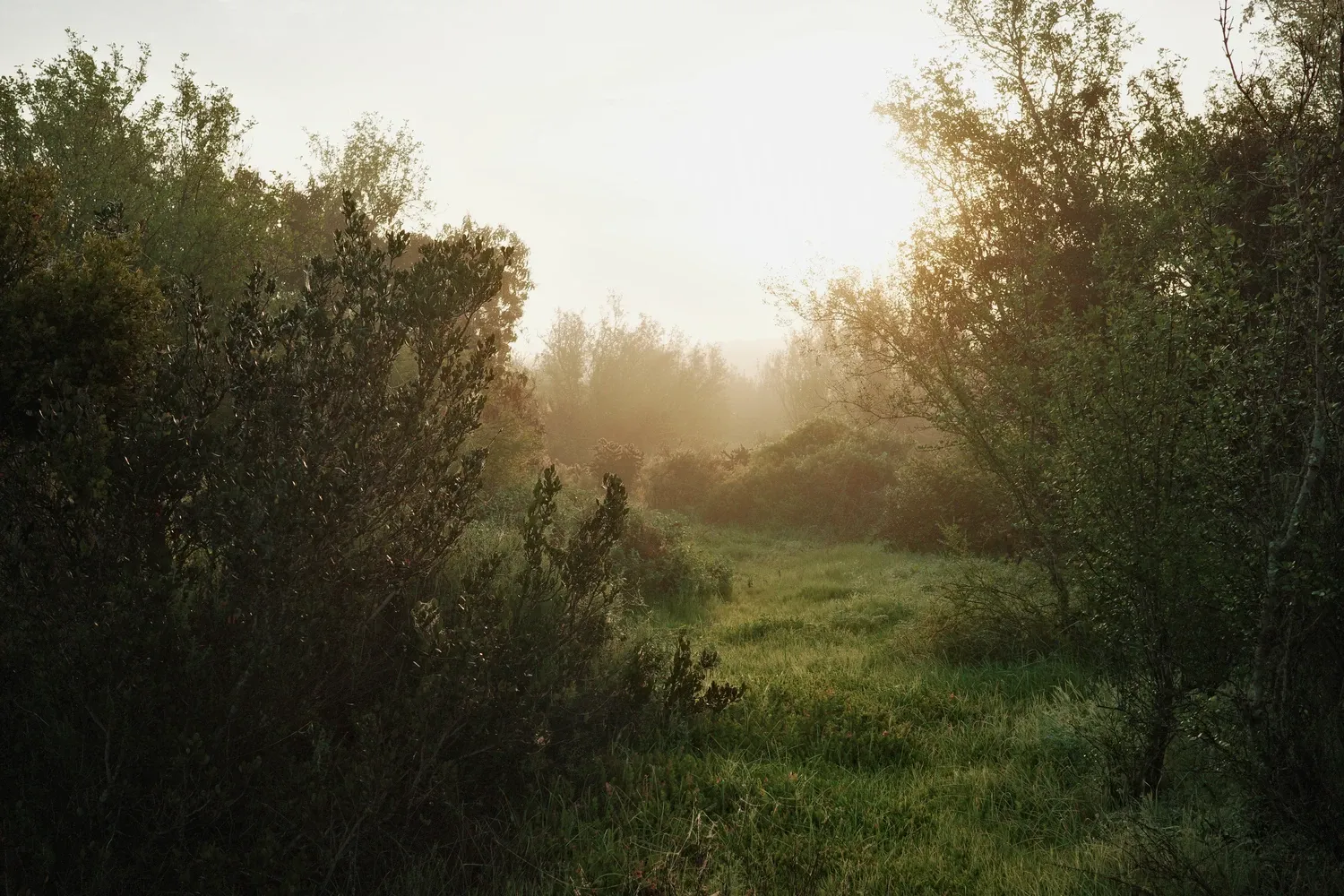
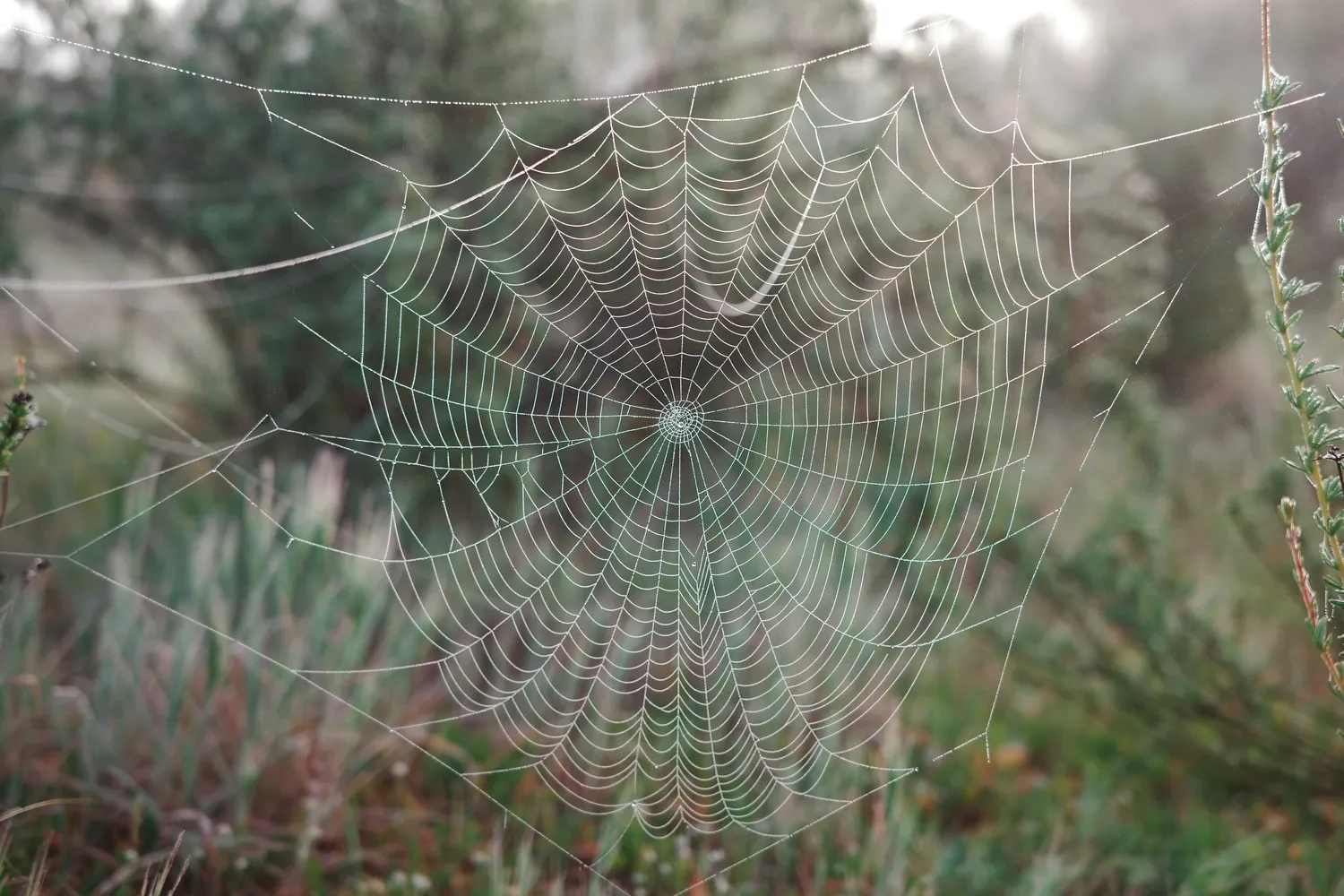
Morning is foggy and the tent is wet again. I can’t see the town or even the nearby pasture through the fog. Spiderwebs are everywhere: on the shrubs, across the ground; a few ambitious strands stretch all the way between our bikes and the tent.
The sunlight breaks through the fog and moisture begins to evaporate; the droplets swirl up and around us in a fine mist. It's beautiful. I run around snapping pictures and ignoring my breakfast duties.
We start the day with immediate hike-a-bike and hard climbing. Eventually we crest a rise and spy the ocean again. At the top, we begin a long and satisfying descent, only to check the map and realize we’ve gone the wrong way. We hastily backtrack and set out downhill, the right way. At the bottom, we follow a stretch of singletrack to the edge of Camalú. There are painted lines in the dirt — maybe from a mountain bike or trail running race?
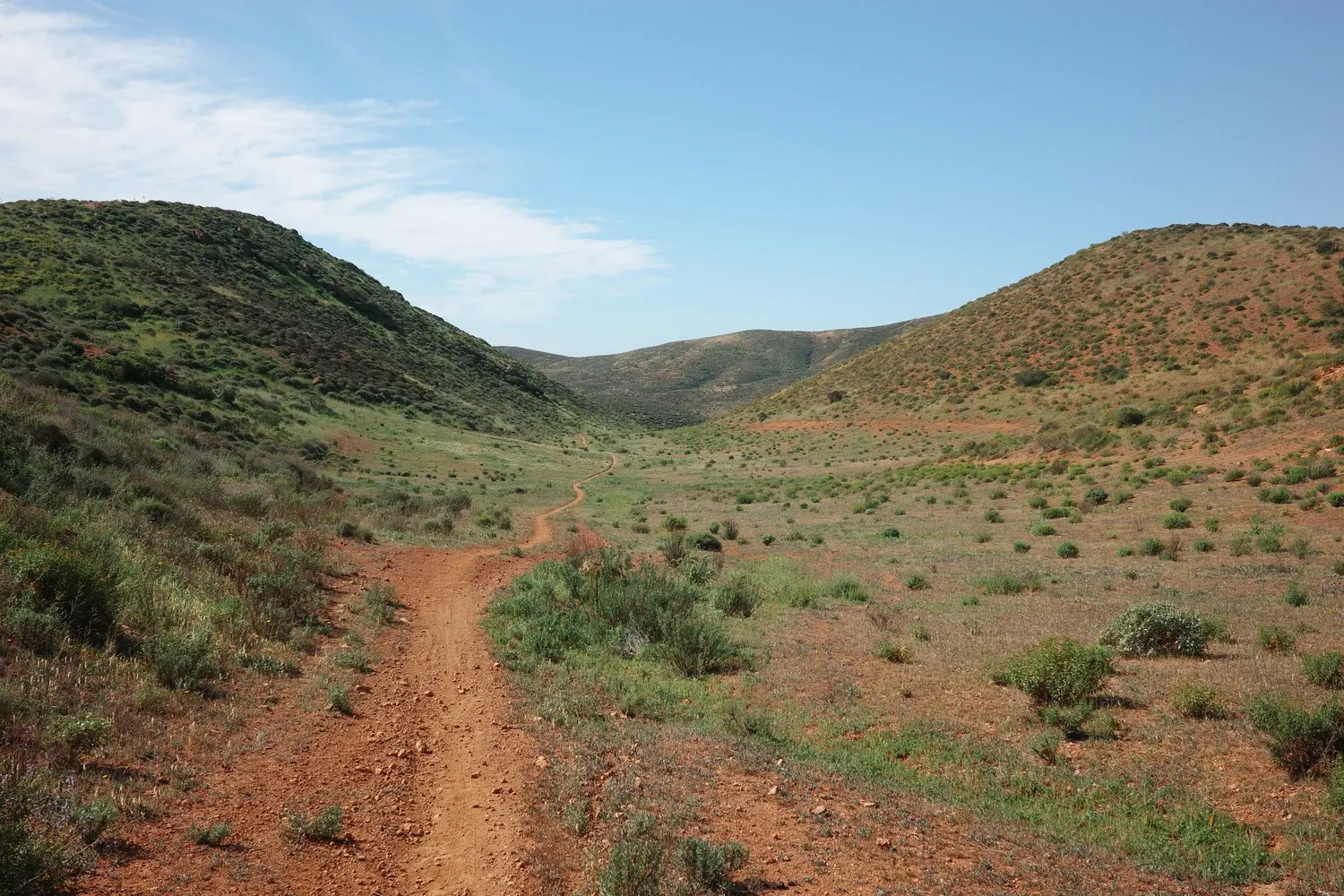
We enter town via down dusty side roads and stop at a tiendita to get groceries for lunch, then pop out onto the highway. It’s an unceremonious return to civilization. We bump along the frontage road, passing auto repair shops, industrial supply stores, agricultural buildings, and roadside restaurants. After a couple miles, it fades out again and we turn west, toward the ocean.
The road takes us past large greenhouses and open fields. As we get closer to the water, a headwind picks up. Then the road turns and we’re riding parallel to the ocean, high on a bluff above crashing waves. Every so often we see someone fishing or digging along the rocky shoreline below.
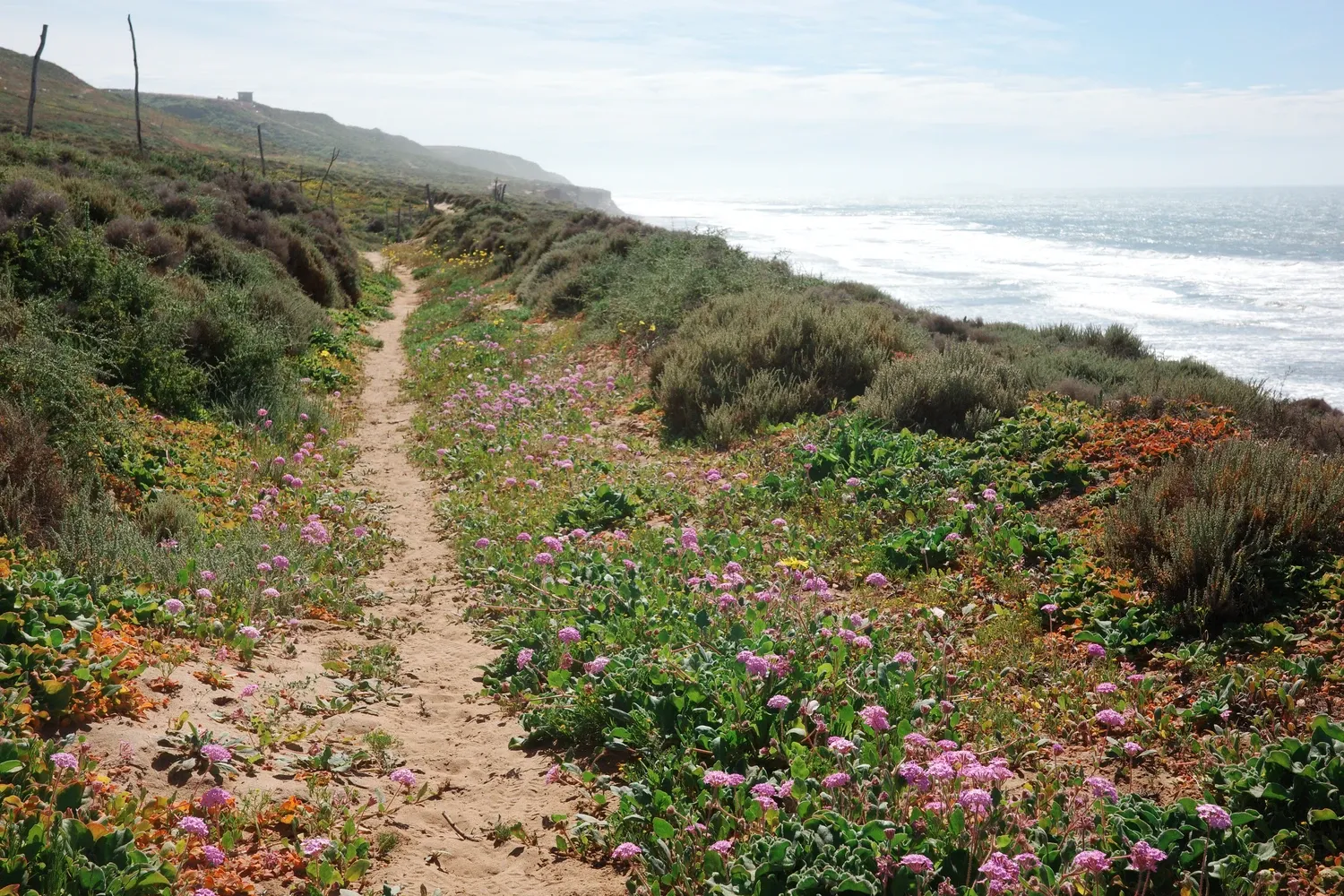
We leave the road for a narrow, ditch-like trail along a fence line. It's on the cliff side of the fence, not the safe side. It’s exposed, but the vegetation makes it worth it. Small plants cling to the sandy hillside in bright reds, oranges, yellows, and greens. A sudden and unexpected autumn palette among the salty breeze.
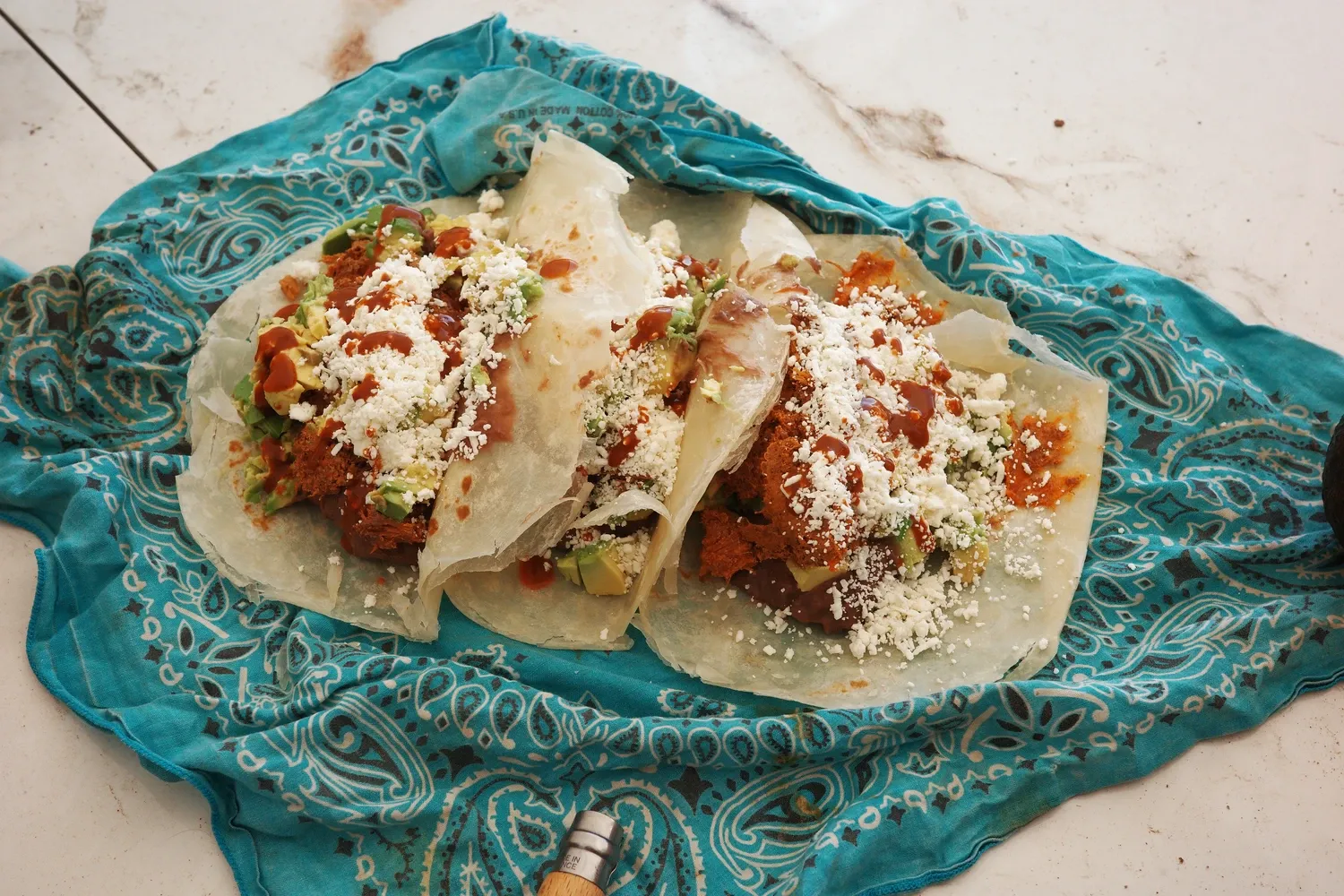
We climb back up to the road and stop for lunch inside an unfinished single-room concrete building, to get out of the sun and wind. The avocado from the grocery store is enormous. The unlabeled, hand-bagged cheese is pleasantly salty. These might be our proudest burritos yet.
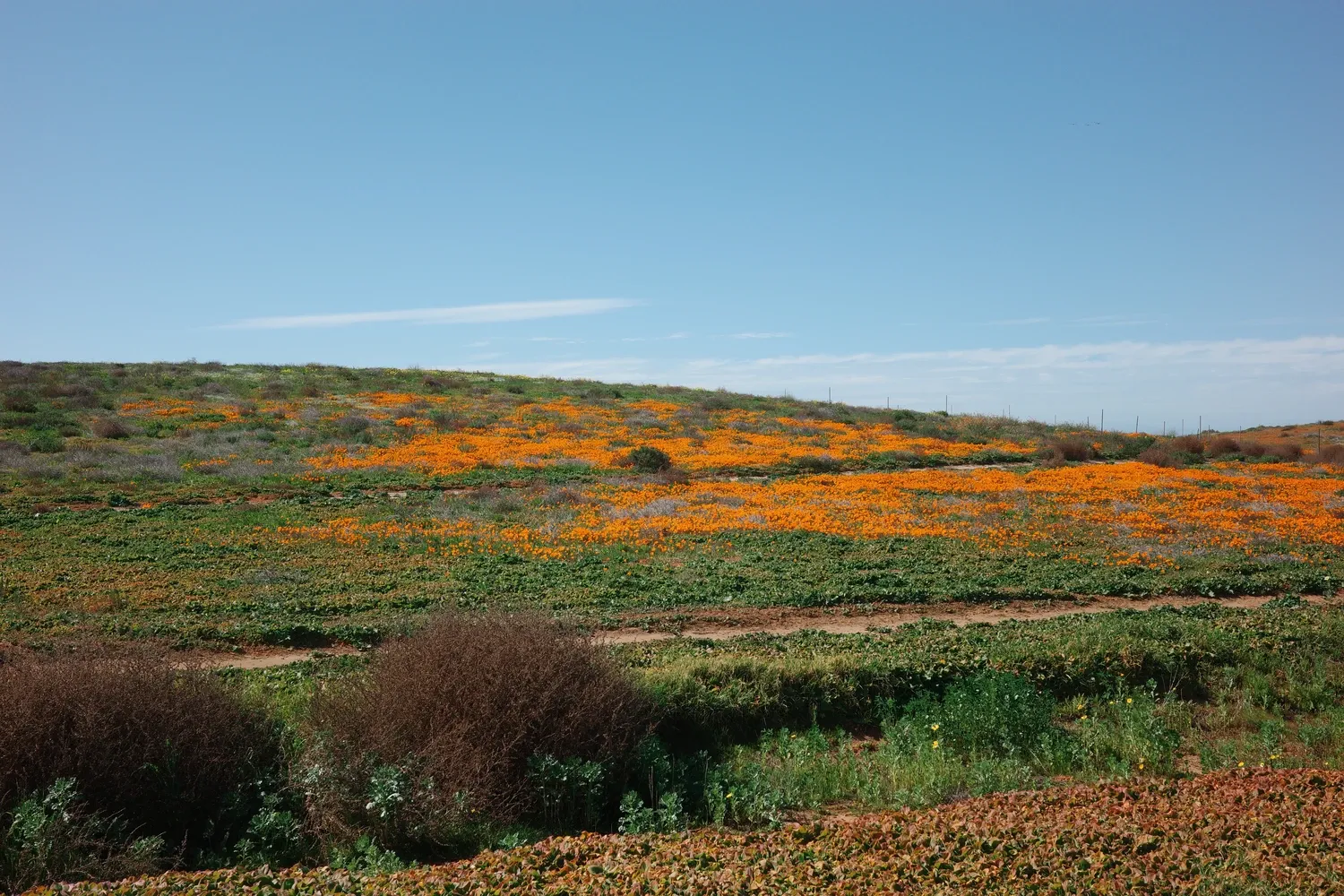
We put sunscreen back on, but the wind has picked up even more, so sand immediately sticks to our skin. D'oh! A thin layer has already settled on our gear and inside our open bags while we were eating. We ride another mile down the coast through deep sand and past new housing developments, dotted with vivid orange poppies (maybe?), before turning inland again and rejoining the highway into Vicente Guerrero.
We pass directly in front of a coffee shop and decide to stop.I try to brush some dirt off Leah’s face, but it’s mostly a lost cause. She wears more sunscreen than I do (and will probably have better skin in twenty years), but the tradeoff is that she now looks completely feral while ordering an iced chocolate mint drink, sand smeared everywhere. We sit down with drinks and start looking up places to stay. An older blond woman approaches us and asks about our trip. She’s from the U.S., traveling with her husband. They tell us about some of their favorite places in Baja. We make note of a few for later. Another vote for Loreto. Before leaving, they ask if they can say a prayer for us, for safety on the trip.
Hotel Posada San Martin is within walking distance, and we decide to stay for two nights. It will be our first rest day of the trip. The hotel has a small courtyard set back and down below street level, and is surprisingly quiet despite the busy road outside. The receptionists are kind, the price is reasonable, and the room is huge enough to roll the bikes inside — though we try to knock some of the dirt off first.
After long showers, we do laundry at the hotel then head out again and find a comedor for mulitas. On a whim, we stop at a wine tasting room across the street from the hotel. After passing vineyards since Santo Tomas, it feels appropriate to explore. The wine is from San Quintin. It’s good, though neither of us is particularly discerning. We’re mostly there to sit, talk, and prolong the evening. It ends up feeling a bit like a date. It's nice to be off the bikes, clean, and out together in public for the first time in a while.
February 13
Rest day in Vicente Guerrero. It starts with coffee and pan dulce from the hotel, then a walk around town. We get cash and stop at a large grocery store before returning to the room. I spend some time cursing technology as I back up photos from my camera, then we head back out toward the plaza.
There are lots of woven rugs, blankets, and clothes for sale. We stop at a small food stand with a few seats and enjoy excellent chile relleno and puerco tacos. People are waiting in a long line at the bank next door. We speculate a bit about the cause — lack of access to credit, fewer bank accounts, maybe some level of distrust in the financial system? Leah finds some fabric to use as a cover for her sleeping pad. She wants something light and comfortable so it doesn’t stick to her skin at night.
We wander through backstreets and notice a surprising number of zapaterías. Eventually we make our way to FASS bike shop and talk with the owner, Salvador, about the route ahead. A large map of Baja on the wall, full of signatures from past Baja Divide riders. We find our friends' signatures who rode the route in 2020. I mention the pain in my palms, and he shows me a few options for stems. I decide to come back later with my bike.
We return to the hotel by a different set of backstreets on the other side of the highway. The houses there seem a bit larger, cleaner, more solidly constructed.
Back at the shop, I get a new stem. It has a higher rise and slightly longer reach, which puts me in a more upright position and shifts weight off my palms and onto my butt — a trade I’m happy to make after a few nights of poor sleep due to wrist pain. We chat a bit more about surf spots for Leah and general riding tips ("always check your bolts!") before I head out.
Dinner is tacos again, at a tiny place a few doors down from the hotel. The menu is simple: pollo, carne asada, or queso, on either harina or maíz tortillas. That’s it. Minimal extras. All business, but very friendly. The ingredients are fresh and delicious.
February 14
We wake up early and go to the hotel restaurant for breakfast, but they seem a bit unready for the day. They apologize and the food takes a while. The chilaquiles are very good. The coffee is meh. Leah reminds me there is free coffee at the reception. Oops.
We spend more time than expected packing and loading the bikes. With five days of food needed between Nueva Odisea and Cataviña, I need more storage. I remove the top cross pole from the tent, so the fabric can be packed down smaller, and separately from the poles. This lets me add another rear pannier and stuff the tent inside it instead of strapping it onto the rack. Now the pannier holds the tent plus extra gear, freeing up space for food. It works, but requires a lot of fiddling to get everything sorted. I convince myself that deep down, my engineer brain loves it.
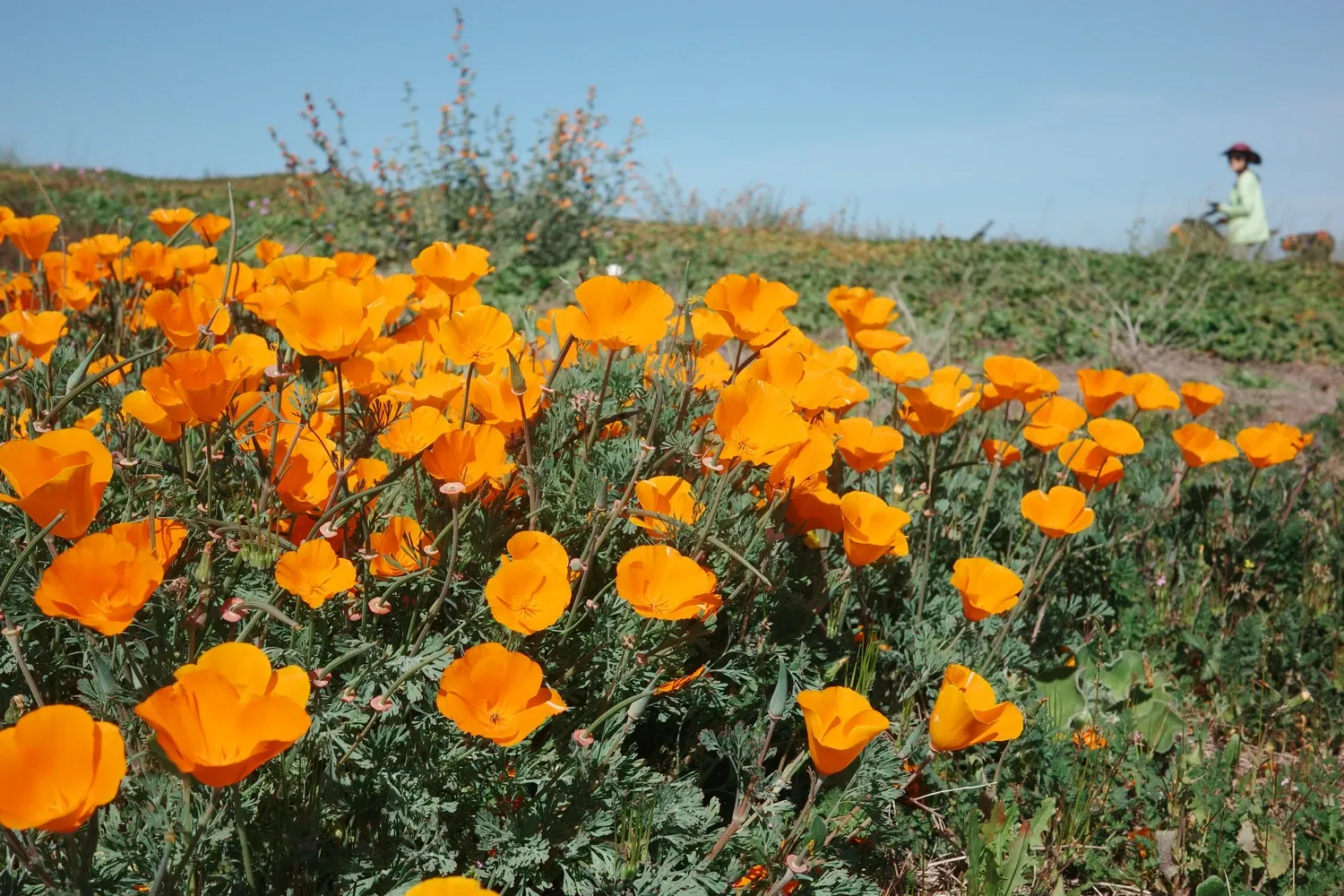
We return the key and start our dusty, busy ride out of town, alternating between the highway shoulder and the dirt frontage road depending on traffic. We pass a massive Driscoll's fruit facility. Eventually we turn onto a flat dirt road heading toward the coast, though we don't see the ocean for a long time. We're riding behind a line of large dunes, slogging through semi-soft sand. The surface is inconsistent and tiring. But the surroundings are unexpectedly beautiful, with saltwater ponds, and wildflowers everywhere. More bright yellow and orange poppies that look almost cartoonish, bluebonnets, and red/purple/orange ground cover that looks like lettuce. It feels out of place against the dry, drab sand, but in a jovial way. I think it livens up the place.
The riding becomes frustrating as the surface constantly changes. It's firm one moment, then suddenly soft, grabbing and twisting the tires. We're forced into frequent hike-a-bike on the climbs, with near crashes on sandy descents. We eventually reach the edge of La Chorera, a small village next to a huge beach and what looks like a peninsular nature preserve. We stop at a tiendita. I get cookies and a Coke, and gummy panditas for Leah.
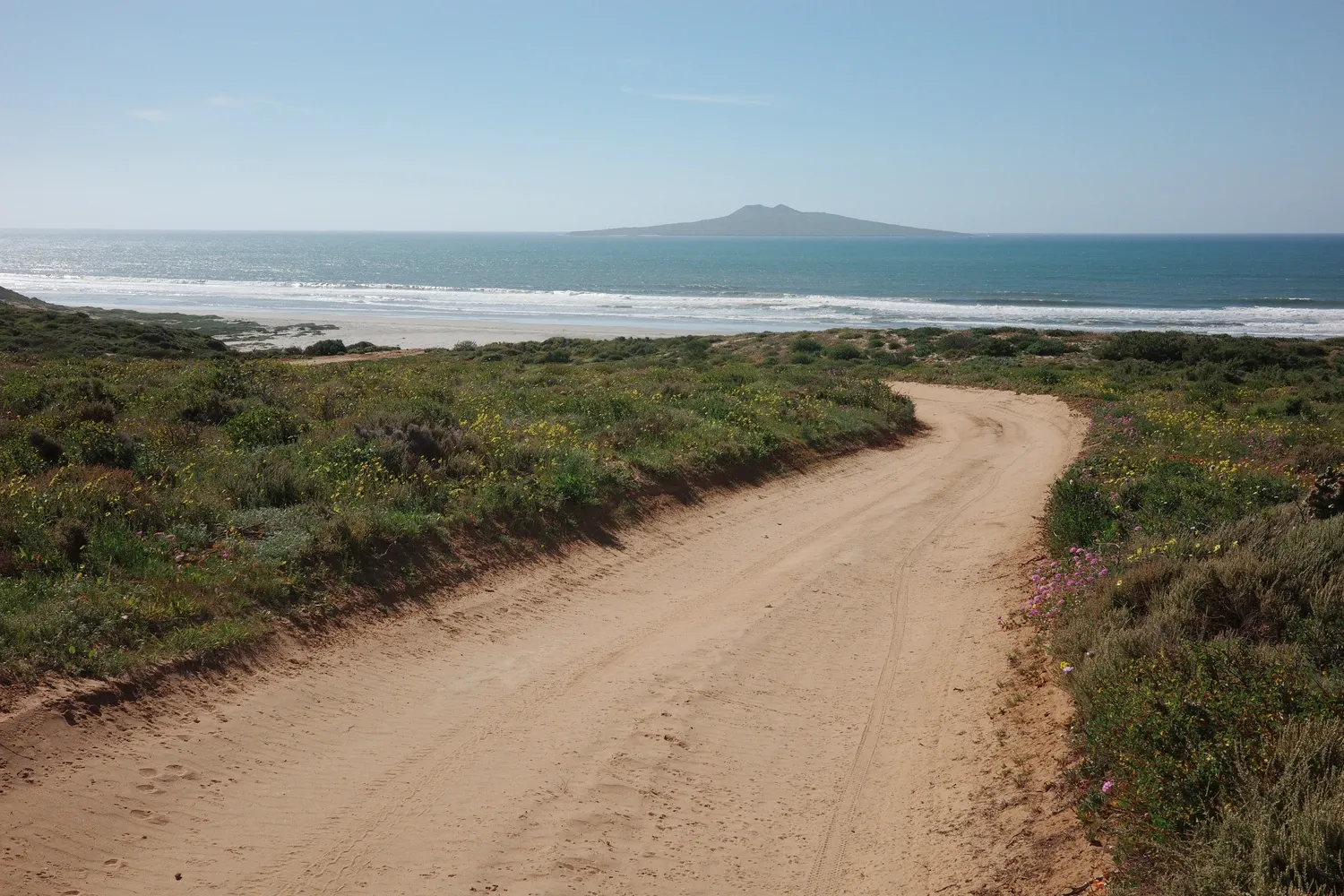
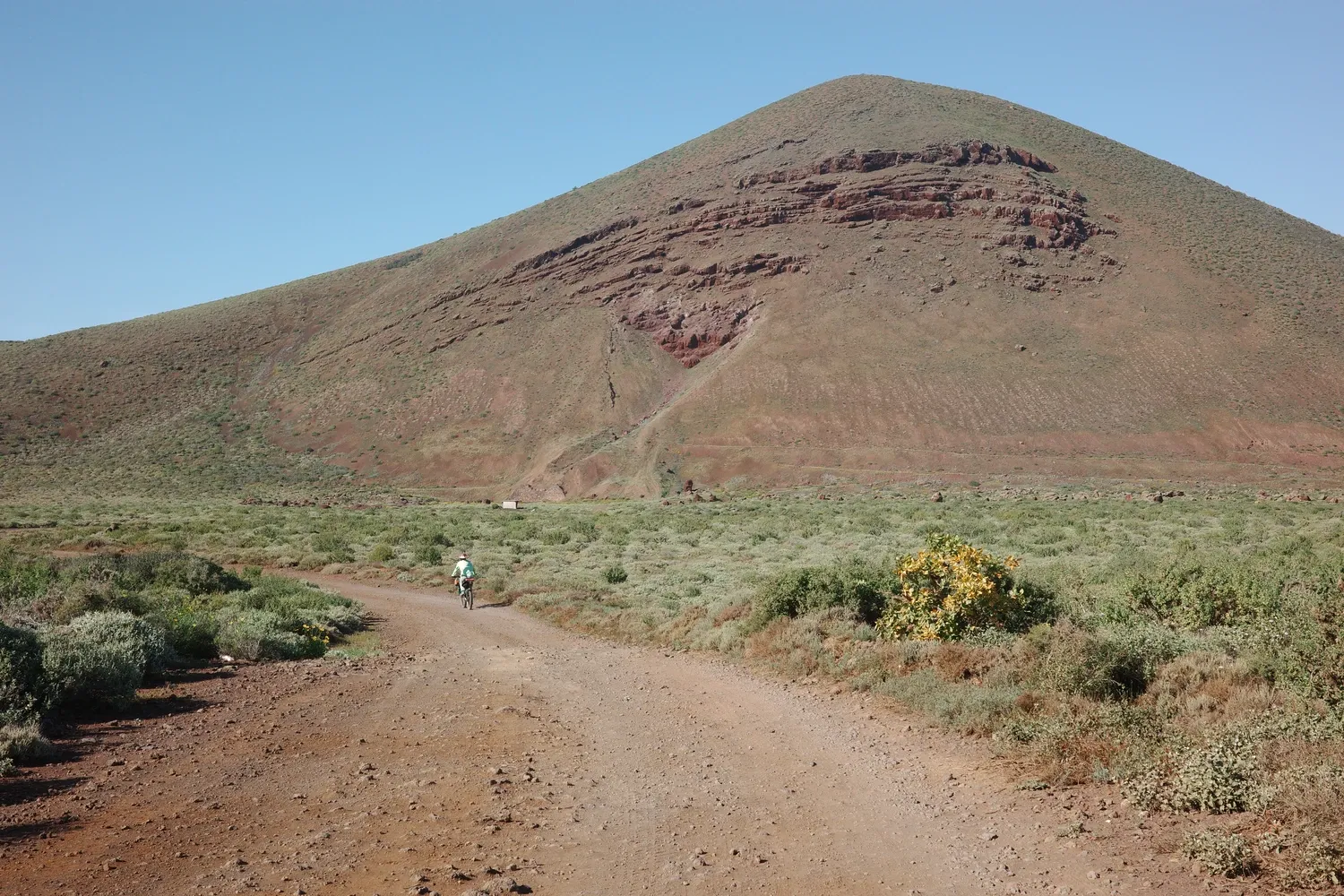
The road curves around a wide bay, passing beneath three old volcanoes. Their slopes are slowly eroding, giving them the look of grassy hills dotted with sinkholes. At the base are large greenhouses stretching almost all the way up the slope. I've heard volcanic soil is good for growing, so maybe that explains it. How long does that kind of fertility last?
We start seeing houses on stilts as we continue along the coast. The land is very flat here, so I suspect flooding from storms, or even tsunamis is a concern. The route continues in a series of sandy detours and roundabout paths. At one point, a military vehicle stops on a narrow stretch to check on us. They ask if we're okay, if everything is safe, and tell us they're at our service. It's a bit of a grand gesture given how remote we are, but it feels sincere.
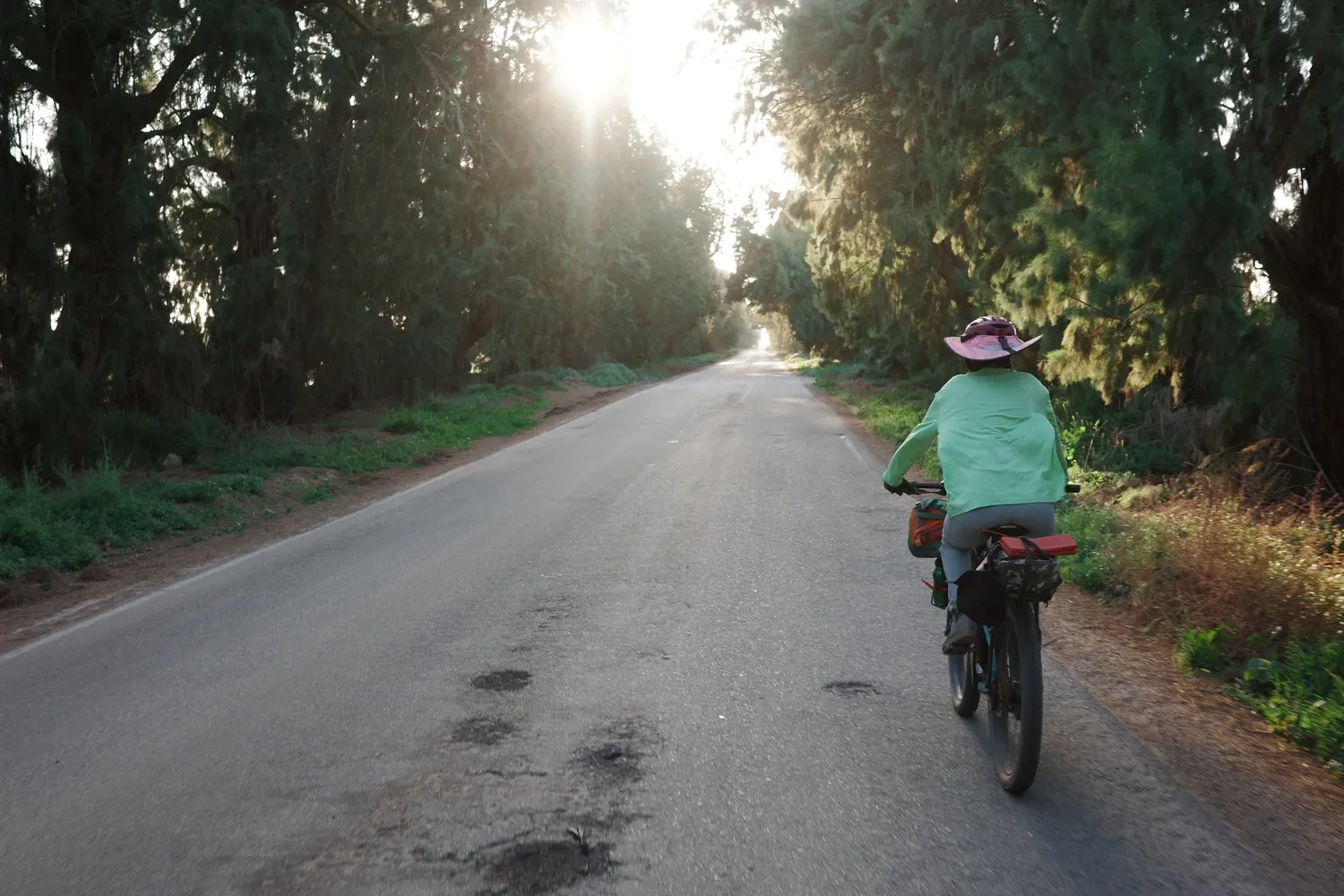
We finally turn onto a paved road heading straight toward the beach. The sun is setting, and the light filters through tall, thin trees with long needles that arch over the road. It's beautiful.
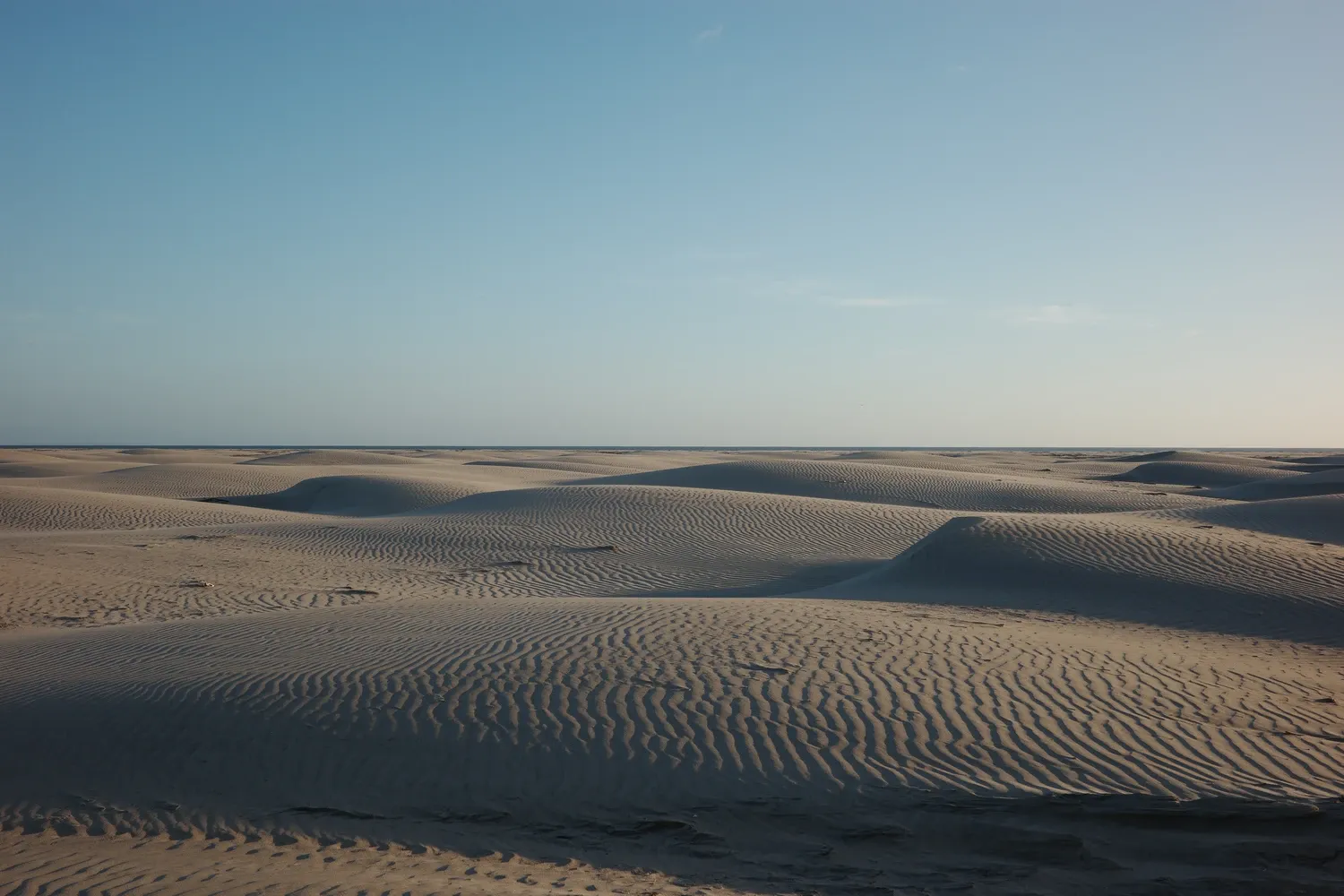
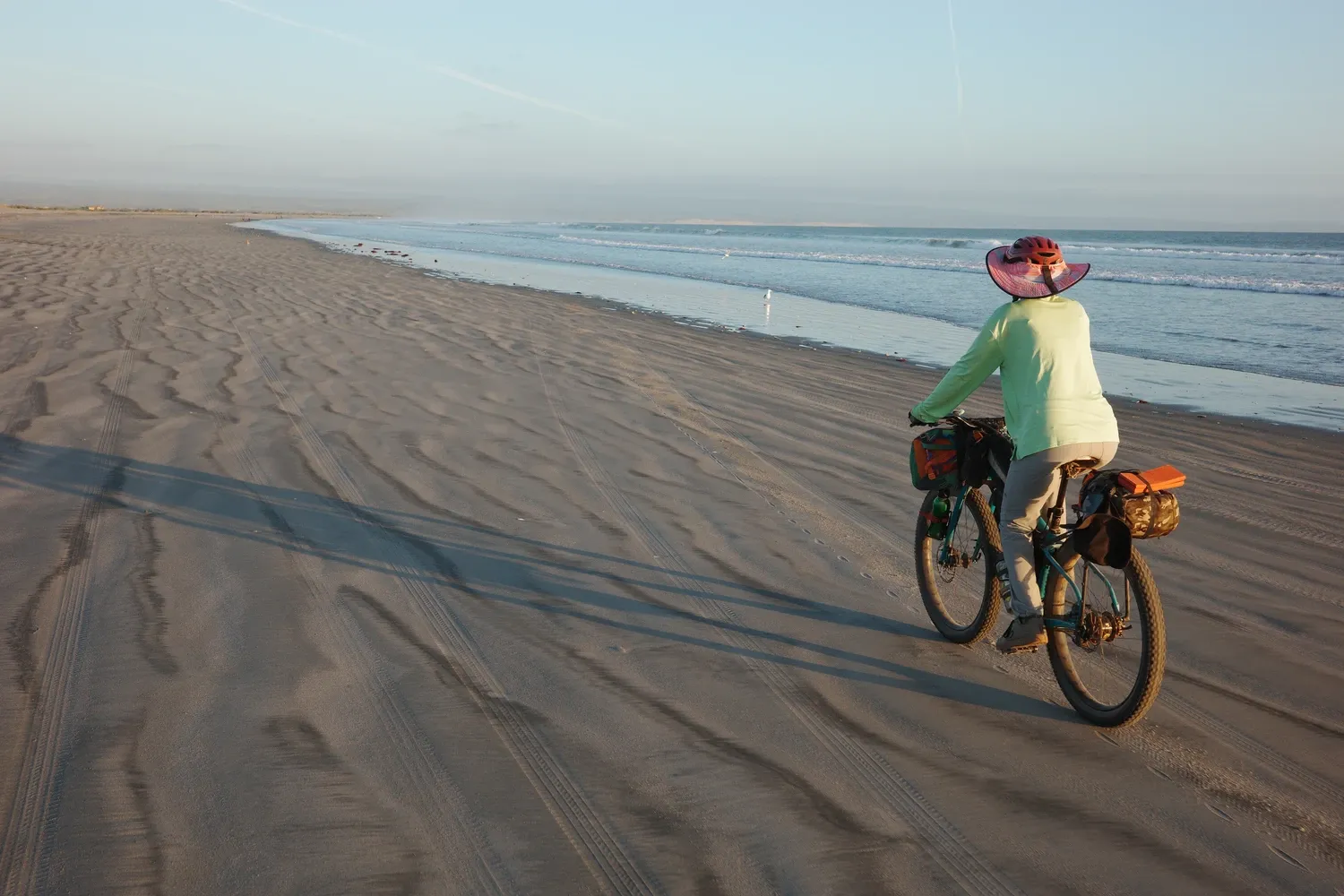
We arrive at the beach near sunset. At first we have to push through soft sand dunes. With about four miles still to go, I worry we'll be pushing well into the dark. Then we reach the waterline and the sand firms up completely. What felt like it might be a disaster turns into a fast, smooth ride along the shore, the tide lapping at our tires. We stop often for photos as the sun goes down.
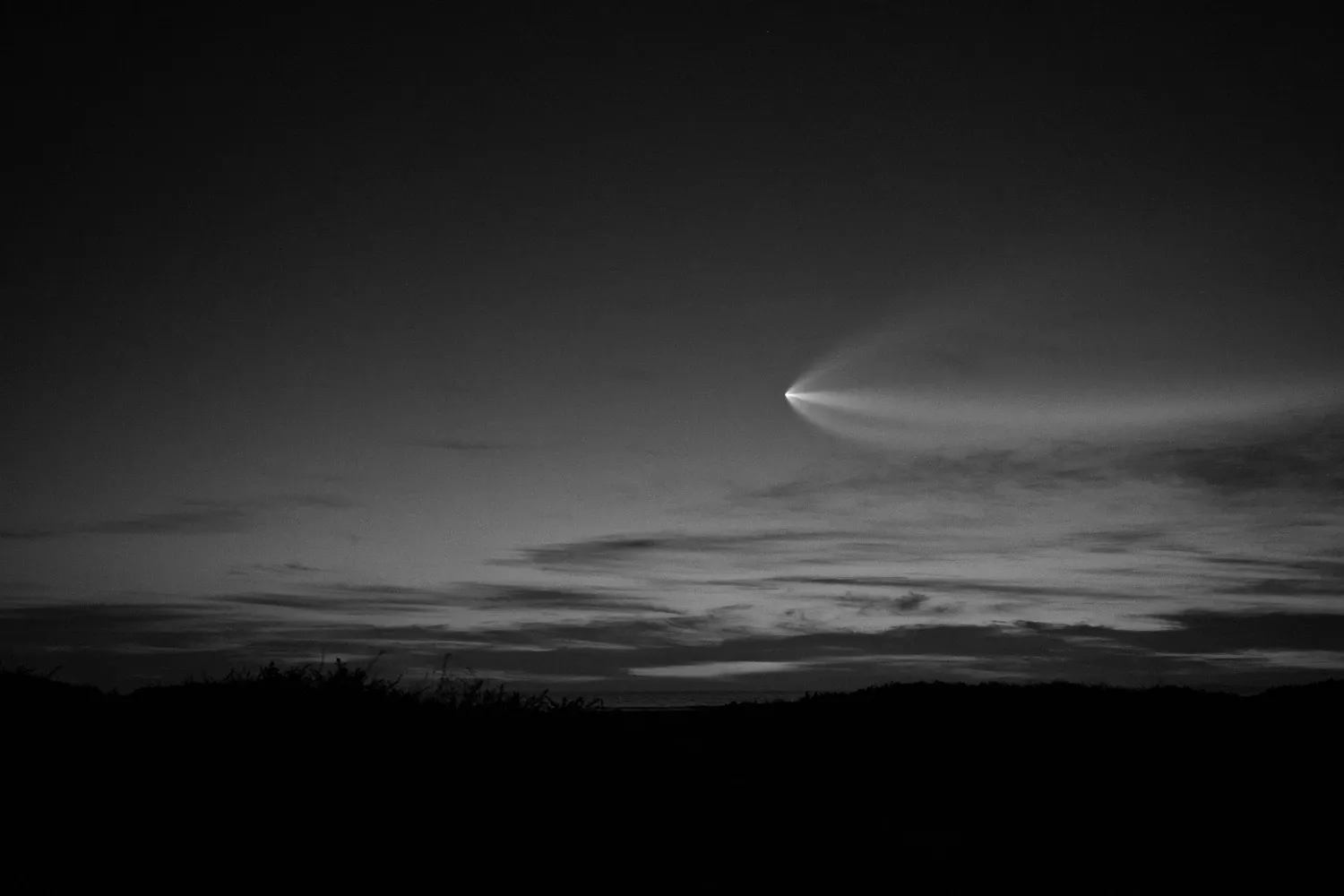
We arrive at the campground—a mostly empty lot with a few bathroom buildings—and find the office to check in. The woman there is friendly and gives us a key. While we're getting the tent ready, we notice a bright object moving slowly across the sky, trailing a wide cone of light behind it. Neither of us has seen anything like it. Leah suggests it might be a reentering rocket. Or aliens. (Note: it was a SpaceX Falcon rocket)
Later, we sit in the tent, cooking and going over the "roses, buds and thorns" from our day. The campground host seems to have disappeared — her car and dog are both gone — so I leave payment by the door. Before bed, we look at the sky. We find Orion first, then use the star chart to pick out Gemini, Lepus, and Canis Major. Clouds start to move in as we're looking.
February 15
We ride through Nueva Odisea and stop at the El Pabellón market. We load up on more beans, about 15 liters of water, cookies, and powdered donuts. Among other things. It all barely fits — shoehorned into bags and cages — but we make it work. Now laden with five days of food and two of water, we roll out.
We pass more farms for the first few miles. At one point we notice a large group of workers walking slowly through rows of green crops. The fields are shimmering, almost twinkling. I have no idea why. Maybe there are small reflective objects strung up to deter birds? Leah suggests it is a glitter farm. The workers are moving too quickly to be harvesting anything. It's a confusing but whimsical scene.
We ride past greenhouses with their sides partially rolled up and low fences, so we can finally see what's inside. Raspberries! A few miles later, just beyond what feels like the last house we'll see all day, I hear loud traditional Mexican music off to the left. A man is getting onto a motorbike with an enormous speaker strapped onto the back. He waves as he rides off in the direction we came from.
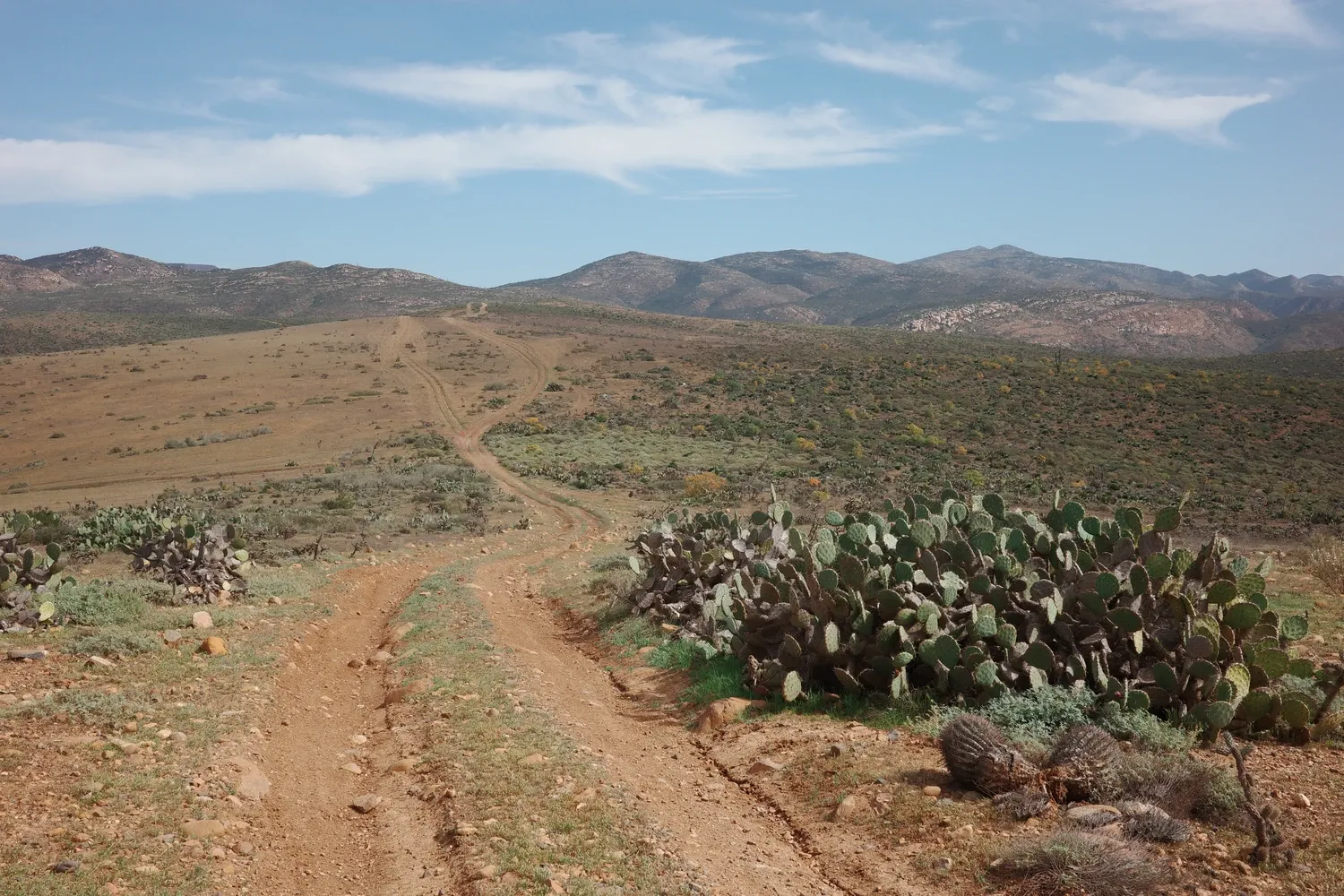
Saguaros start to appear more regularly, though still somewhat sparse. (Spoiler: they aren't actually saguaros, we just don't know yet). Cholla, barrel cactus, agave and yucca fill in the landscape, with yellow and purple flowers scattered between them. It feels like we are fully in the desert now, even as we continue climbing.
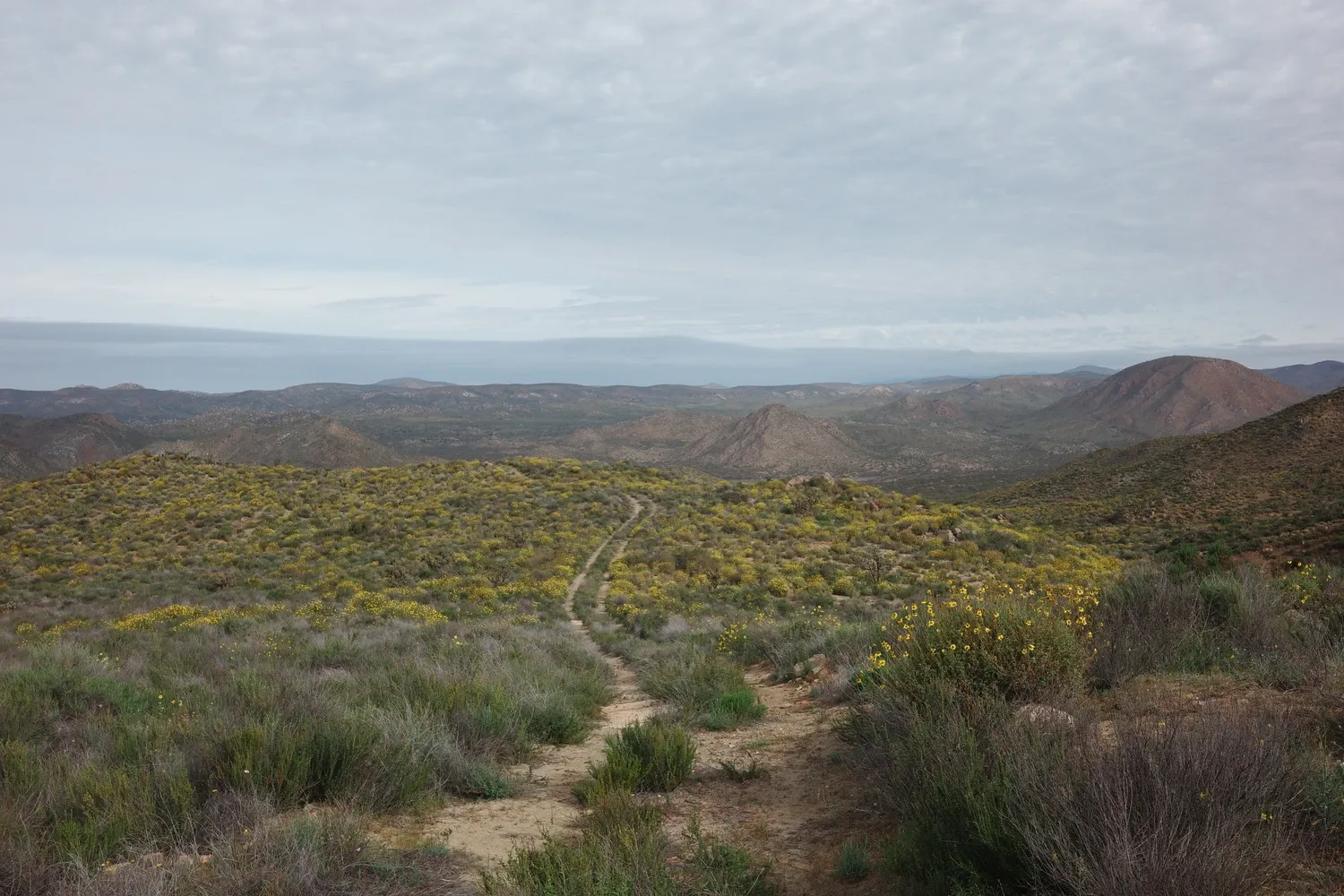
The road gets progressively rockier, and more of the climbing turns into hike-a-bike. I push or ride up a steep section until it flattens slightly, leave my bike, then walk back down to Leah and help push hers up the rest of the way. The rocks are loose and rounded — baby heads — and difficult to walk on. The descents aren't much better: steep, rutted, and loose, requiring just as much attention and nearly as much time as the climbs.
Progress is slow. Around 5:15 we find a flat spot to camp on a small saddle. We set up the tent and, as has become routine, lie on our pads watching the sunset, talking through the day — including some frustration this time — and letting things settle before making dinner. I dub this habit "sleeping practice."
There's a fire ring here, and Leah gathers some very dry, dead wood. It burns cleanly and quietly, with a faintly pleasant smell. It's nice to have a bit of warmth while we sit outside cooking on the alcohol stove, which doesn't give off much heat. The stars are bright. We find Orion first, then Canis Major, Gemini and Taurus. The sky is clearer than last night.
February 16
An early departure is delayed by a wet tent. I'm starting to think the fabric may have lost its waterproofing after all these years. I spend about ten minutes mopping both the inside and outside with a cloth, wringing it out repeatedly before stuffing the tent into the basket, trying not to soak everything else in the panniers. We roll through a few miles of gentle hills, mostly downhill, then turn and begin a gentle five mile climb toward the high point of the day. The road is rocky and bouncy, but not quite steep enough to force hike-a-bike until the last mile.
At the top, Leah realizes she's missing a front pannier. Oh crap! I unload my bike and start heading back down. This could be a long mission.
Yet two minutes down the hill, I run into our first other bikepacker of the trip. Larry, from Portland. And he has Leah's bag. He says he found it about seven miles back. It feels like ridiculous luck. He's friendly and has ridden Baja twice before. We chat briefly and then he heads off while I repack my bike, having already taken most of it apart to go searching.
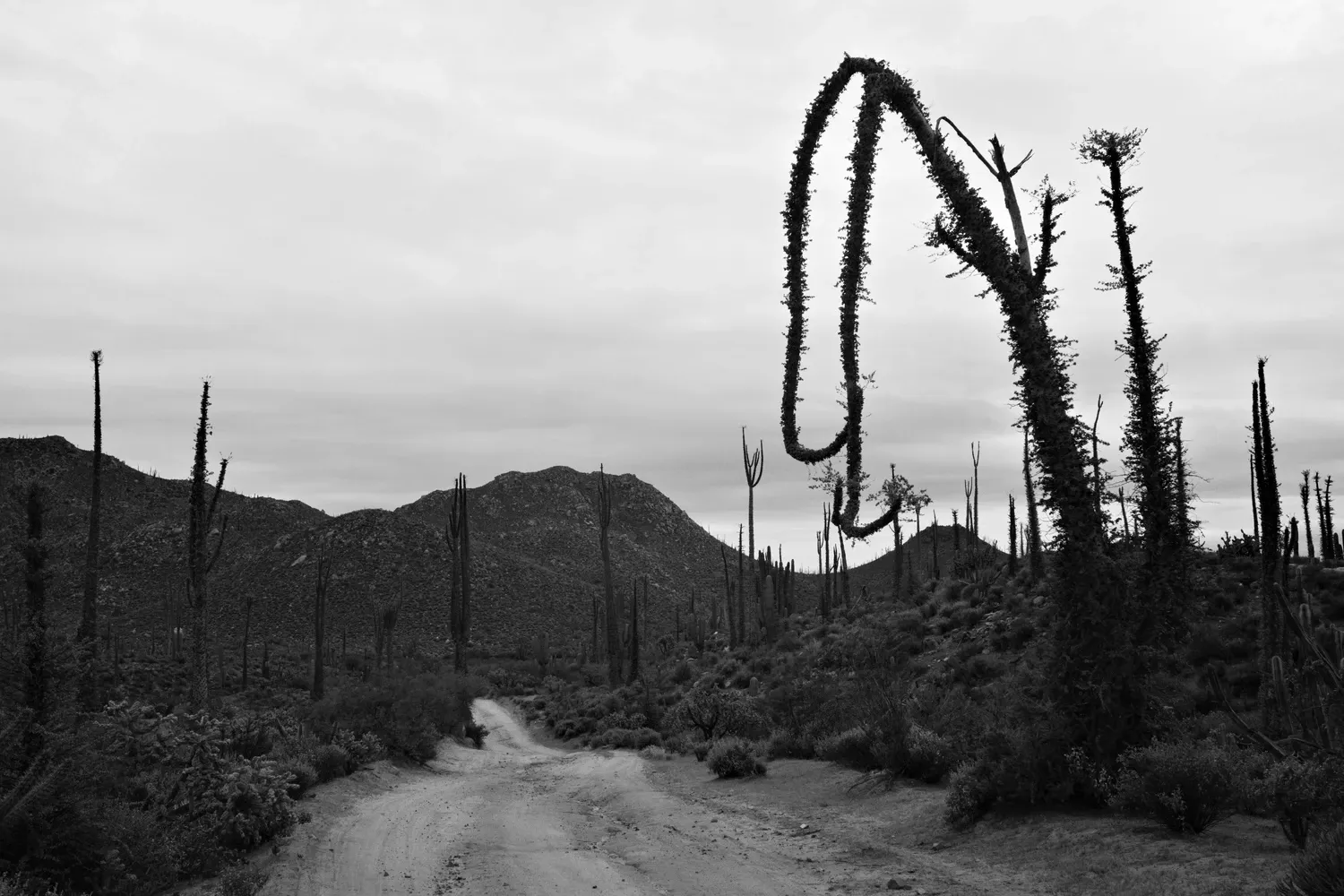
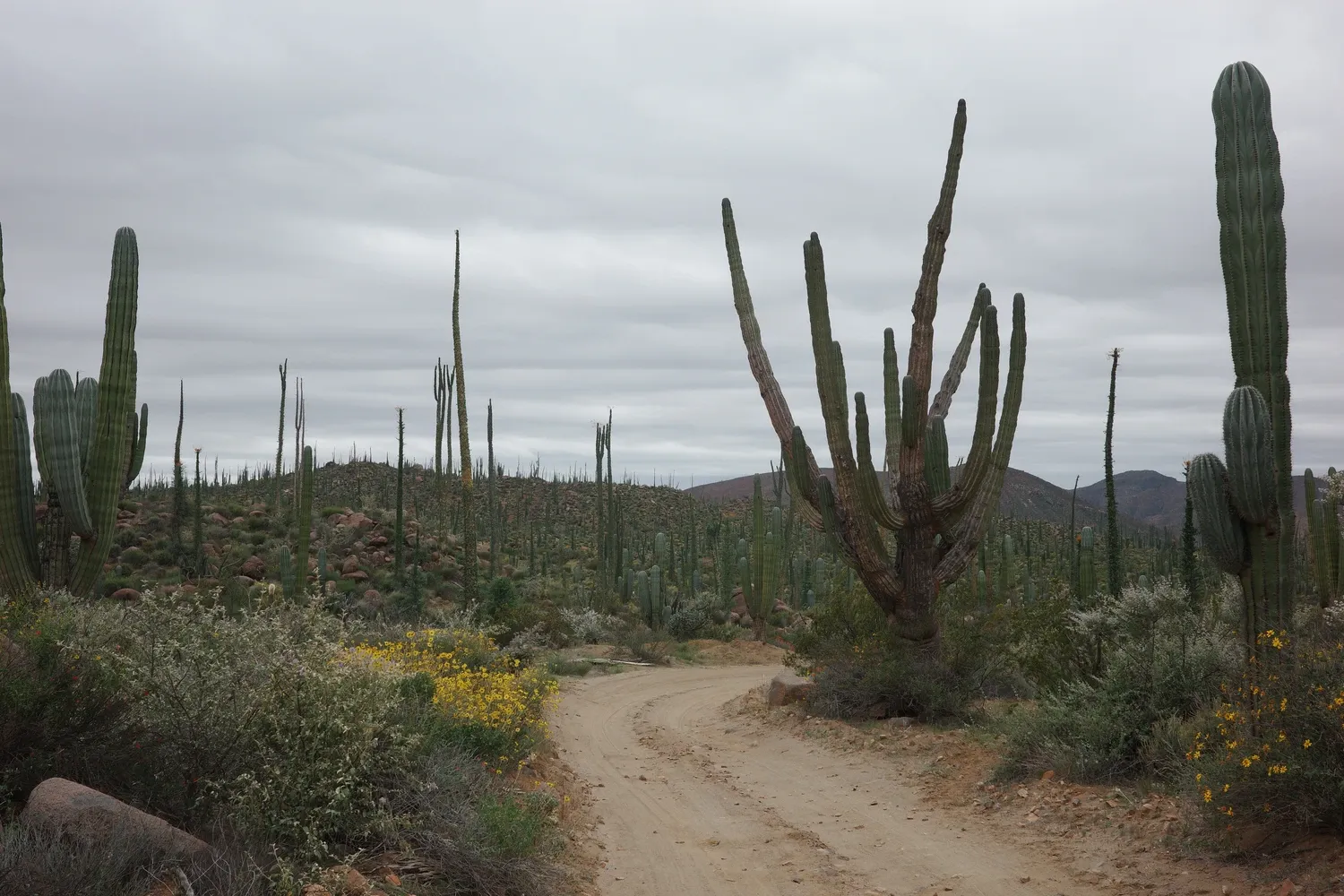
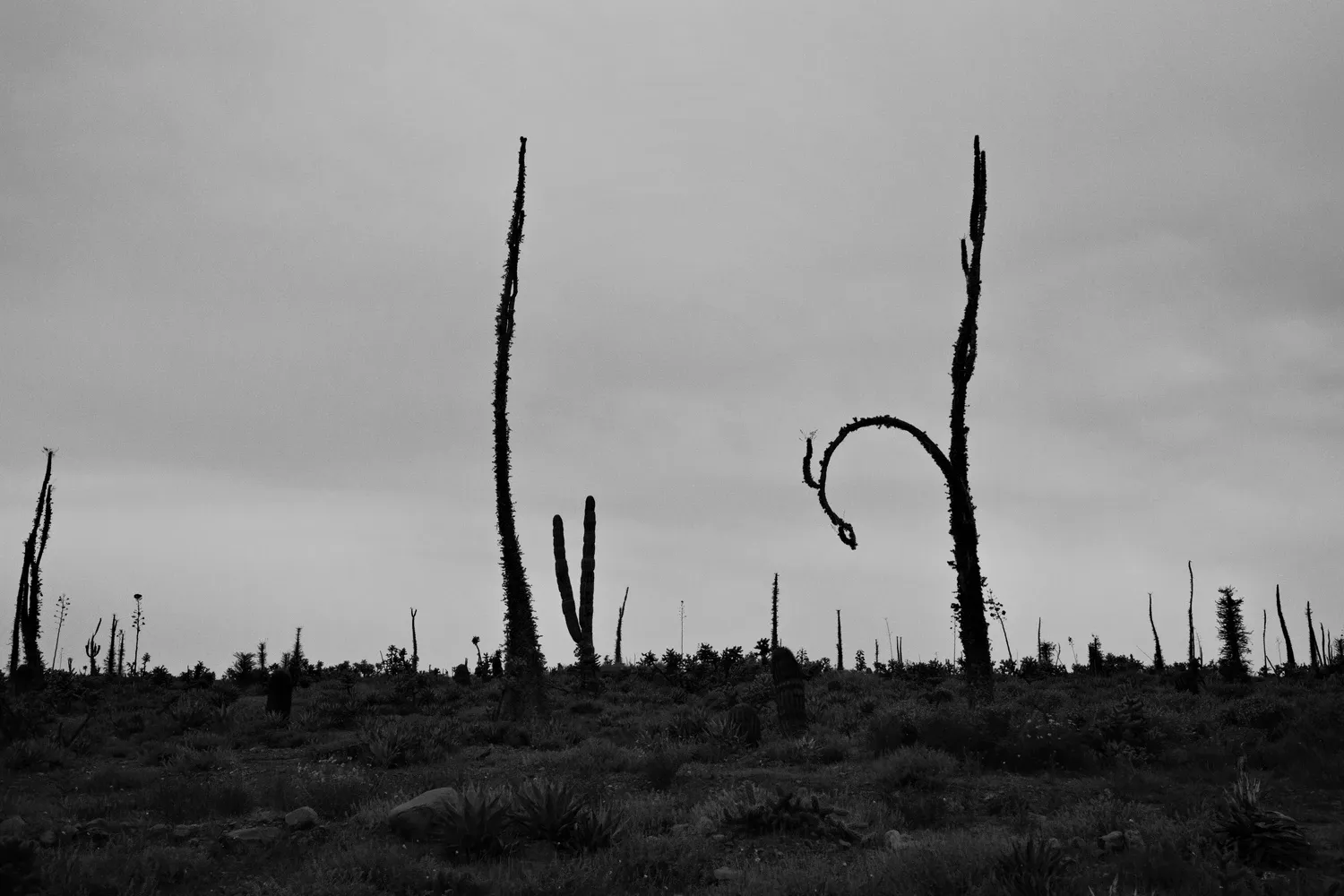
We drop into Valle de los Cirios, where the landscape changes dramatically. Tall, thin, whimsically wavy and fuzzy looking cactus-like trees cover the hills. They look like something from a Dr. Seuss book. The cirios trees become more dense as we descend, and are mixed with large cacti of all kinds. There's less underbrush and fewer flowers here, so the large flora stand out more starkly against the smooth, rolling terrain.
We enjoy a gradual seven-mile descent, frequently slowing or stopping to giggle and stare at the weird organic shapes around us. It's hard to keep any momentum, but that's fine by us.
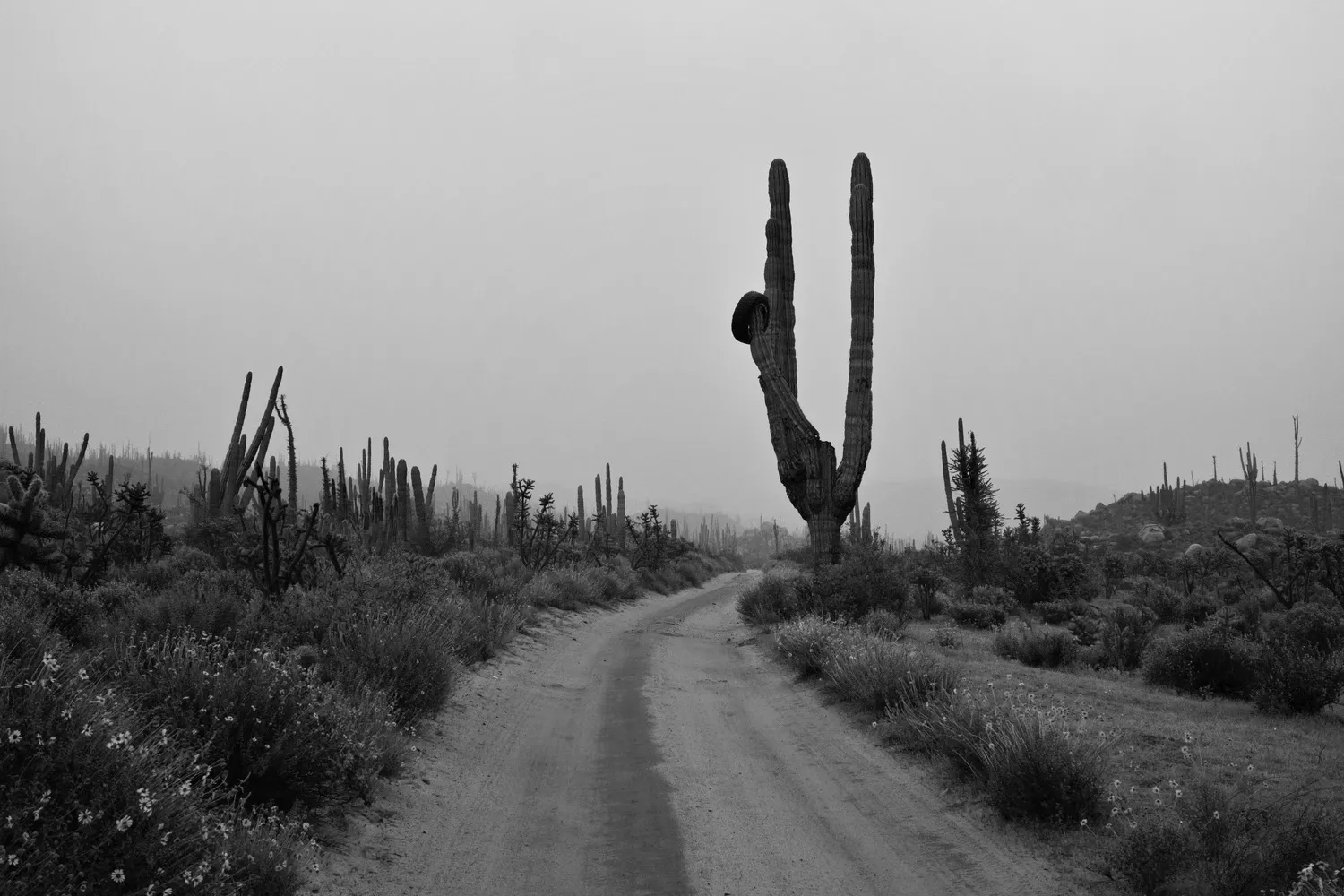
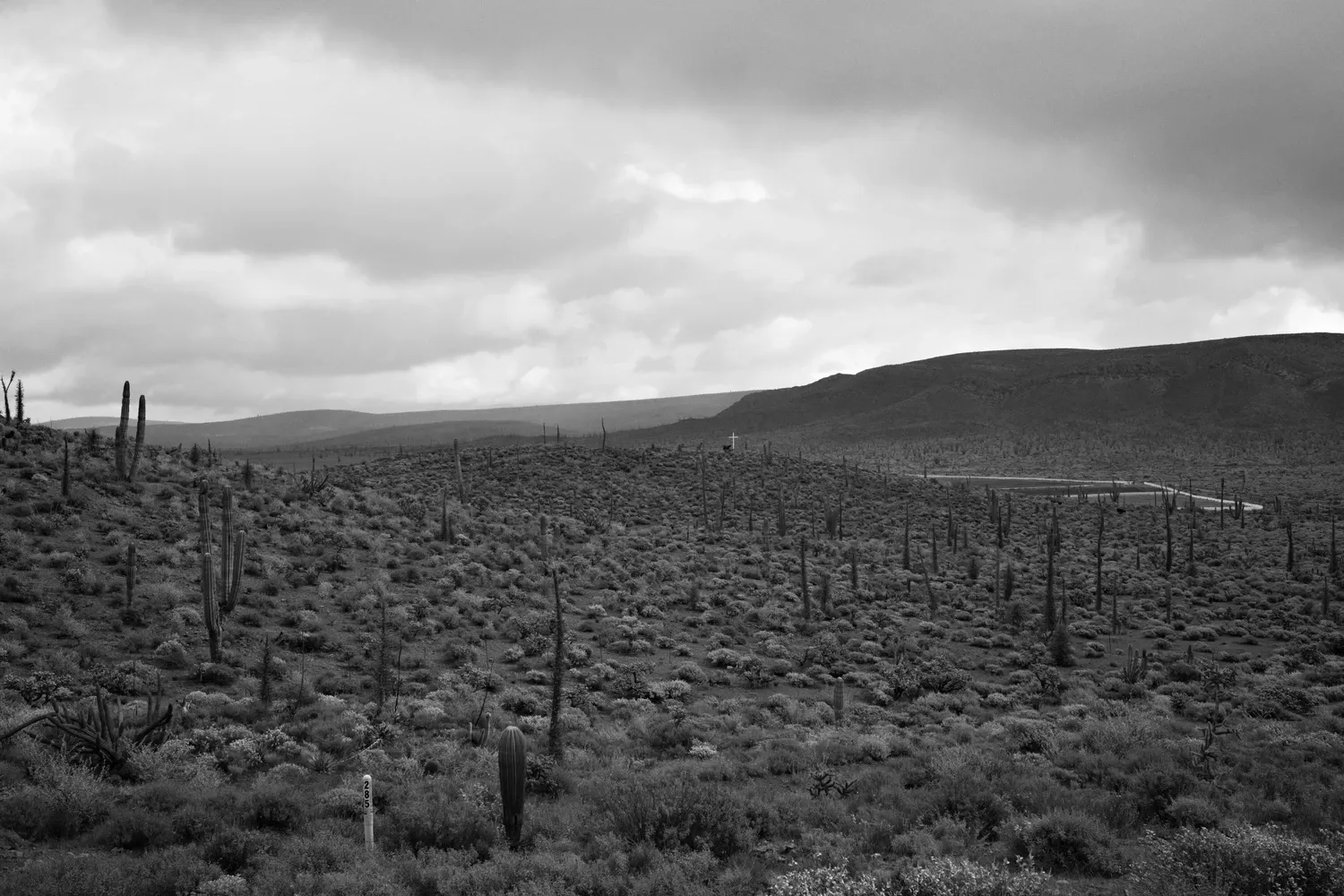
Around 3 PM, rain starts in earnest. Not quite a downpour, but more than a drizzle, and it's paired with a headwind. I get cranky and want to stop, but Leah points out that if we wait it out, the road could turn into the infamous "peanut butter mud" and be completely impassable. She's right. We press on.
My DIY rain jacket isn't holding up well. I'm soaked from the chest down. After another hour we reach El Sacrificio truck stop — a small building that feels more like someone's dining room than a business. We ask if we can camp, but the man leads us to a small outbuilding with beds and says, in good but slightly mumbled English, "your friend is already waiting." Sure enough, Larry is inside.
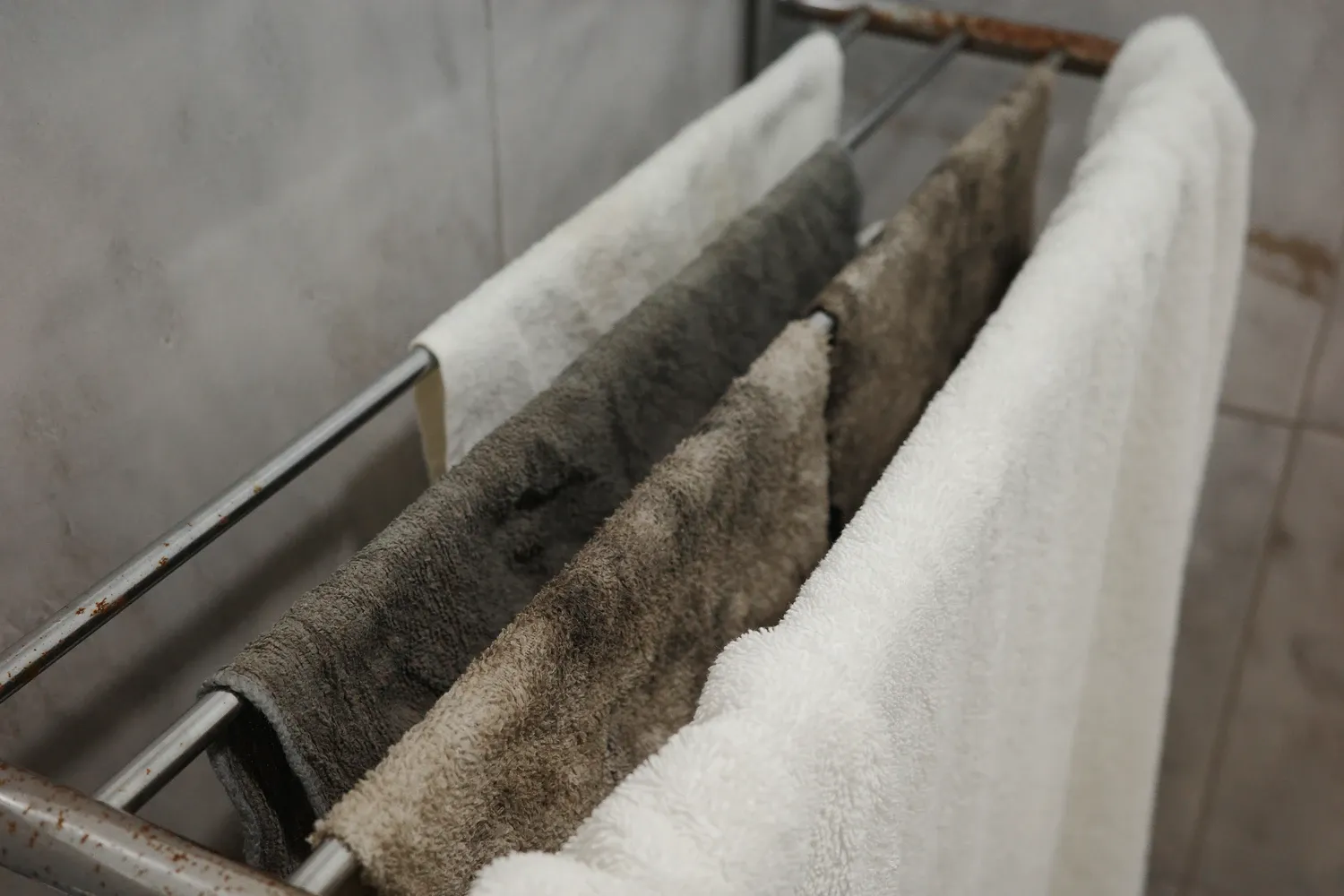
We wheel the bikes in and start to settle. Leah and I change out of wet clothes and hang everything up, wherever we can. Clothes, tent, random gear — it all goes on nails and beams around the room to dry.
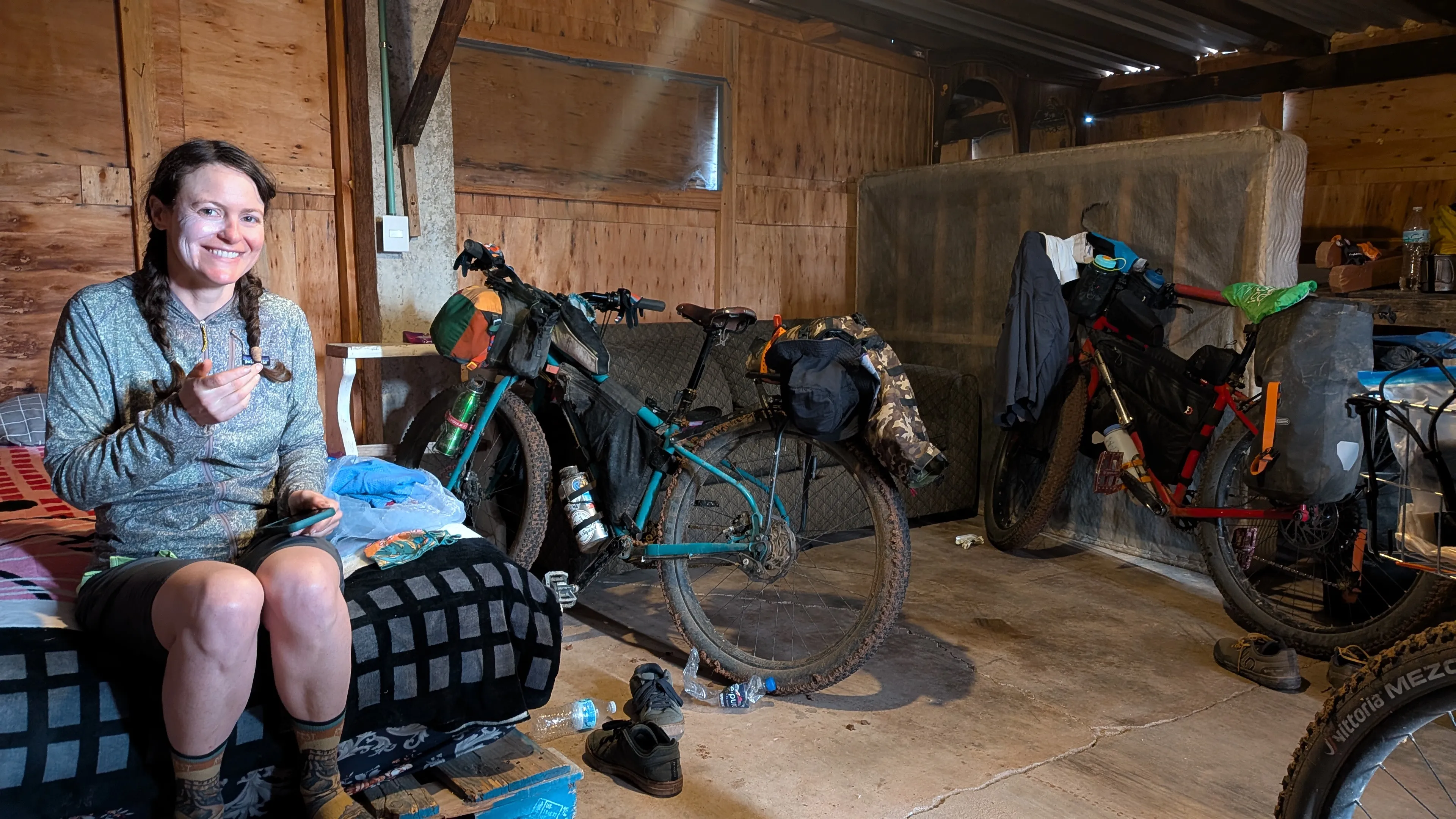
Dinner is in the main room: pollo ranchero and Nescafé for me. We sit and warm up, eating and talking, with an overly friendly cat wandering around and the sound of the two women and the man who run the place laughing in the background.
We learn that the "saguaros" we've been seeing are actually cardón cacti. Both cardón and cirios grow incredibly slowly, barely more than an inch per year. Meaning the larger ones are hundreds of years old. It's hard to wrap my head around the thought that the valley we just pedaled through might have held the same trees half a millennium ago, as seedlings. Just like redwoods, but sillier looking?
We head back to the hut to sleep. One of the dogs growls and charges at Leah when she goes to the bathroom, so I go with her the next time. The dog still isn't friendly, but seems slightly more hesitant when faced with two of us. When she comes toward us again, I yell and she turns away. Yikes.
February 17
We eat oatmeal in the shelter. Larry is brewing up coffee and offers us some. Yes please. Soon we've run out of things to do except change back into our damp clothes and continue the ride. Gross.
We fill water bottles in the restaurant and set off for an 80 km road ride to Cataviña. There is an off-road route for this section, but with the rain it could be a mud pit. Plus Larry tells us it's hard even when dry. It rains on and off throughout the morning. A nice tailwind moves us along at a good pace and dries us out when the rain pauses. Repeat. There are a few small stores early on, but mostly it's a very empty roadside. We pass some colorful abandoned buildings. Larry rides by us before long — it's the last we see of him for the day.
We stop for lunch beneath the road in a drainage underpass to get out of the wind and sun. After that, we descend into a broad valley filled again with more cirios trees. As we get closer to Cataviña the landscape becomes more dramatic, packed with huge boulders and even larger cirios and cardónes. They fill the view in all directions. Looking out across the valley, it feels like a field of green shapes rising up, almost like seaweed growing from a vast ocean floor.
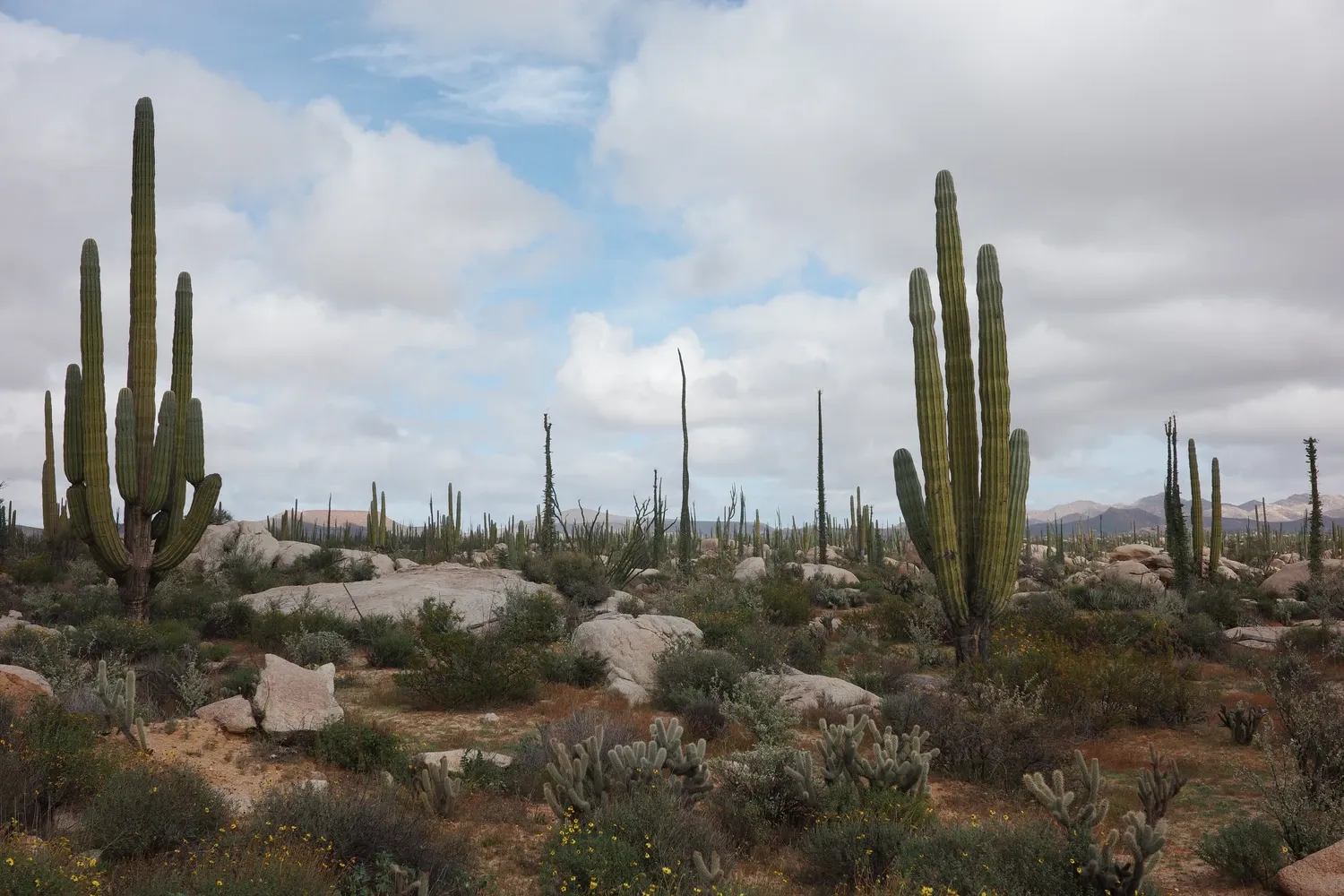
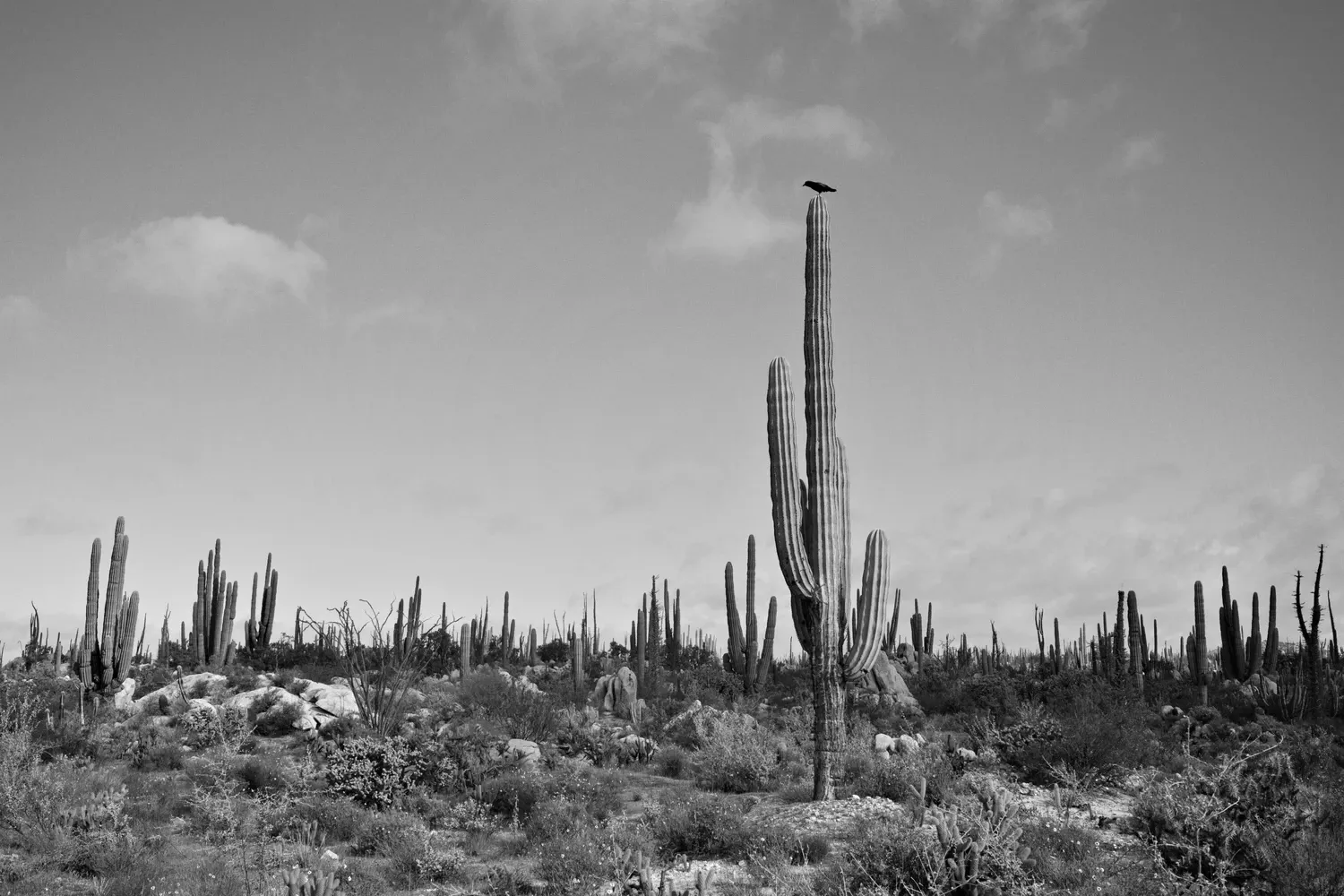
We stop at an old archaeological site (unclear what exactly it is/was, the museum is abandoned) and walk a short nature trail through the plants, exploring them up close. Leah is excited to spot flower blooms at the top of a small cirio.
We ride the last few kilometers into Cataviña. It's surprisingly small given that it's an essential resupply point. We go to the campground as planned, but as we start setting up the tent, Leah reconsiders and wants to try the hotel instead. It's been a long few days, and it's really windy. She gets grumpy, and I get grumpy back.
At that moment, the campground hosts appear with a large domed tent — "for the bicycles," they explain. They go through a fair amount of effort to set it up in the wind. Now we feel committed to staying, given their excessive goodwill. The giant bike tent looks silly at first, but quickly wins us over. It's a great storage spot and windbreak. And the reflective material inside makes it quite warm.
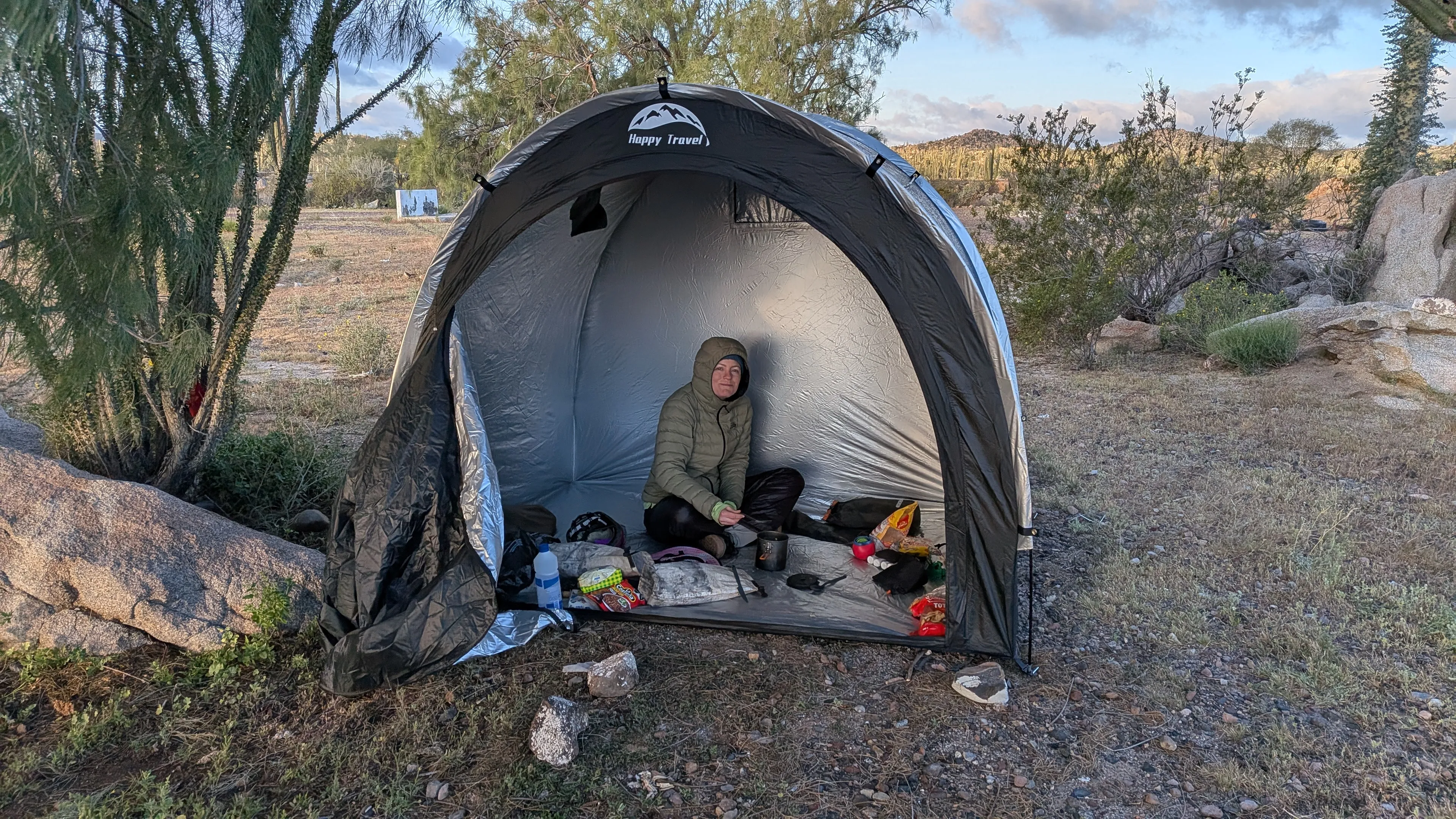
We ask about a shower. After about twenty minutes of back-and-forth with a friend and some activity at an outbuilding, the host tells us it's ready. It's a small cinderblock hut, maybe 5x5 feet, with a door curtain that flaps open in the wind. But the water is warm, and we enjoy it while wondering what combination of generator, propane, or wiring is supplying it all. I forget the soap, so Leah runs back to the tent to grab it while I hop in. The water isn't quite hot enough for me to wait around, so I get out and dry off with my tiny washcloth.
We change and walk the main road, stopping at two small grocery stores and doing mental math for the next section. We need enough food and water for the next four days — about 120 miles. Our longest stretch without water. Leah had texted the owner of a small fishing market on the coast, but she's out of town. So it's all on us until Santa Rosalillita.
We end up buying two giant 3-liter bottles of Coke (to be replaced with water later, we just need the containers), plus three more 1.5 liter water bottles. It's the best we can find.
For dinner, we stop at a place that looked completely closed during the day but now glows with light and voices from inside. There are only three tables, and a group of German tourists occupies the large one in the center. We sit and order pollo ranchero again. For the second night in a row, though this time with soup. Yum. There are a lot of fruit flies hovering at the edge of the table, which itself is a bit unstable. A mouse keeps darting back and forth across the doorway. Leah tastes one of the sauces and thinks it might be turning, but the food itself is fine.
We haul the groceries back to camp. Frogs are chirping near the road. We sit and work out how to fit everything on the bikes. I drink as much Coke as I can from one bottle before we refill it with water. We come up with a storage plan that seems workable. Eventually, more thinking won't help, so we go to bed. There's a kind of Mexican polka music playing somewhere nearby, so we put in earplugs.
Sometime in the night, I hear the frogs again around the edge of the campground — or maybe I'm dreaming.