Baja Divide
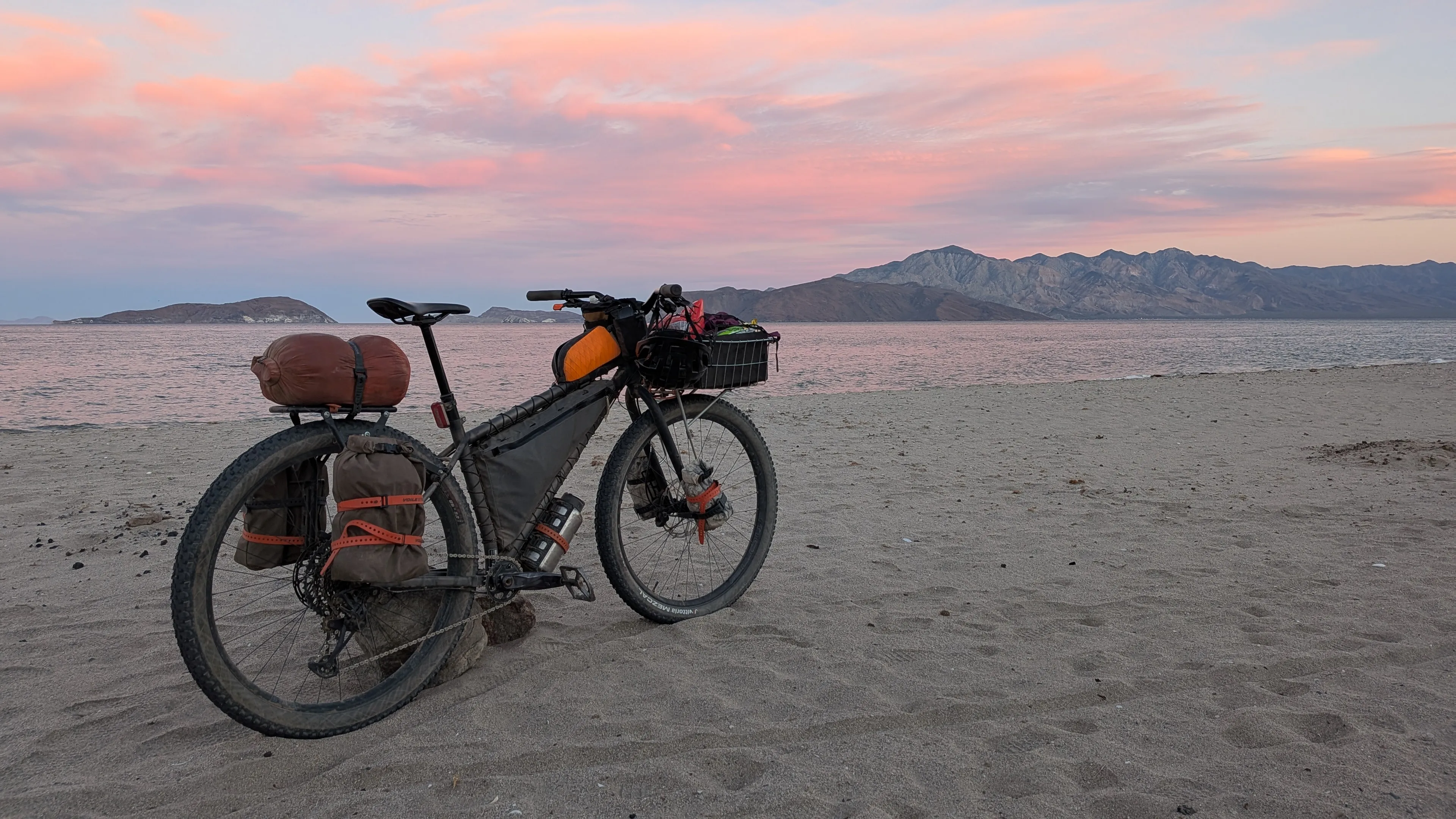
February 23
Coyotes snuck around the tent in the night and chewed through some straps on Leah's front pannier and handlebar harness. We kept waking up to the sound of them near her bike, but couldn't see what they were actually doing. We didn't get much sleep due to the constant paranoia.
In the morning, Leah uses a needle and floss from the repair kit to do a lot of sewing, and with some creativity is able to get things usable again. I eat a yummy breakfast of turkey omelette at the campground café (Siete Filos). Leah is still sewing at the table. I get a coffee, then another while she's in the bathroom, pushing our departure back gradually. It's almost 9:30 when we finally leave the campground.
We hear news that a cartel leader was killed, leading to violence in the streets in some Mexican cities. There's a U.S. travel advisory warning for more parts of Mexico. I feel a bit worried, but Baja feels calmer and more out of the way, so I convince myself to ignore it.
We stop at a market for water on the way out — 12 liters. The bike is heavy again and feels silly with all the front weight and slack head angle. But it's kind of fun to plow over bumps with the huge water mass acting as a vibration damper.
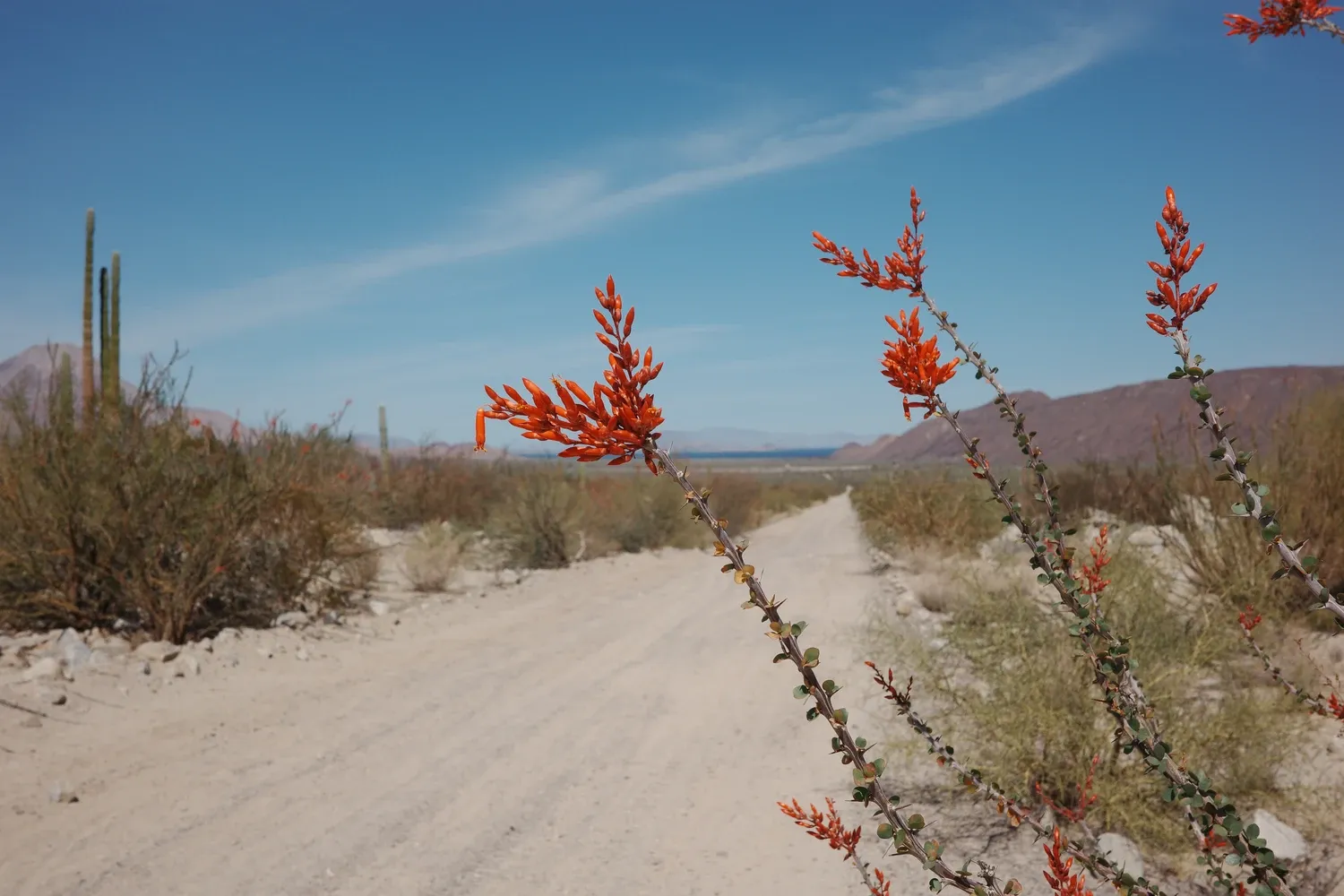
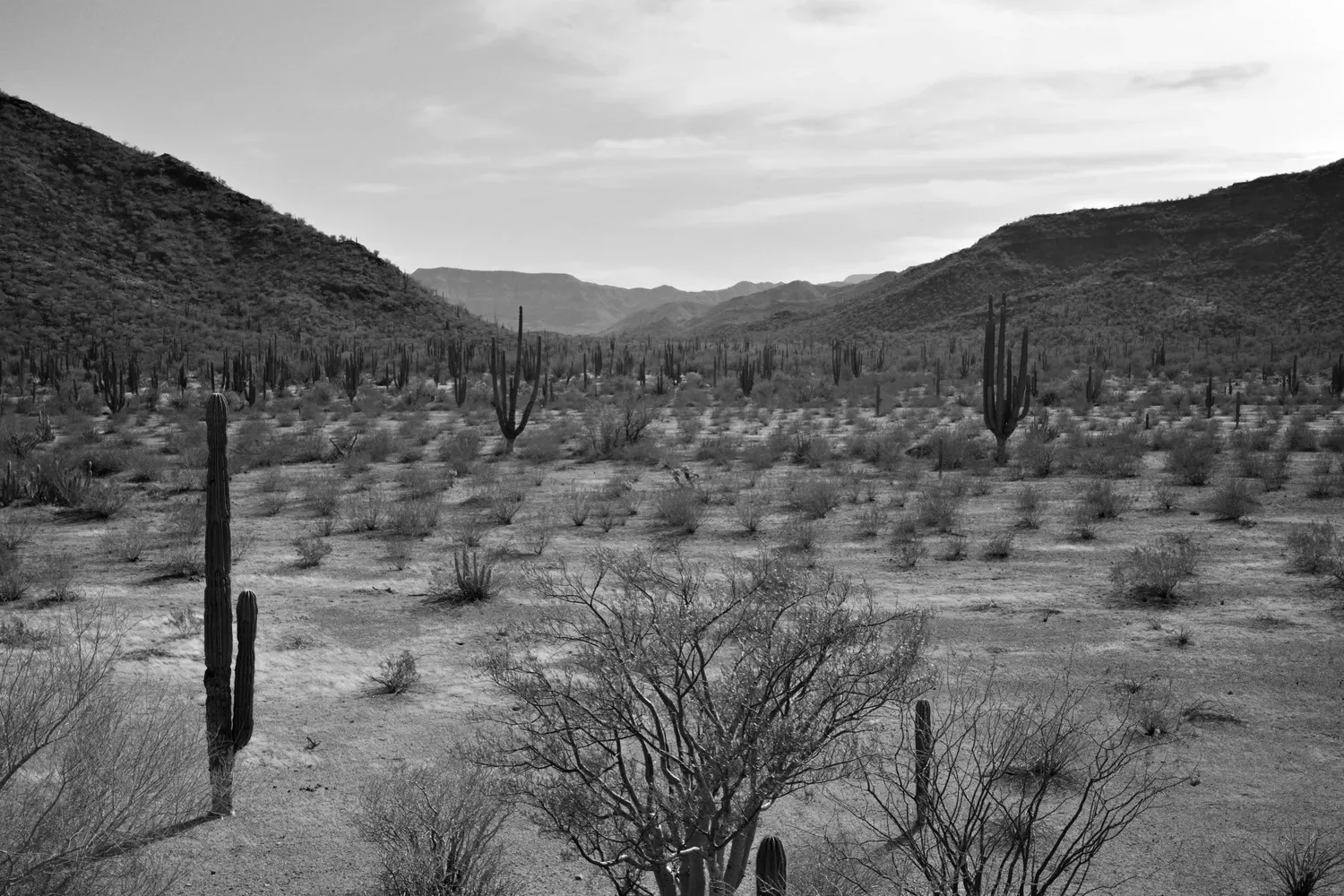
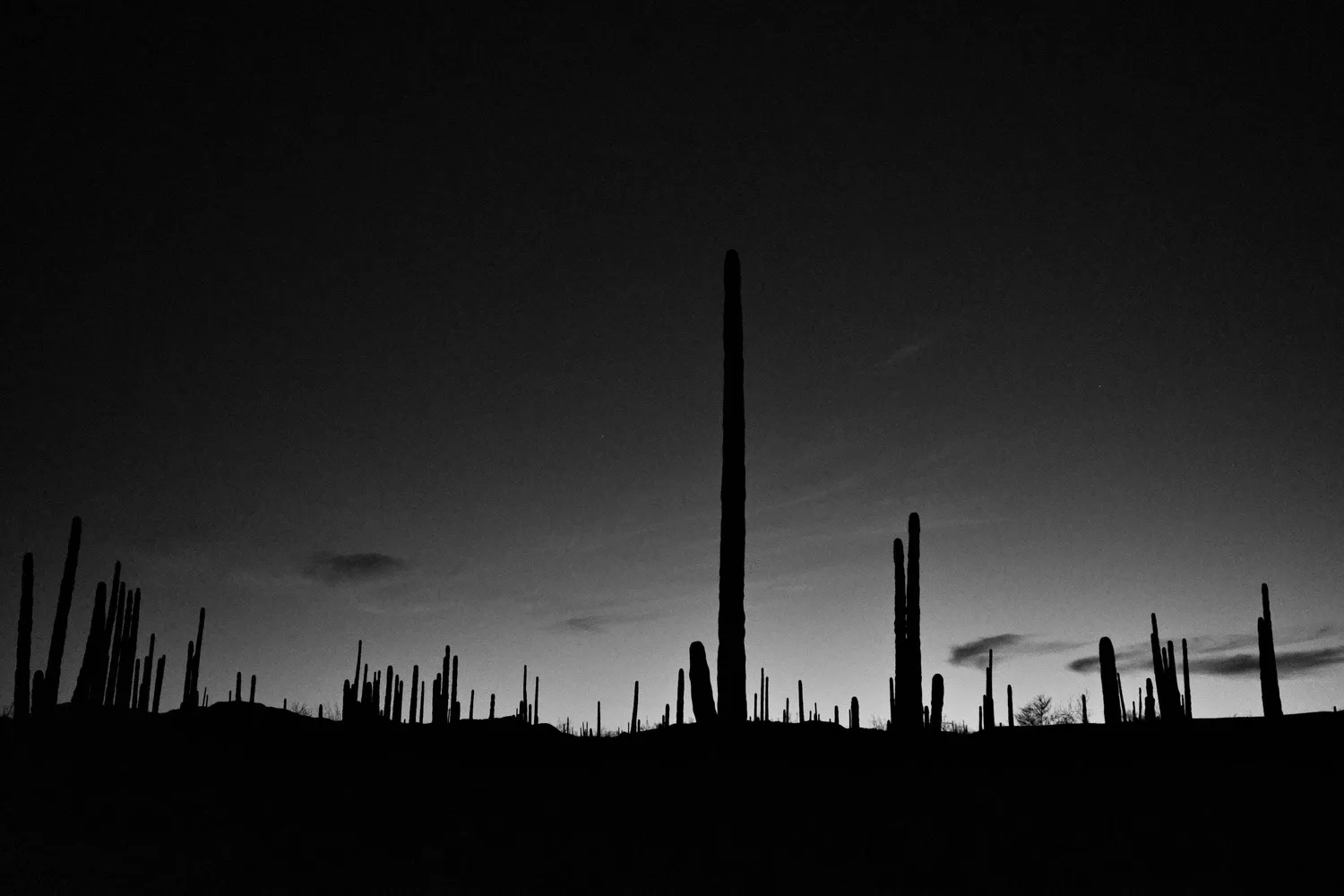
The air is hot and still. The road is a very gradual uphill but exposed and sandy. It's our first truly sweaty day. We both drink lots of water, slowly but steadily. We pass a cyclist going the other way on a day ride. We briefly chat while I wrestle with strapping Leah's water bottle to my rear rack. He gives us some GU packets. A few cars pass, including an old maroon VW bus. The road can't be that bad ahead, we figure. Eventually we get a downhill, and the landscape opens into an immense valley filled with cardónes and little else, surrounded by distant mountains. Their vertical, stick-like arms contrast with the flat valley floor and the angular mountains. We pass a sign that reads "Animas," each letter painted on a large stone. Does it mean "soul" in Spanish? I wonder.
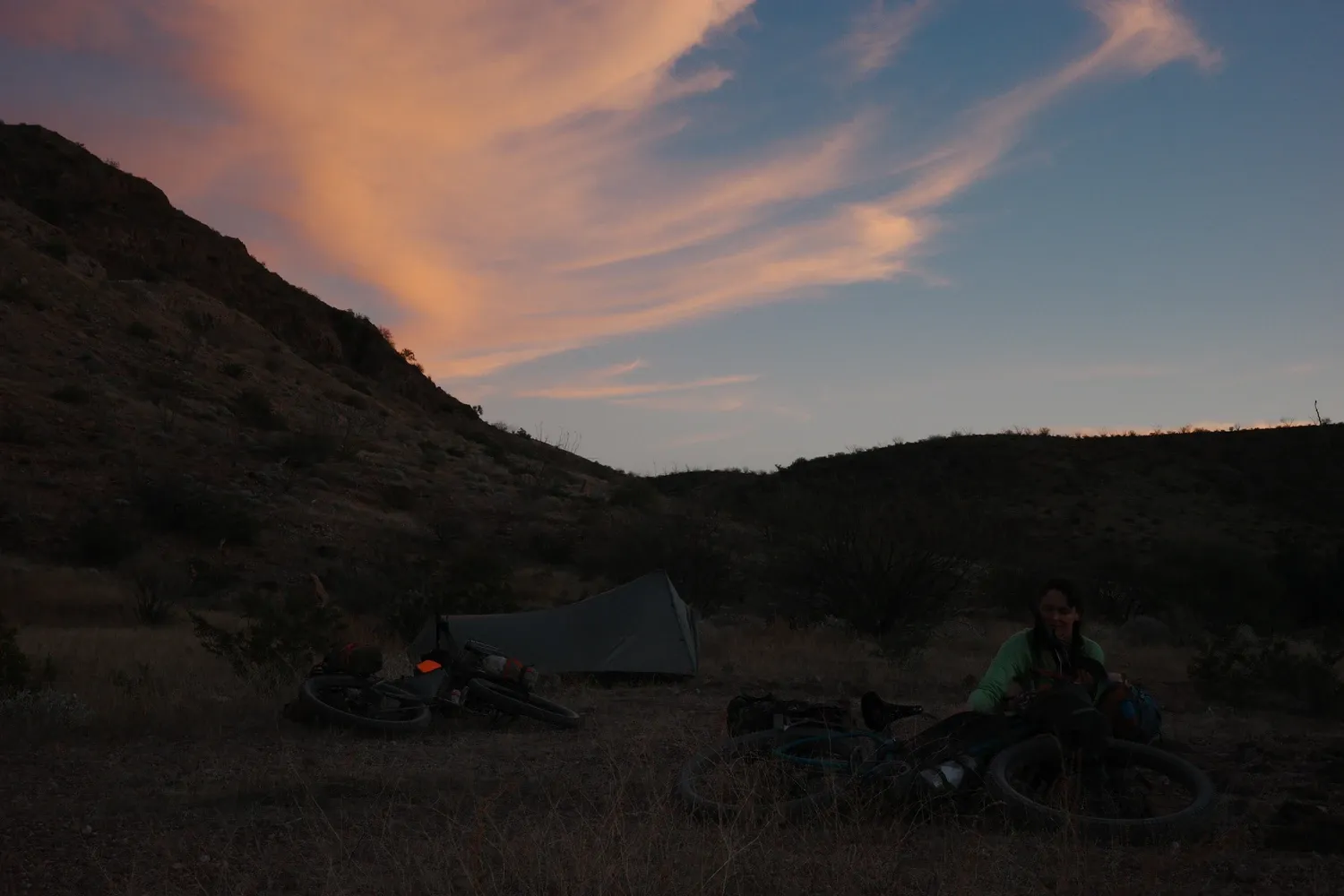
Sunset is brief but beautiful. A wide band of clouds above the hill we've camped near catches the light and turns a bright peach, while the rest of the sky fades from teal to aquamarine. We lie down for a while, eat, and then stargaze.
February 24
The Hard Day.
We get an early (for us) start, riding by 8. Just after starting, we meet two northbound Slovenian women riding from Ecuador to Alaska. They give us some info about upcoming sections — what's in bad shape and what's ok. El Arco, apparently, is an empty mining town with some sketchy drug traffic now, so don't stay there. Got it.
We climb up a hill and get a great view of the valley flattening out toward the beach. Forests of cacti butt right up against the ocean, both sharing the same sandy base. Two coyotes stroll across the road, returning back from the beach.
We make good progress at first across the low rolling hills — 15 miles by 11 AM — then it gets hot and the road becomes very sandy and bumpy. We pedal and often push up a very gradual slope. A big group of dirt bikes passes us, one every minute or two. The sand is so loose that I don't trust myself to pedal while they go by — I might swerve into their path. By lunch at 1 PM we're only at 20 miles. Moving through the sand and windless air feels impossibly slow. We're both frustrated. We sit for a while and resume our pedalling and plodding for another few hours. On the final climb to the high point of the day, Leah says she feels nauseous and is too exhausted to push her bike. I resort to a series of hike-a-bike shuttles, including pushing both bikes at once (note: it's hard), to get us up the final 500 vertical feet.
There are nice views from the top, but we don't really stop to enjoy them. The landscape looks greener from here than it felt while trudging through it. A hawk floats overhead for a few moments. I raise my hand to block the sun and get a better look. In the moment, I'm feeling a little scared for Leah and concerned about the rest of the trip. But I tell myself I'm doing what I can about the former, and the latter is a worry for later tonight.
We take a long, straight, gradual downhill on the other side of the pass to Rancho Escondido. It's a nice setting. We set up the tent and shower. The shower light is automated to turn on at dark. But we're in that awkward liminal window where it's too dark to see well yet not time for the light to come on. After about ten minutes, it flicks on to illuminate the poor job I've done cleaning the dirt off myself. Smoke from the wood stove heating the water begins to flow in through the window slits, blanketing the ceiling. It reminds me of childhood. But I'd rather be alive than nostalgic, so we hurriedly dry off and dress, the campfire scent clinging to our clothes.
We eat dinner at the restaurant pavilion. An American guy buys us beers and we have a nice chat. He runs a podcast about slow travel in Baja, and also leads more rugged off-road tours. He shares some recommendations of places to see: Loreto, San Ignacio.
Lots of friendly ranch dogs work here. One is slouching against the door of our tent when we return from dinner and has to be forcibly rolled off. She remains there all night, periodically barking at the top of her lungs whenever something stirs in the woods. I am reassured by her vigilance, but I don't sleep much
February 25
We wake at 4:30 AM to beat the heat, then decide we can snooze for another half hour since we're not eating breakfast before riding. We wake again at 5:10 and start packing for real. It's light enough to ride by 5:30, and we roll out of Rancho Escondido at 6.
The dog that guarded our door all night and another brown collie-looking dog both follow us down the road. I assume they'll eventually get bored and go home. I am wrong. It's chilly at first, but the sun is already hitting parts of the road through the cardónes and it warms quickly. We climb gradually, but the road is deep sand in many places and progress is slow. The dogs are still with us. I start to worry — they're now five miles from home. I yell at them and squirt water, but they're too smart for my usual tricks. A truck drives by and they gleefully chase it, keeping pace through the sand at an absurd speed before trotting back to us. I tell Leah to ride ahead while I stay behind to try to convince the dogs we're not worth following. It feels awful — yelling, tossing things, trying to scare them — but it seems to work. They huddle in the shade of a bush as I ride away. A mile later, halfway up the climb, they catch us again. I repeat the routine, and this time they finally turn back for good, it seems. The brown one never seemed that committed anyway.
At the top of the hill — which features a single paved section at the steepest part (for traction!) — we eat breakfast. It's 8AM and already hot, but at least we've made it through ten miles of hard riding during the coolest part of the day. Ten miles later we refill water at Rancho Piedra Blanca, run by a friendly older couple. There's a huge veranda providing shade and a breeze. We don't want to leave.
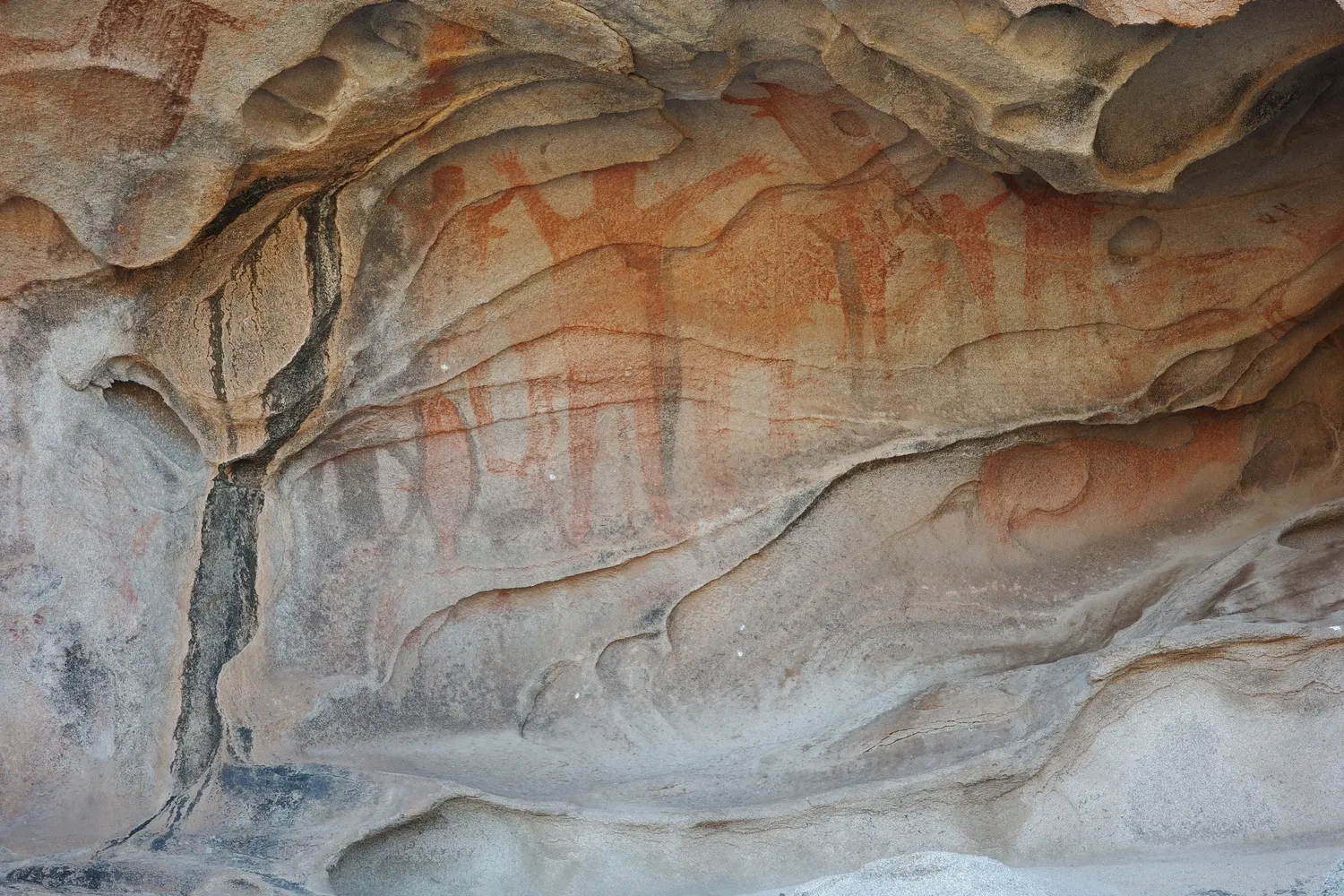
We ride another six miles to a spot Leah has marked for cave paintings. A short dirt road leads to a parking area filled with U.S. camper vans and trucks. A big group is hiking the trail. We follow Leah's map, which sends us bushwhacking up a canyon. We roast in the sun, get poked by everything, and argue about where to go. On the way back down, we see hikers on the real trail and follow it to the cave. The cave is covered floor to ceiling with painted human figures (why do they all have six fingers?), along with shapes that look like fish and deer. The view back over the valley is incredible. I admire the huge, flat cactus field that we rode through, stretching to low mountains in the distance.
We linger for lunch in the parking lot, then reluctantly head back out into the heat. It's close to 90°F. The road is mostly flat, but the heat is catching up to us. We stop just outside El Arco under a shady tree to regroup and support each other. I worry we won't have enough water for dinner, breakfast, and the rest of tomorrow's ride, but there's not much to do except ration while still taking care of ourselves.
El Arco looks abandoned. It features some old trucks, mining remnants, an old church, and not much else. We'd heard it's a narco town, so we don't linger or search for supplies. A mile later I find a good-looking orange in the road. "Extra water," I think! Another mile later, a bag rattles off the fork cage and Leah almost runs it over. I start holding sips of water in my mouth while riding, for as long as I can, making the liquid last as long as possible.
I reach back to hold Leah's hand (something I do now and then, just for fun). She suddenly pulls away and brakes. I assume it's because of the bumpy road, but she yells, "Snake!". I roll past its head before realizing what it is, and roll to a stop about twenty feet later. A four-foot snake is stretched across the road. Leah gives it a very wide berth, pushing her bike in a huge arc through the brush. I approach cautiously — it's a rattlesnake, probably a diamondback from the pattern. Yikes. I'm glad it's lazier than I am.
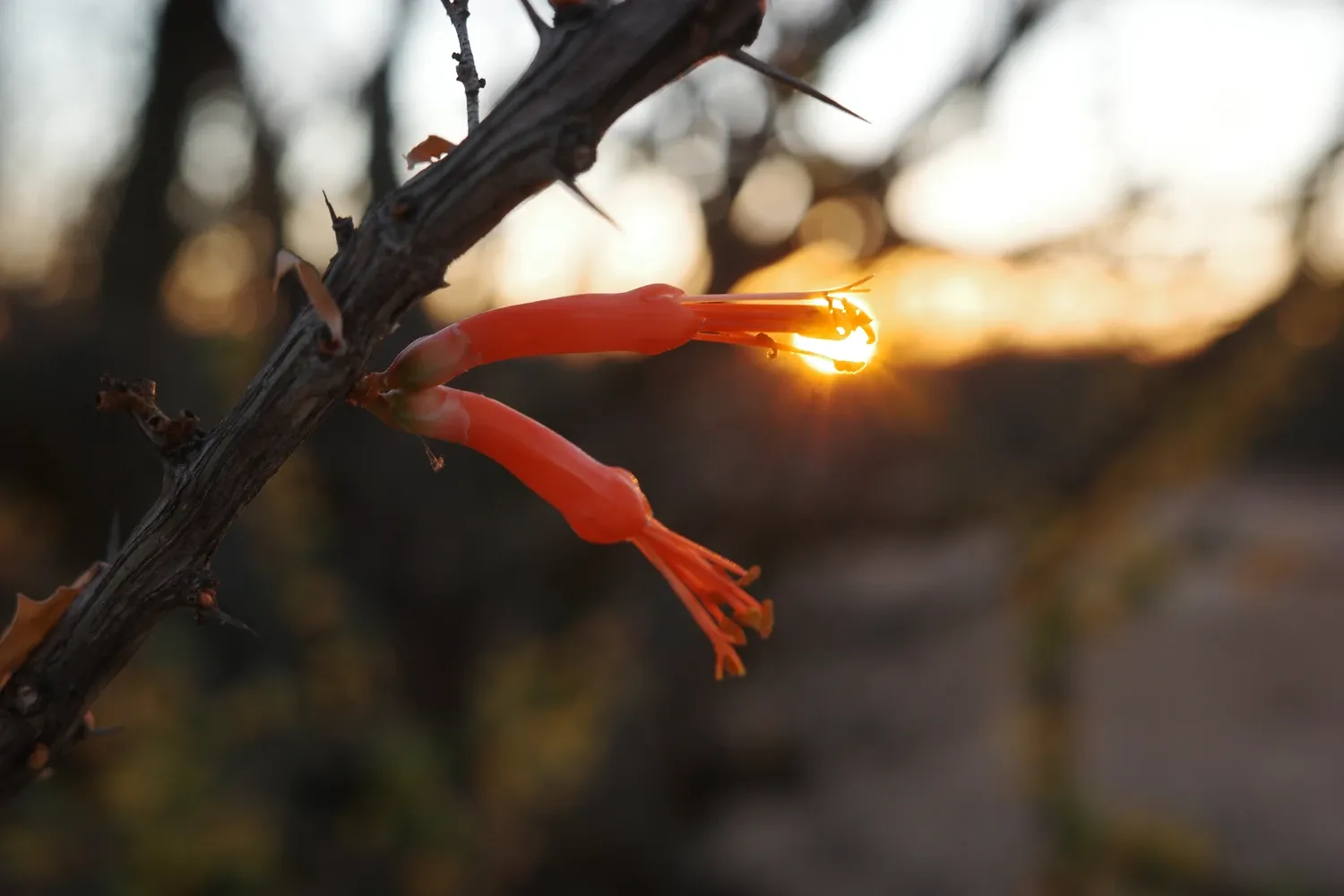
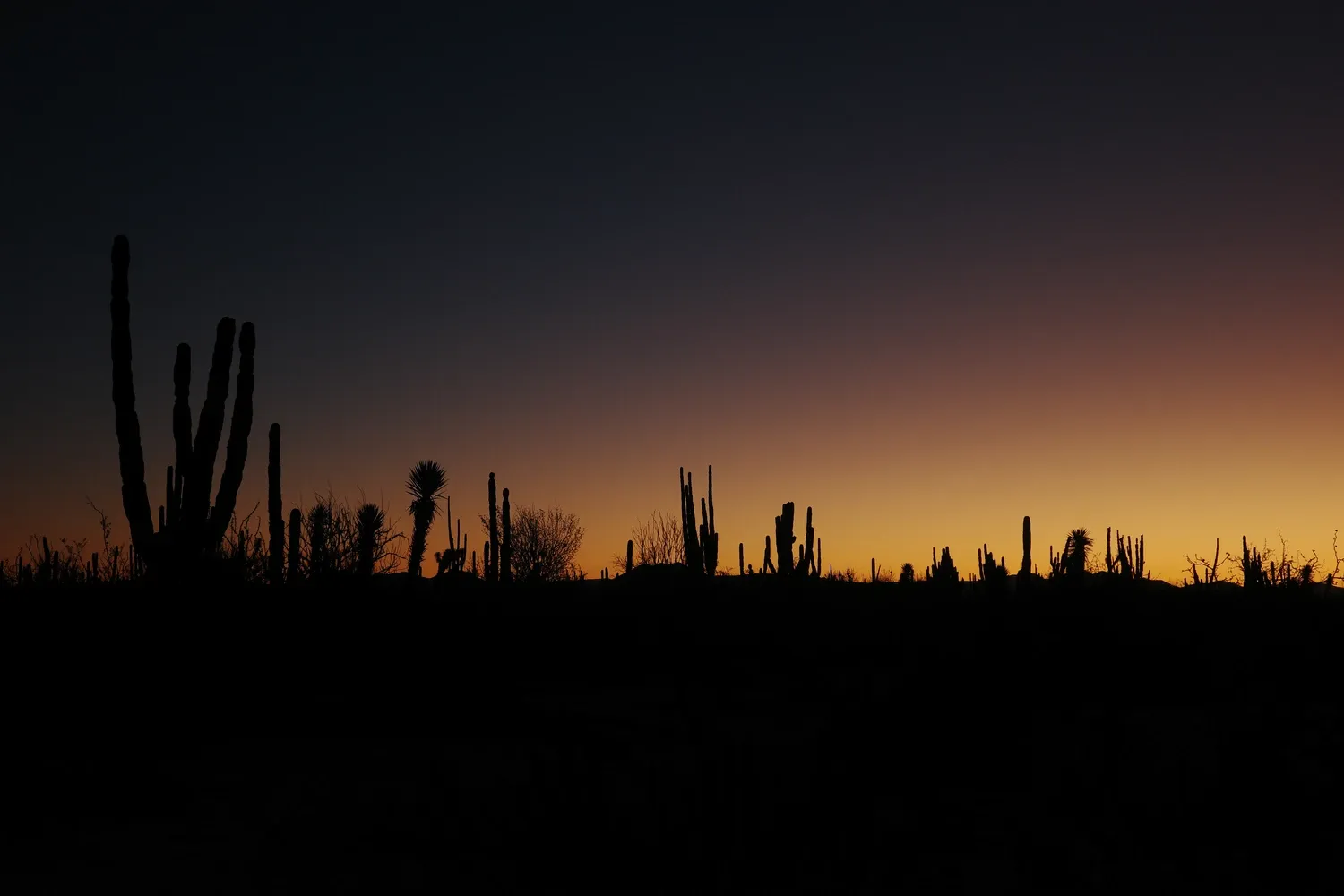
The low sun brings some relief. We ride about eight miles past El Arco before finding a flat spot among evenly spaced cacti. We camp well off the road, just in case of traffic. We've crossed into Baja California Sur now. Ah, a state border. The drug trafficking rumors make more sense. The sunset is perfectly clear, and hues of mauve, peach, and blue fade into the horizon. The dark shapes of cardónes and other desert plants stand out against the colorful sky like cut-outs.
A drone flies overhead while we wipe dirt off in the tent. Drug smugglers scouting the route ahead? Police? Another tourist filming the sunset? I mostly ignore it, focused on slowly sipping water and trying not to chug my remaining three liters. But I am glad we've camped a good way off the road tonight.
February 26
We wake up at 4:30 again. There was dew last night (the west side of the Baja mountains get more moisture, I'm learning), so we lie in our sleeping bags not wanting to move or shake the tent. Eventually, we cautiously change clothes in our sleeping bags and start packing up in the dawn light. We eat breakfast and I wrap up the wet tent, knowing it will be unpacked in Vizcaíno for repairs. The zipper now doesn't close at all for the upper two-thirds of its path. I pump up my tires, which lost air overnight, then after a mile of riding I let a lot out again. Too bumpy. I bought new tires for the trip and love them overall, but there's a very narrow range of pressure where they work perfectly.
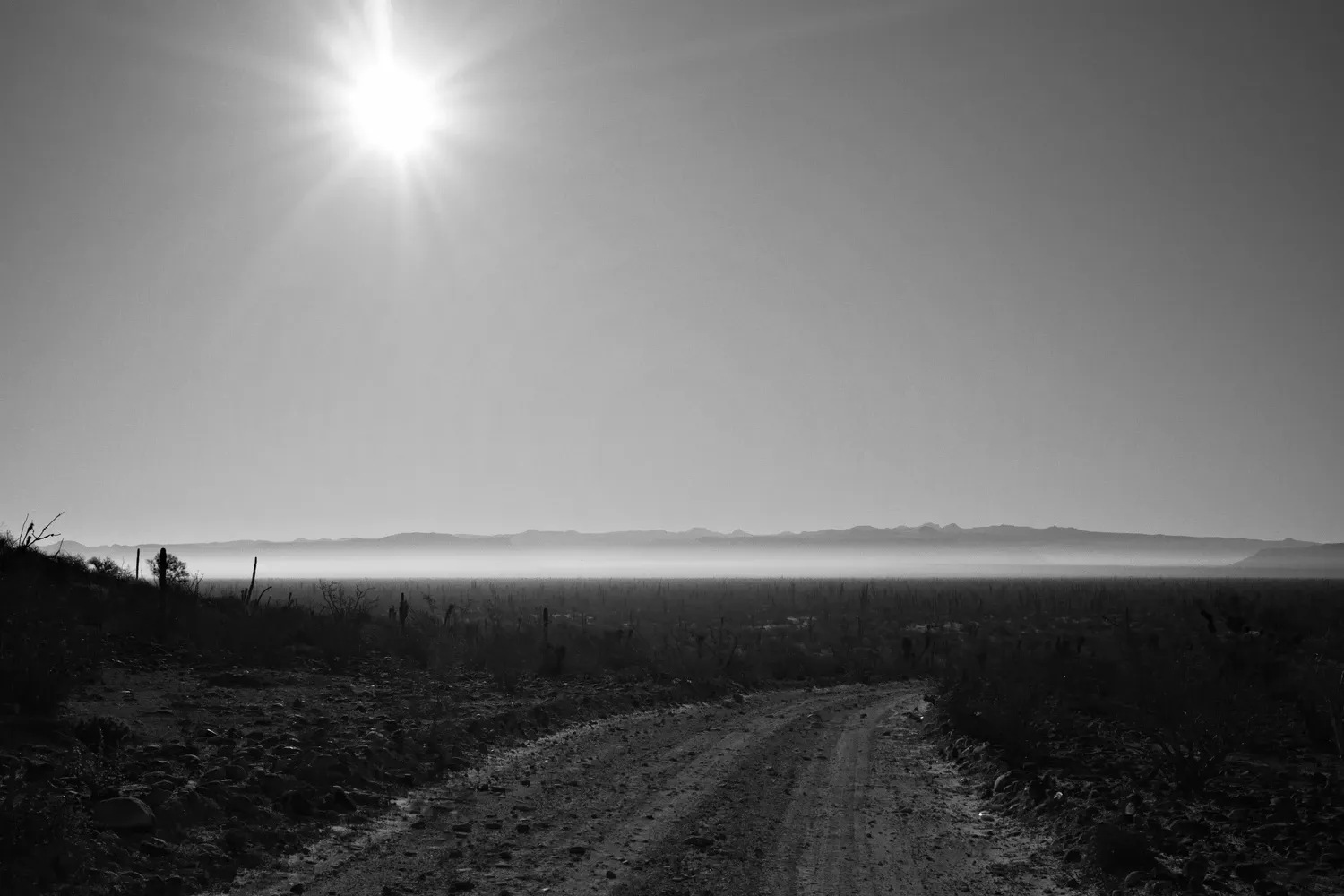
We catch glimpses of what looks like fog in the valley that we're descending into. Is it really that wet here? Is it actually the ocean in the distance? Are we even close to the ocean? Are we hallucinating? Sure enough, we crest a small hill and see an army of cardónes disappearing into a silvery sea of morning fog. It's beautiful, even if the viewpoint isn't ideal.
We pass through Ejido Guillermo (?), which features an impressive trash pit on the outskirts, guarded by turkey vultures and one crested caracara perched on a cardón. The "town" is very empty, and curiously the few houses are all located around the perimeter of a huge empty square of land. A town without a center. A donut town. We ride straight through it and turn onto a larger (still dirt) road toward Hwy Mex 1. It's dead straight and mostly smooth. At the highway we pump up tires, and I quickly disassemble the tire pump to clean grit out of it and squirt in some chain lube (this will work, right?). Based on the squealing noises it now makes, I'm worried the last few weeks of crud might have damaged the seals.
Another flat, straight 10 km brings us into Vizcaíno, making for a short 25-mile day. Leah smartly marked the bus terminal ahead of time, so we stop to confirm times to San Ignacio tomorrow. There's an off-road section between here and there that "everyone skips," so we'll do the same.
There's a cheap hotel right behind the bus station, so we take it. It's only 11AM, and suddenly we have a home base for the day! We decompress, and soon the room is covered in our usual sprawl of gear. We try rubbing soap on the tent zipper to lubricate it, but it has the opposite effect — now it won't close at all. I get frustrated and unfairly blame Leah, even though we both looked it up. Dumb. She asks if we need time apart on the trip. After a few minutes, I apologize.
We walk across the street for fried fish and shrimp tacos with mustard, habanero onions, and pico de gallo. I get a Coke and pretend I'm back in yesterday afternoon's heat. We head to a "telas y mercería" shop, carrying the tent (after briefly forgetting it at the taco stand). We need to fix the zipper before heading farther south, into dengue territory. The owner rummages through zippers and we test one — miraculously, it works! We also get a sharper needle for repairs. Total cost: 6 pesos. Incredible.
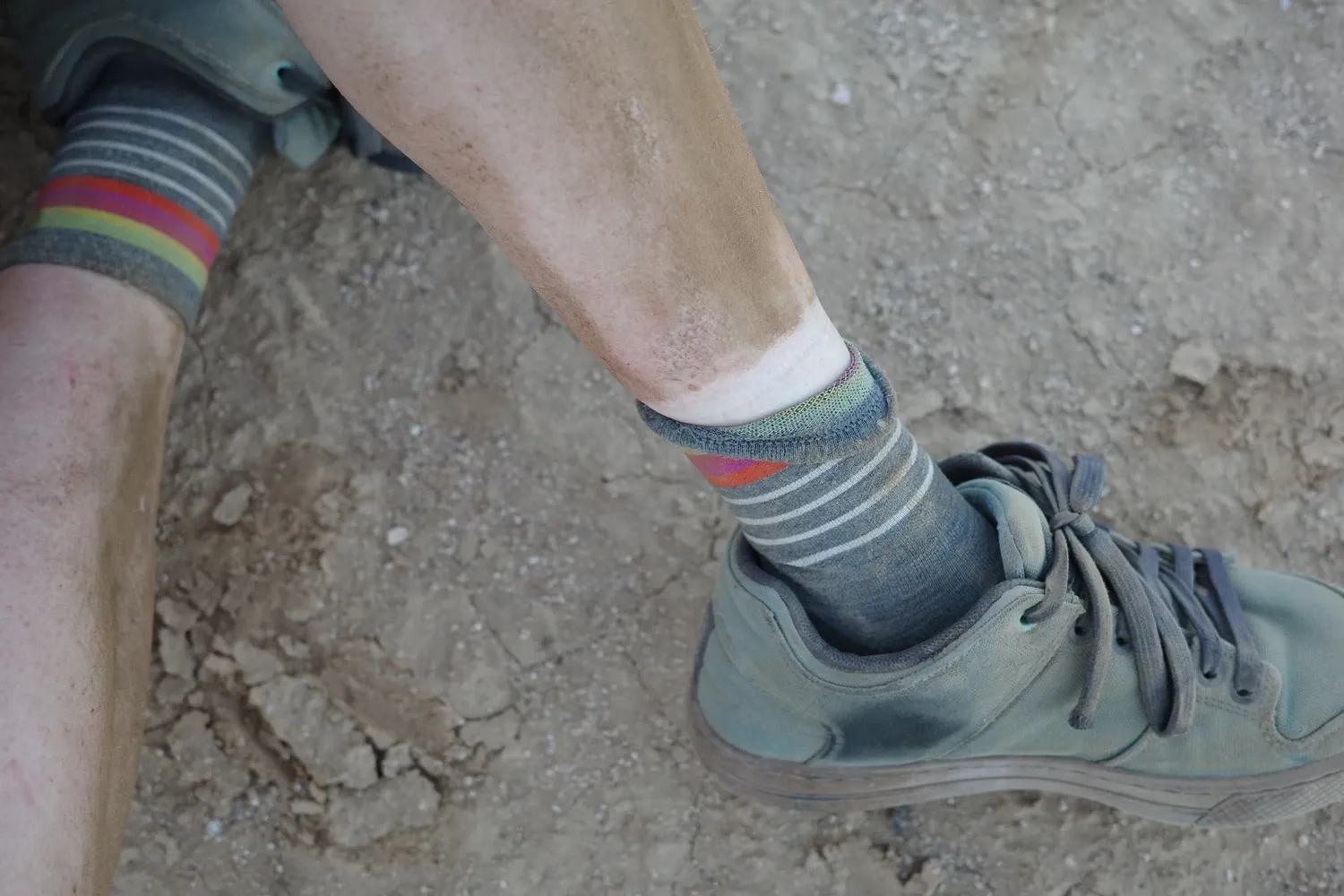
At the hotel we shower, do laundry in the sink. It dries nearly instantly in the heat outside. The amount of dirt I wring out of my socks is absurd. I wash them for twenty minutes and dirt is still coming out, so I give up. Diminishing returns, I tell myself. We do some route planning. I book our return flight home for 3/26 from San Jose del Cabo. Having an end date to plan around will help us prioritize our remaining time, both on and off the bikes.
We get dinner at a small comedor. Carne asada with beans, rice, and salad. The salsa is spicy and great. Then ice cream across the street. Oreo swirl, shared on a bench. We walk home hand in hand as the heat finally fades. We fall asleep quickly, but are soon jolted awake by an incredibly loud cricket. It stops when I stand up, and starts again when I lie down. After a half hour of this game, I find it under the tent by the door and evict it, then block the gap beneath the door with a towel.
February 27
We catch the bus to San Ignacio, skipping a day of riding that we've heard is all sand and zero fun.
Once there, we ride past the oasis — a big lake, canals, and date palms everywhere. It's a strange juxtaposition after so much desert. I guess it still is desert, technically.
We stay at the Misional campground. It is full of tourists and camper vans, but it's comfortable and well-run. The owners are kind and friendly. They seem to appreciate that we try to speak Spanish and they speak slowly and clearly to us. We run into Larry again — he rode the highway, so we must have passed him in the bus at some point. The campground is busy with big vans and trucks, but we tuck ourselves into a quieter spot among the palms. Our campground neighbors have a house in Cabo Pulmo and are on Warmshowers. We hope to remember to get in touch when we pass through there! A friendly guy named Quinn stops by and asks about the ride. He brings us electrolyte drinks and ice cubes from his van (ice is amazing — it's 99°F out) and tells us to keep an eye out in the sky just after sunset - all eight planets will be aligned.
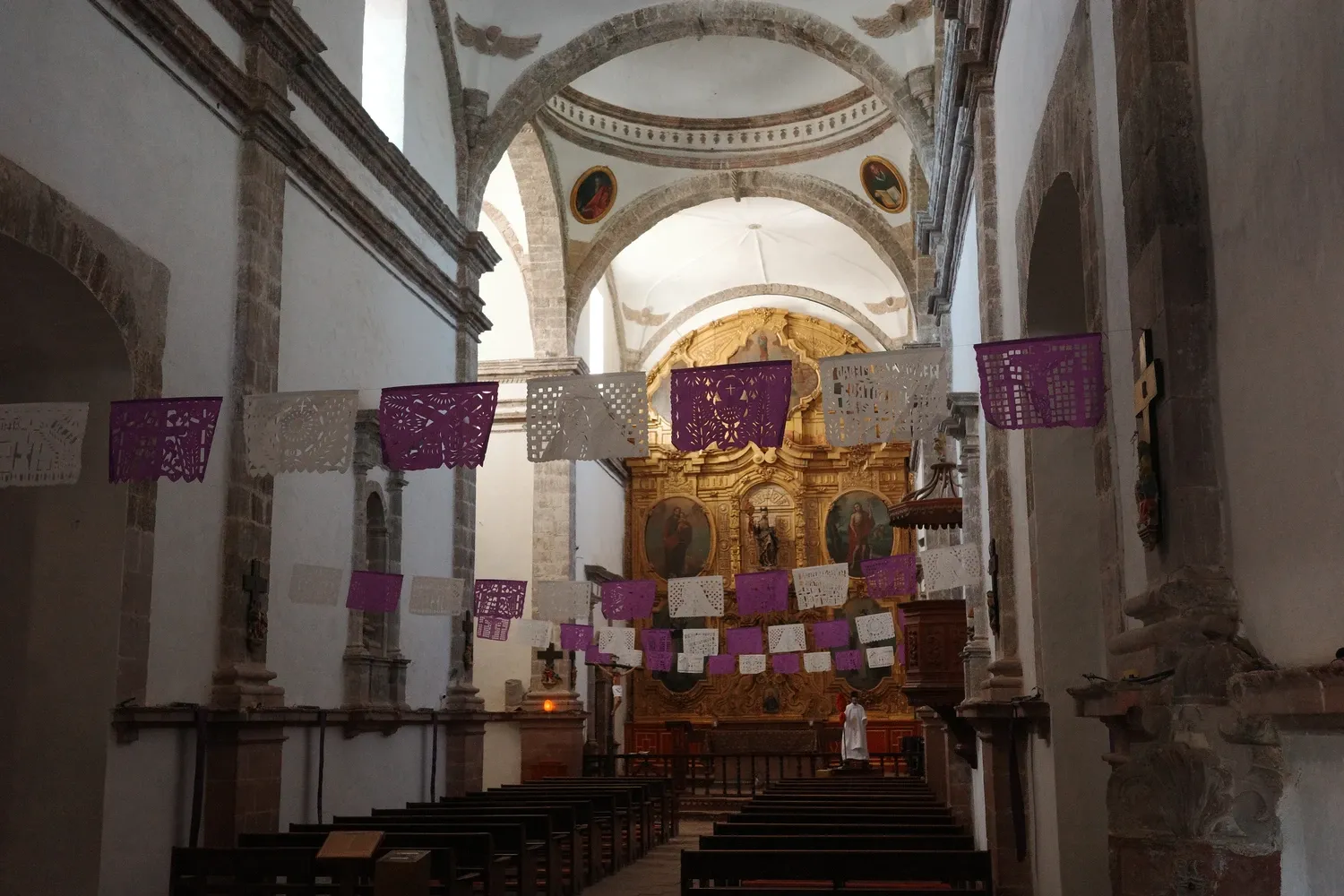
We walk to the town square, check out the mission, and get lunch of camarón tacos. The cave art museum on the map is closed. Or maybe doesn't exist anymore? We can't tell. Back at camp, we lounge. I lie in the tent sweating while Leah calls her parents from a shaded bench area. We return to town for groceries. The small market is oddly full of American brands, which is both familiar and disorienting. We can't find the foods we've become used to eating over the last month. Dinner at a restaurant off the plaza. Leah finally gets aguachile. My scallops ranchero is a bit small. We walk back and pack up as much as we can for the early ride to Kuyima tomorrow.
The campground is loud with frogs, and a nearby donkey occasionally lets out a very loud hee-haw. Definitely an earplugs night.
February 28
We wake early and ride out of town in the dark. By the time the sun rises, we're well on our way to Kuyima.
We're trying to get on a gray whale tour in Laguna San Ignacio. Our campground host contacted an outfitter, and found out that the 2 PM tour is full, but the 11am might have room. The problem is that we need to leave by 6 AM in order to ride 40 miles for the 11am boat, without knowing if there's space. We've decided to go for it.
The ride is paved most of the way, and we make great time. The last 10 km are bumpy dirt road, and it's much hotter by now. Before we get to the town, we pass Pachico's, a small ecotourism camp, and decide to inquire. They're incredibly friendly and take us out. It's just Leah and I, the boat captain, and Pancho, one of the owners.
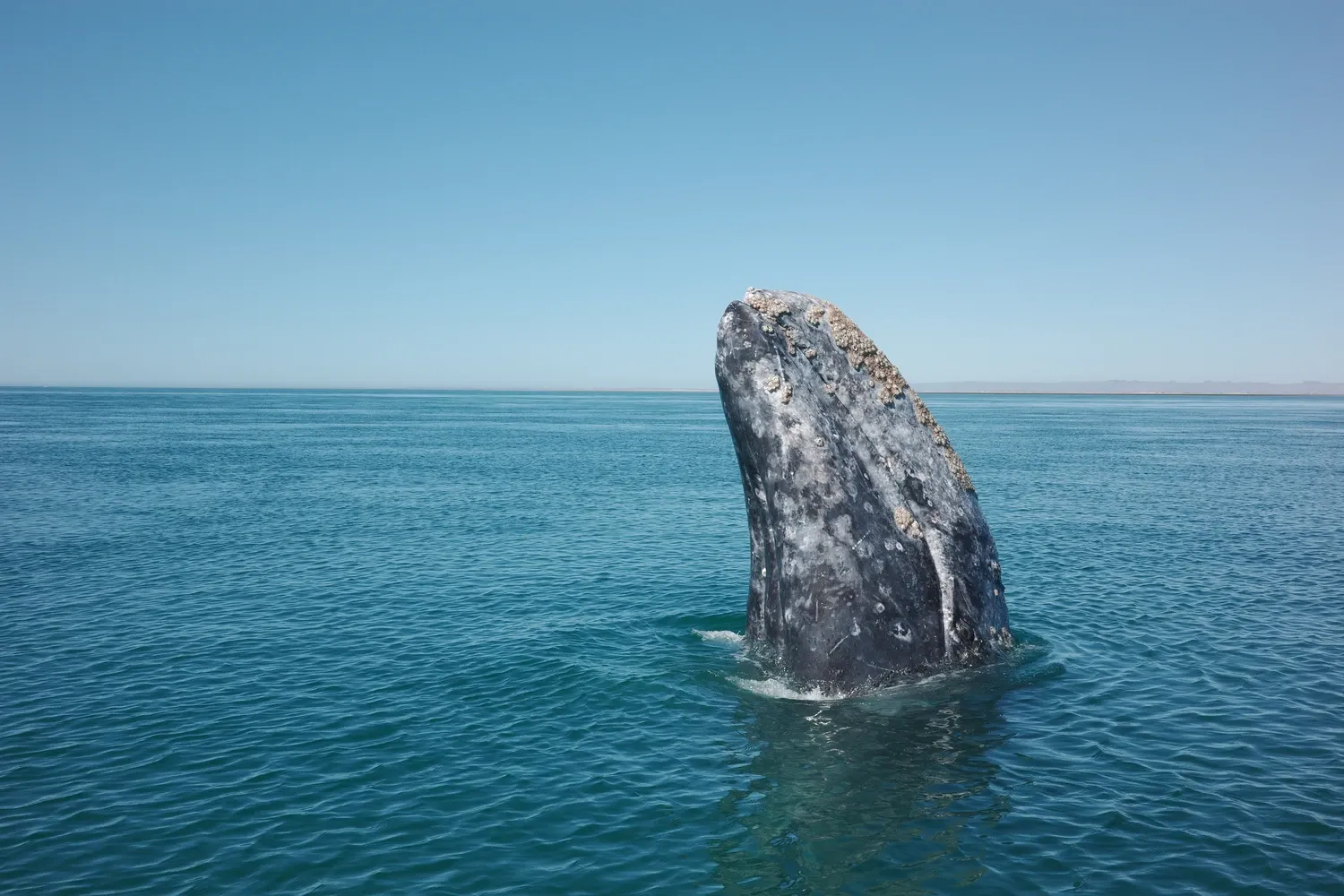
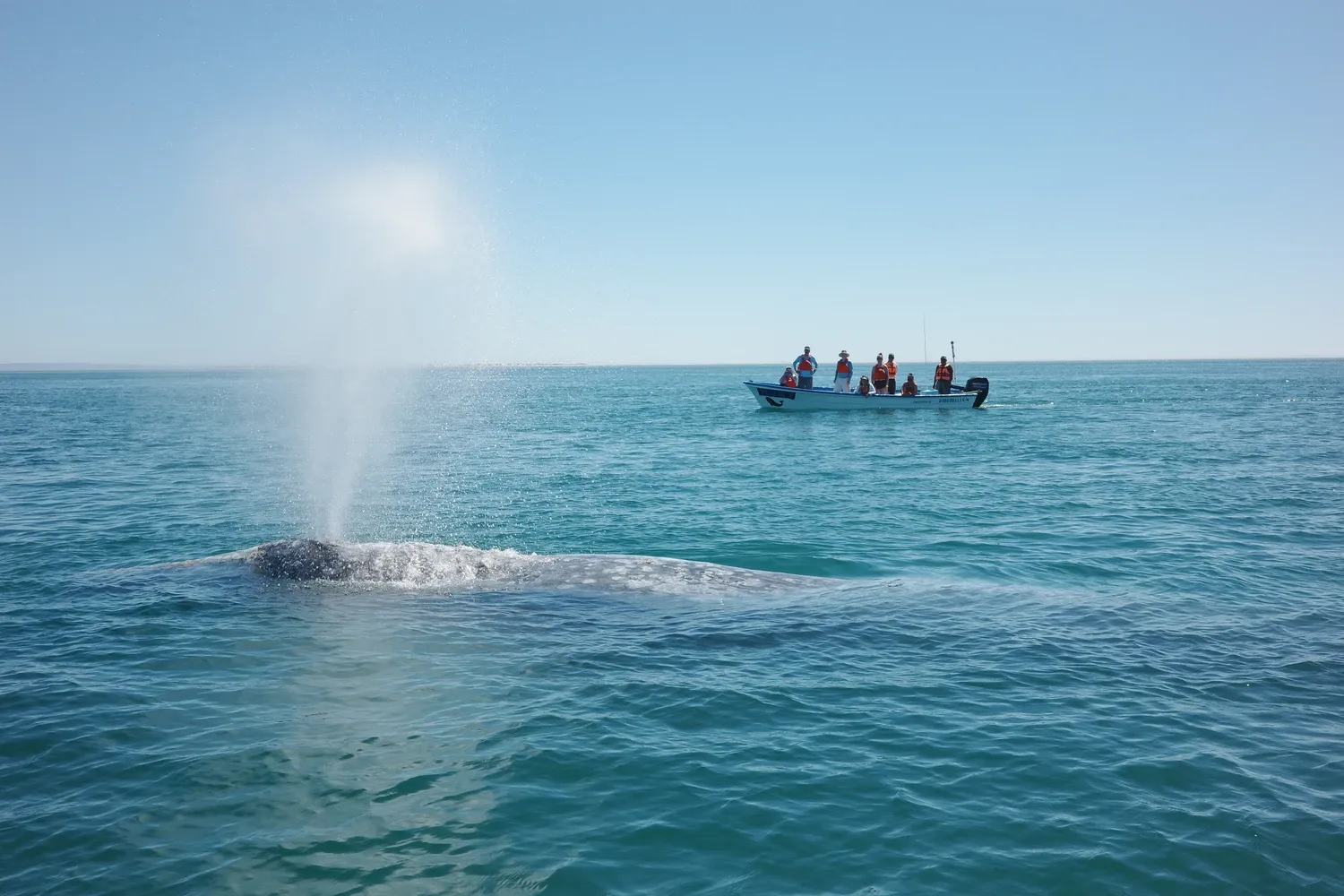
We speed out to the lagoon and quickly see whales spouting, surfacing, spyhopping, and rolling about. I don't know what direction to look. One swims alongside the boat for ten or twenty minutes, breaching and bobbing, getting closer and closer until it's just a few meters away. It's quite a spectacle. Their barnacled skin, sharp ridges, and monochrome coloring are a little eerie, but they're intelligent and playful animals.
Back at the camp, we eat lunch and refill water. An older employee tells us about once being surrounded by six whales, all gently nudging his boat. We ride on into a headwind and heat. Outside a small town, we see a large bird with a messy nest on a utility pole. Maybe an osprey? Like a seagull but meaner, I decide.
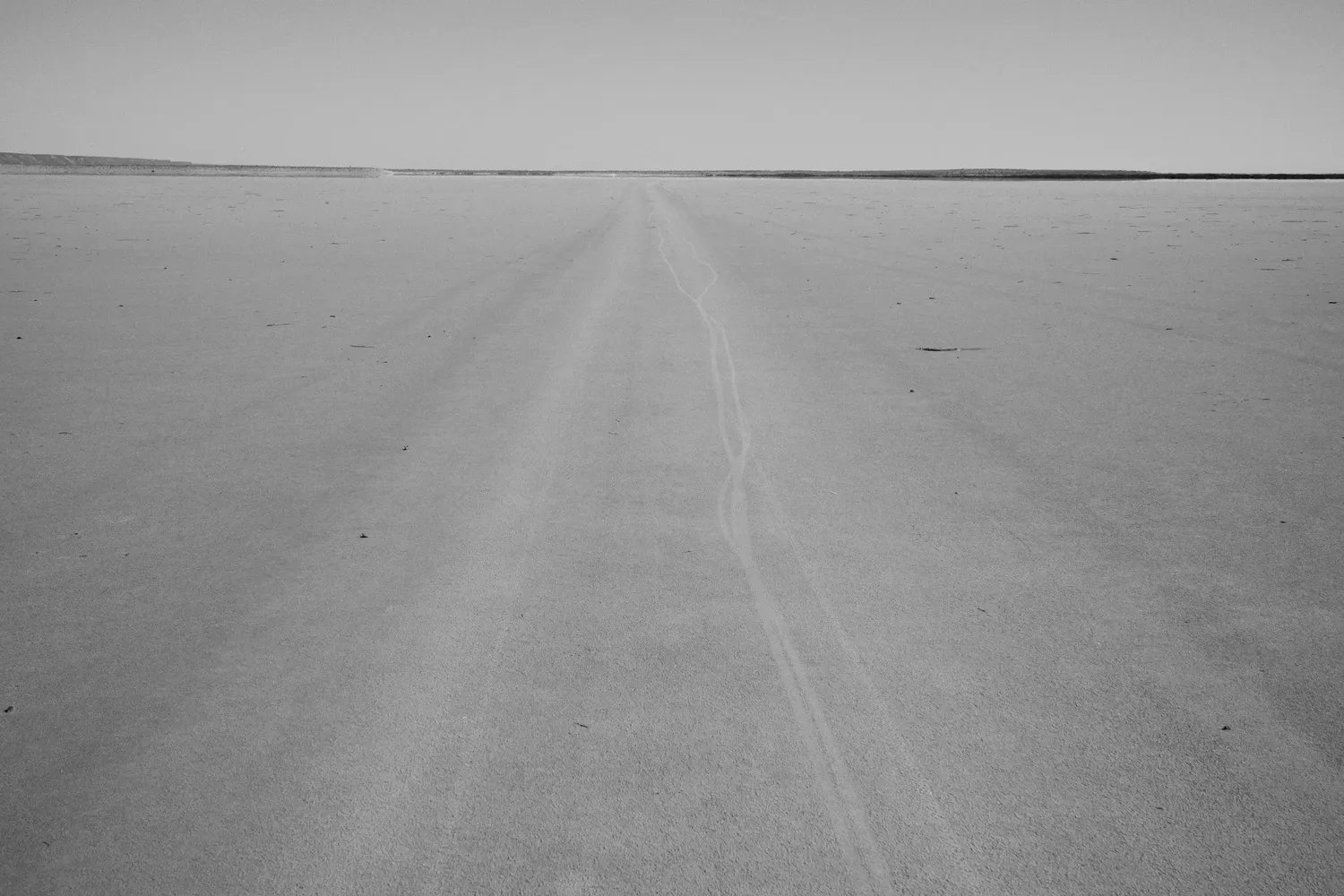
The route gradually turns east and the wind eases. We cross barren salt flats, with a hard-packed road straight through the middle of them. The environment looks like a wasteland, but the ride is surprisingly fast and fun. The flats come and go, interspersed with sandy roads and dried-up bays. There isn't much cover to break the wind, so we tramp around in the vegetation to find a good spot. Leah stops in the shade — she's developed a sudden, painful heat rash on her thighs. After wasting too much time traipsing around, I set up camp. We use wet wipes to clean off sunscreen and dirt, and to cool Leah's legs.
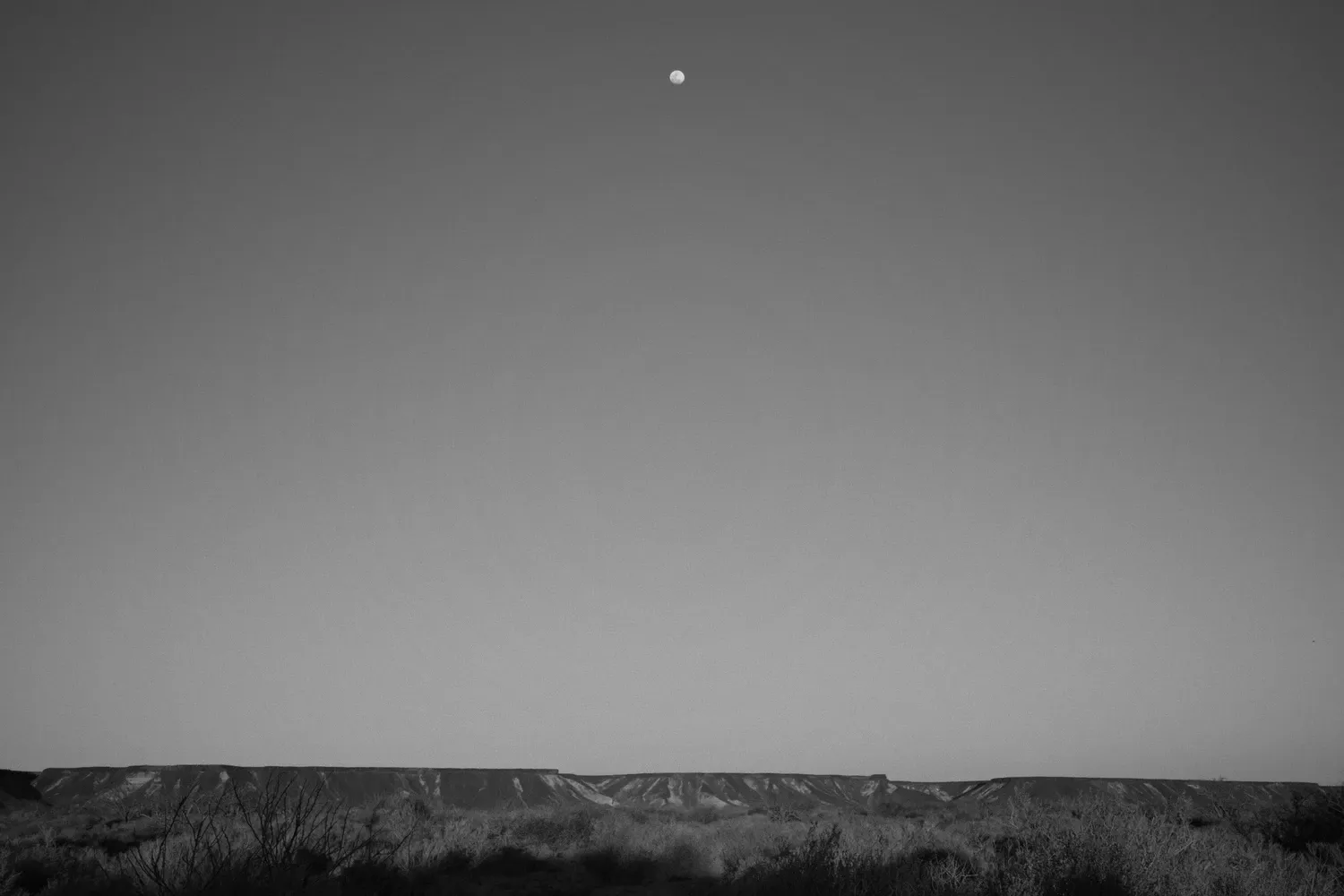
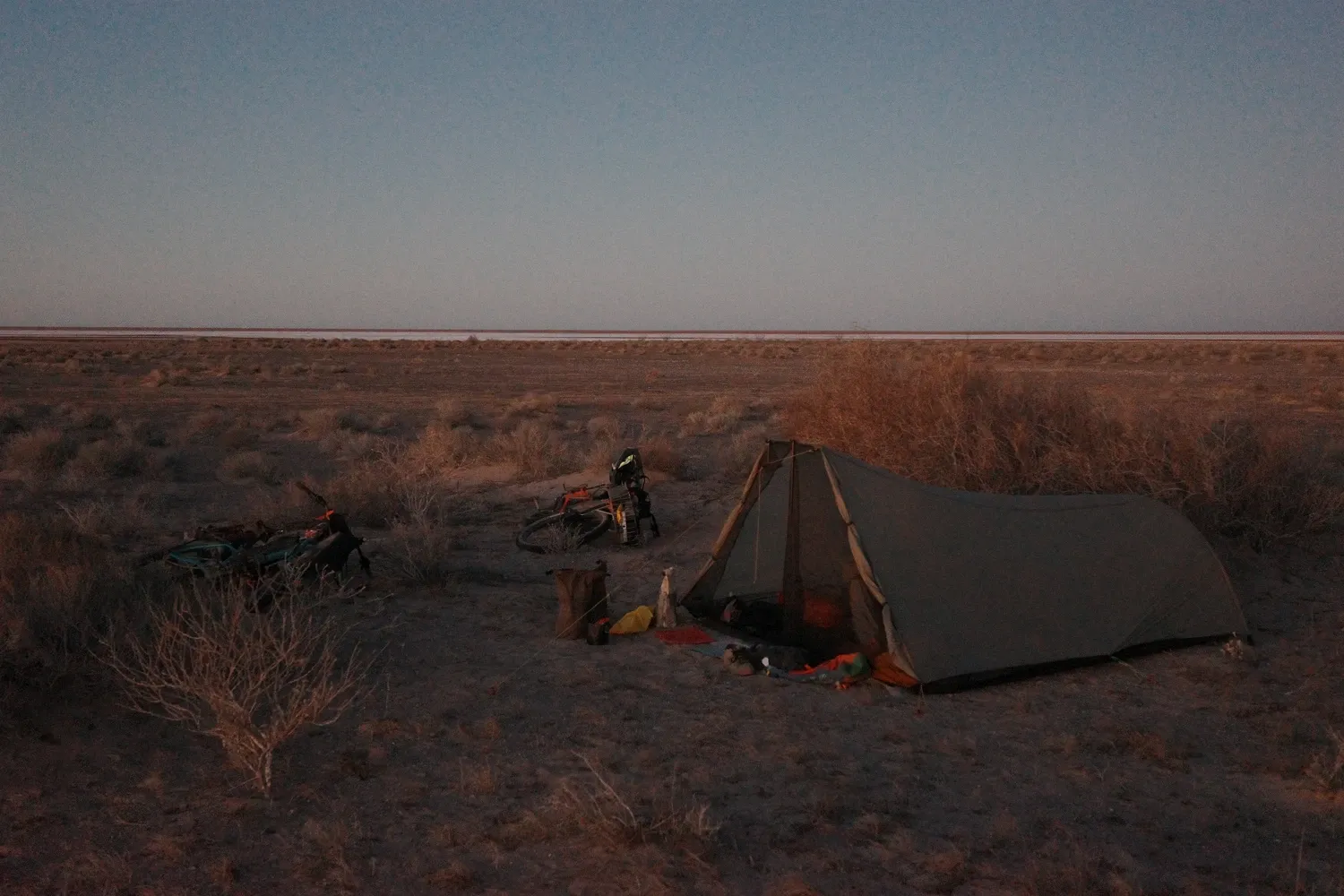
Just as the sun sets, the nearly-full moon rises over the distant mesas. The color and quality of light shifts, but not the brightness. Moonlight replaces sunlight seamlessly, and I don't even realize the sun has set until it's been below the horizon for twenty minutes. Dinner and an early bedtime to make up for the early morning. Substituting ramen instead of rice in our bean/chilorio/zucchini dinner stew isn't bad.
March 1
I didn't set an alarm; we sleep in until 6.
Today's riding is on flat, mostly hard surfaces across large dry lake beds. Periodically we leave one lake bed and cross into another, which involves traversing a very sandy, hilly section of dunes in between. These parts are frustrating — sometimes ten meters, sometimes a kilometer. Now and then a car passes us. It feels funny since there's no real road, but plenty of road-going vehicles are navigating the route.
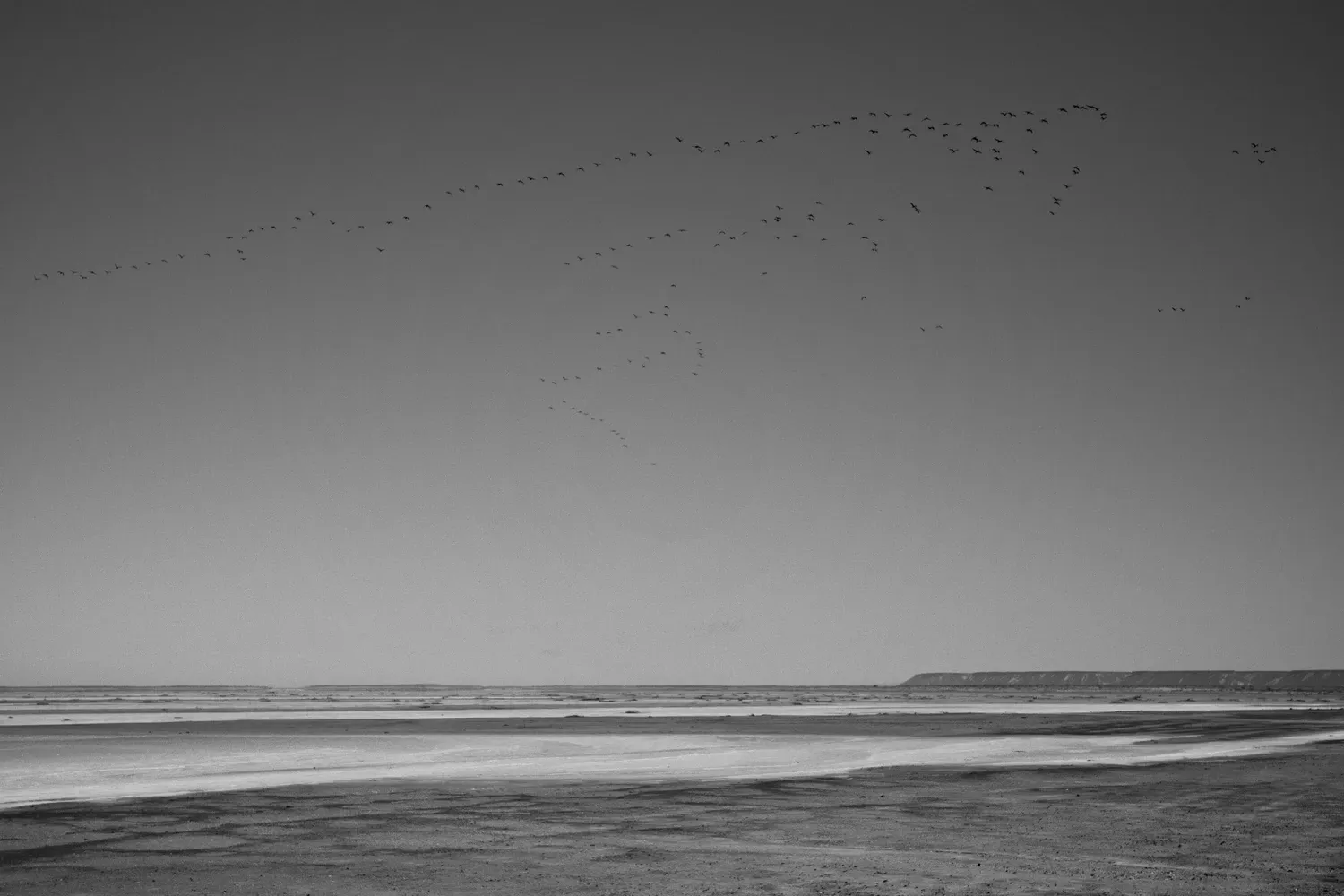
A persistent layer of fog (or a big low cloud bank?) dominates the western skyline, near the beach.\ We can hear the waves at times, yet never see them. It looms all day, but we can never quite tell what it is or where it lies. Migratory birds pass overhead on the salt flats. From afar they look like a cloud of smoke. When they are directly overhead the noise of their wings beating is forceful and impressive. We stop and watch. Where are they going? A few miles later we ride by a row of abandoned utility poles leading to nowhere. Now adopted by ospreys, each pole is topped with a large, messy stick nest. Most of them have a resident bird in attendance.
Before the town of El Dátil, the flats really open up. Everyone has told us how fast this section can be with the prevailing tailwinds, but instead we have an onshore crosswind from the west. Meh. It's more work than expected, though feeling any breeze at all is welcome. The buildings in El Dátil feel more makeshift than in other places we've passed through - more of a permanent fishing camp, but the vibe here is also more lively. People are on fishing boats, porches, walking down the dirt streets.
We ride the main road to the end and back, trying in vain to identify the abarrotes store. We ask three people before a man selling electronics and clothes from his van directs us to the building behind him. We still can't find it — there's only a house with a semi trailer backed up to it. Finally I venture into a door tucked behind the end of the trailer. The store is small at first, then we notice a huge aisle around the corner filled with all manner of packaged goods. Hurrah! We won't starve the next three days.
It's such a contrast with the rest of the store, which has some rotting produce and a half dozen unlabeled fridges containing Coke, yogurt, more sodas, margarine. Only when we ask for cheese does the girl behind the counter open yet another fridge and hand it to us. Car batteries are stacked everywhere, charging from rooftop solar panels to power all manner of apparatus, and wires with alligator clips dangle from the ceiling. We ask for water, and a guy shows us an inconspicuous hose with a toggle switch for the pump, mounted on a display rack shared with bags of chips. The entire space is admirably functional and organically chaotic. My kind of grocery store, I think. Unsurprisingly, the store has an internet terminal and accepts credit cards.
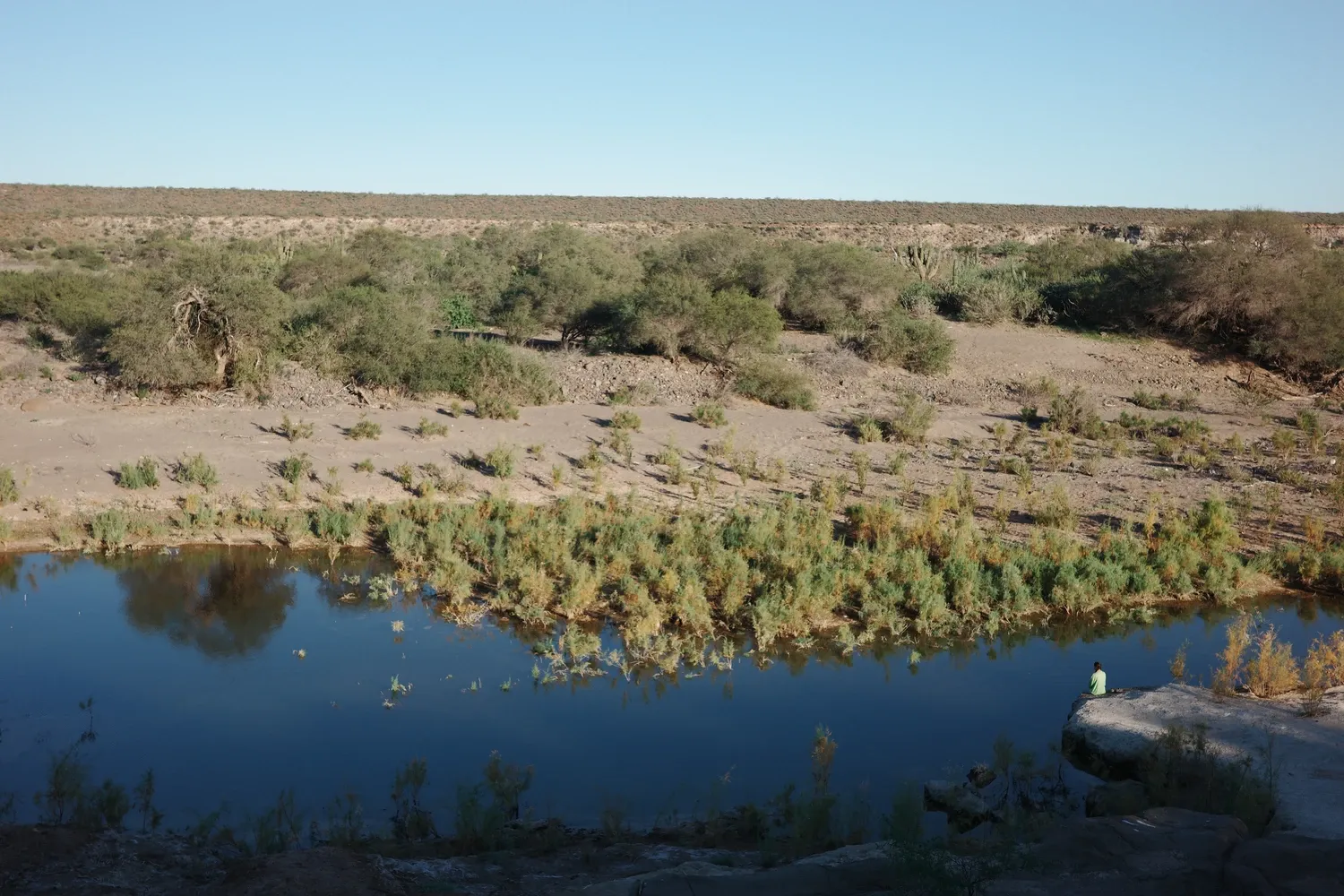
We ride out. A herd of cows guards the substantial trash pit on the sand flats outside of town. The road turns inland and climbs. I find a "Not Bad" sticker that Emerson turned me onto, from Germany. Finally, we turn inland again for the road to Mulegé, up a shallow but wide canyon. We camp a kilometer in. A small patch on smooth sandstone rocks overlooks a small pond (!). Birds take off and crash down now and then, and dragonflies/damselflies skim the surface. It's a farm pond but isn't gross enough to prevent me from wading in to rinse off a bit. Leah soaks her legs to ease her heat rash slightly.
We talk about plans for the rest of the trip — how to do more off the bike, have more fun, and communicate better without getting grouchy. The riding itself has been kind of hard and not that interesting. Hopefully that will change in the southern regions.