Baja Divide
March 2
Today marks one month of riding!
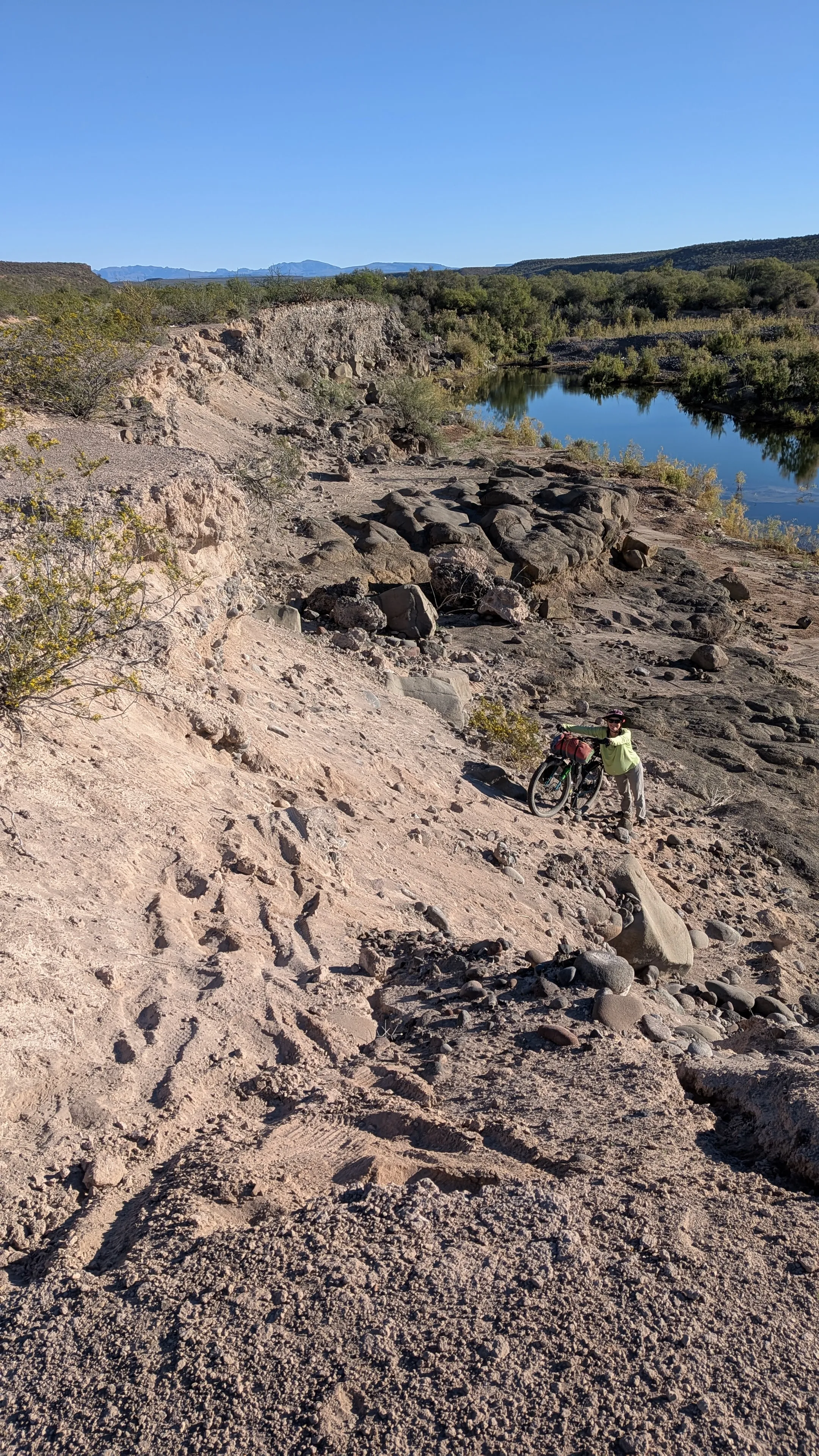
The morning starts with a foggy sunrise in the distance and waterfowl coming and going at the small pond we camped near. We struggle to push our bikes back up the steep, collapsing bank to the road above us. It's a messy two-person job, with me above and Leah below, making sure the bike doesn't slide backward after every grunt of upward progress.
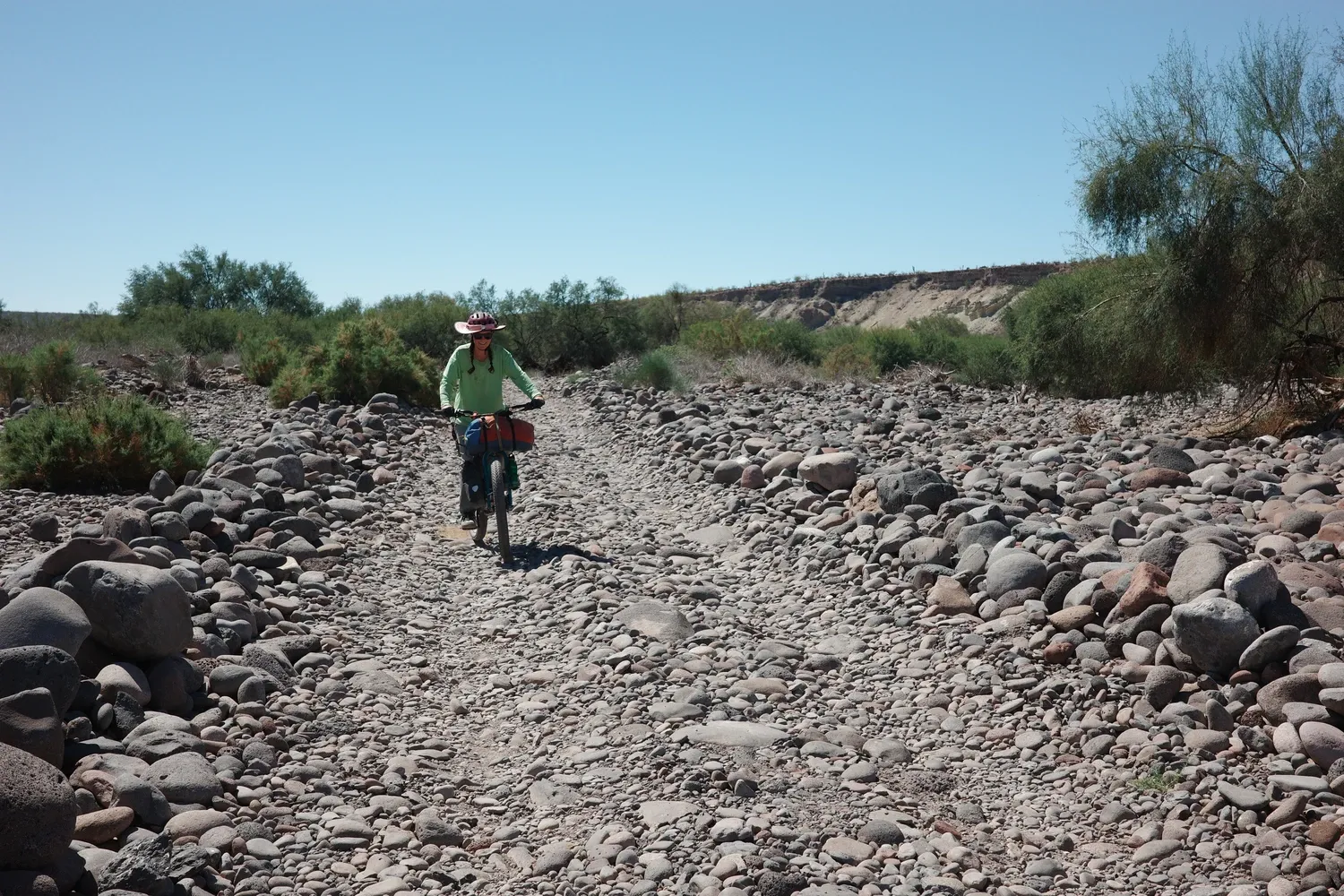
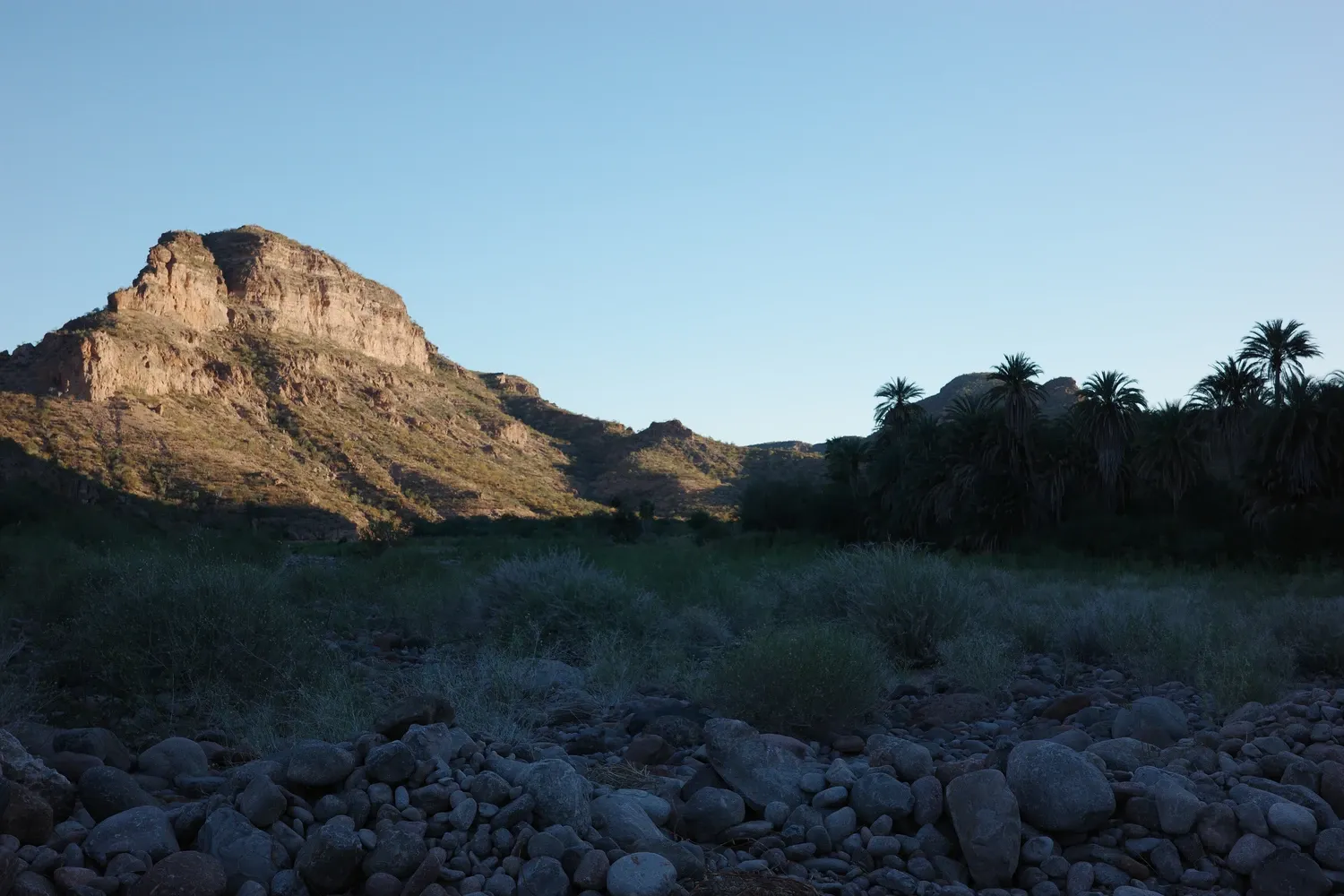
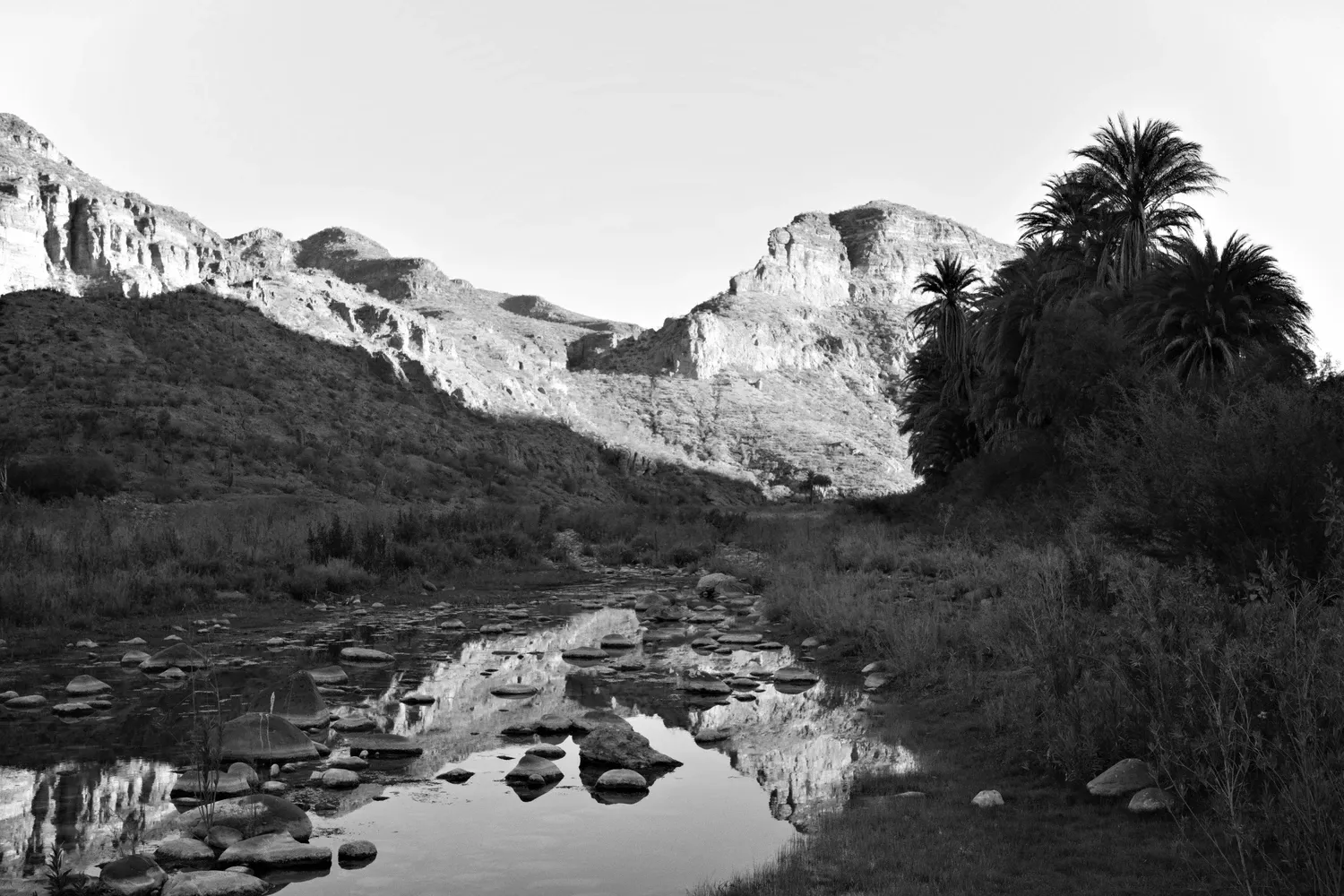
The road crisscrosses the riverbed as we go upstream, the canyon growing wider and deeper. The crossings are full of large smooth river rocks; the rest of the road is pretty decent riding. We eventually pass a few small ponds - it's nice to know we could find water to filter should the need arise.
We stop at Rancho Los Girasoles, run by María and Jesús — and also their dog, cat, and a wild tortuga that crawled up the road one day and now lives in a shady tub and eschews packaged turtle food in favor of tomatoes and lettuce. We get snacks and drinks, and I can't say no to coffee and cookies when María offers them. Leah gets fresh goat cheese. We pose for a photo for her Facebook page, then reluctantly head back into the heat.
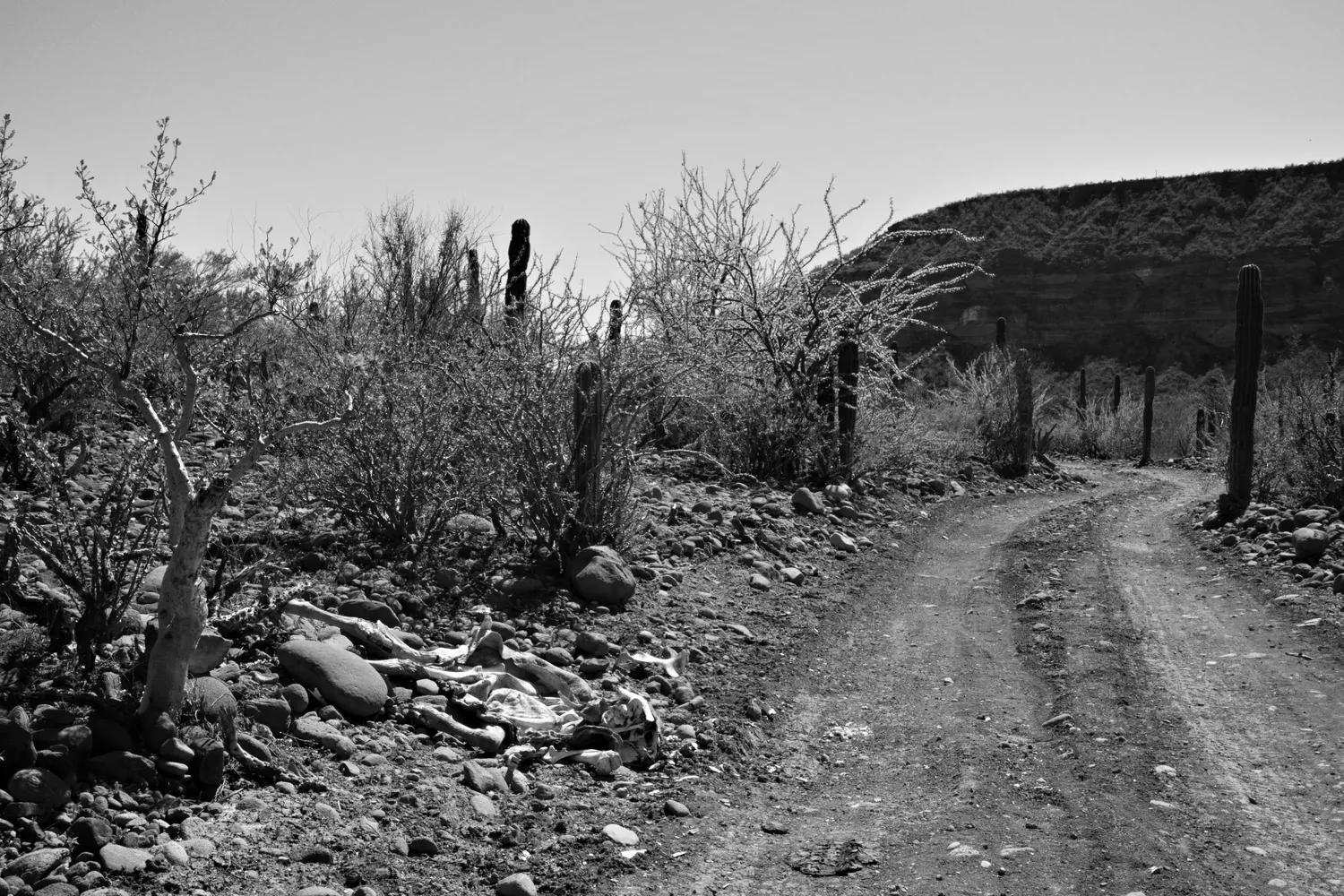
Leah lets me take her front bag when I ask. I'm surprised but glad. It's another scorching day, so anything to lighten her load will help. Progress is slow. We stop for lunch a few miles after the rancho. The cheese is melting rapidly but tastes great; we eat it all. After another mile or so Leah is flagging. She has her pants on to prevent sun rash and is overheating, so we take a siesta in the shade around. I'm worried again. Just like the day to Rancho Escondido, it feels borderline scary. The thought of just calling off the remaining biking and pivoting to "normal tourist mode" crosses my mind again. We press on after a half hour. It's still hot but cools slightly. The scenery gets more impressive with each turn: the riverbed widens, canyon walls steepen.
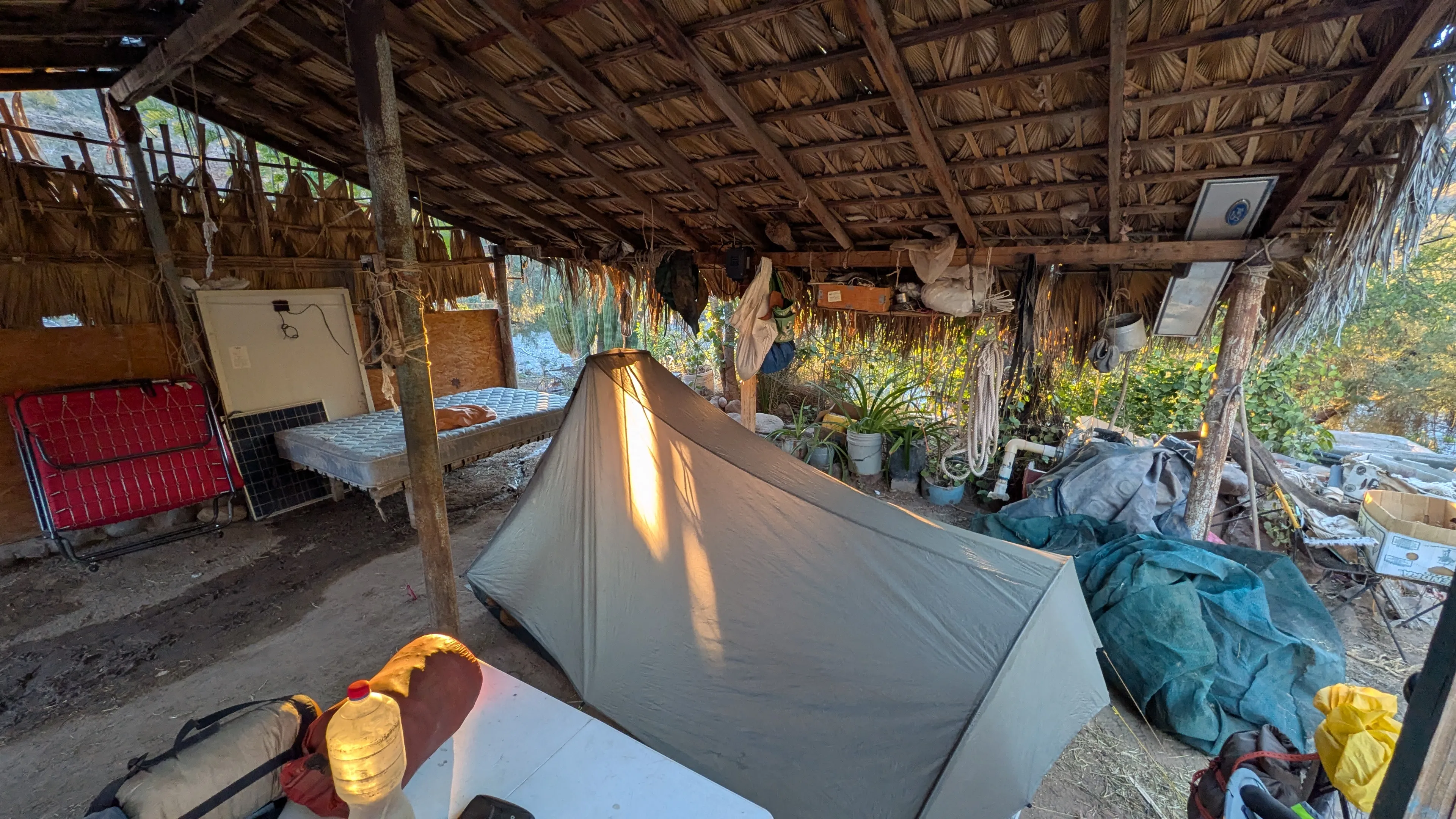
We make it to Rancho Rinconada and decide to stay — it's 5 PM, we won't get much farther anyway, and this will be more comfortable. Carmelo is our host, a chatty 83 year old who runs the small farm and seems younger than his age. We set up the tent under a hut; he has an outdoor mattress, but we're worried about nighttime bugs and the many flies. He is very gracious. Things are very dirty and a bit unkempt. He shows us three day-old goats in the pen and lets us each hold one. We shower inside with a bucket of water and a scoop. The lukewarm water is very refreshing after such a hot day. Dinner is machaca with eggs, cebollas, and tortillas. I eat a lot of tortillas to fill the hunger void and hope it suffices.
There are many spotted gray frogs hopping around on the ground. Frogs, frogs, frogs on this trip. Carmelo has a daughter and nephew who work in Mulegé. We refill water bottles, and he laughs at the strangeness of trying to hold open Leah's floppy plastic Camelbak bladder. "Que curiosa".
March 3
We wake early, determined to get to Mulegé and avoid another hot painful afternoon. Carmelo is already up to see us off. An hour later, we're riding through the shady canyon.
We come across a quartet of horses in the road and spook them. They run farther up the road and we repeat this a few times before they finally trot into the brush to avoid us once and for all. The light catches the tops of the canyon walls and slowly creeps downward as the sun rises.
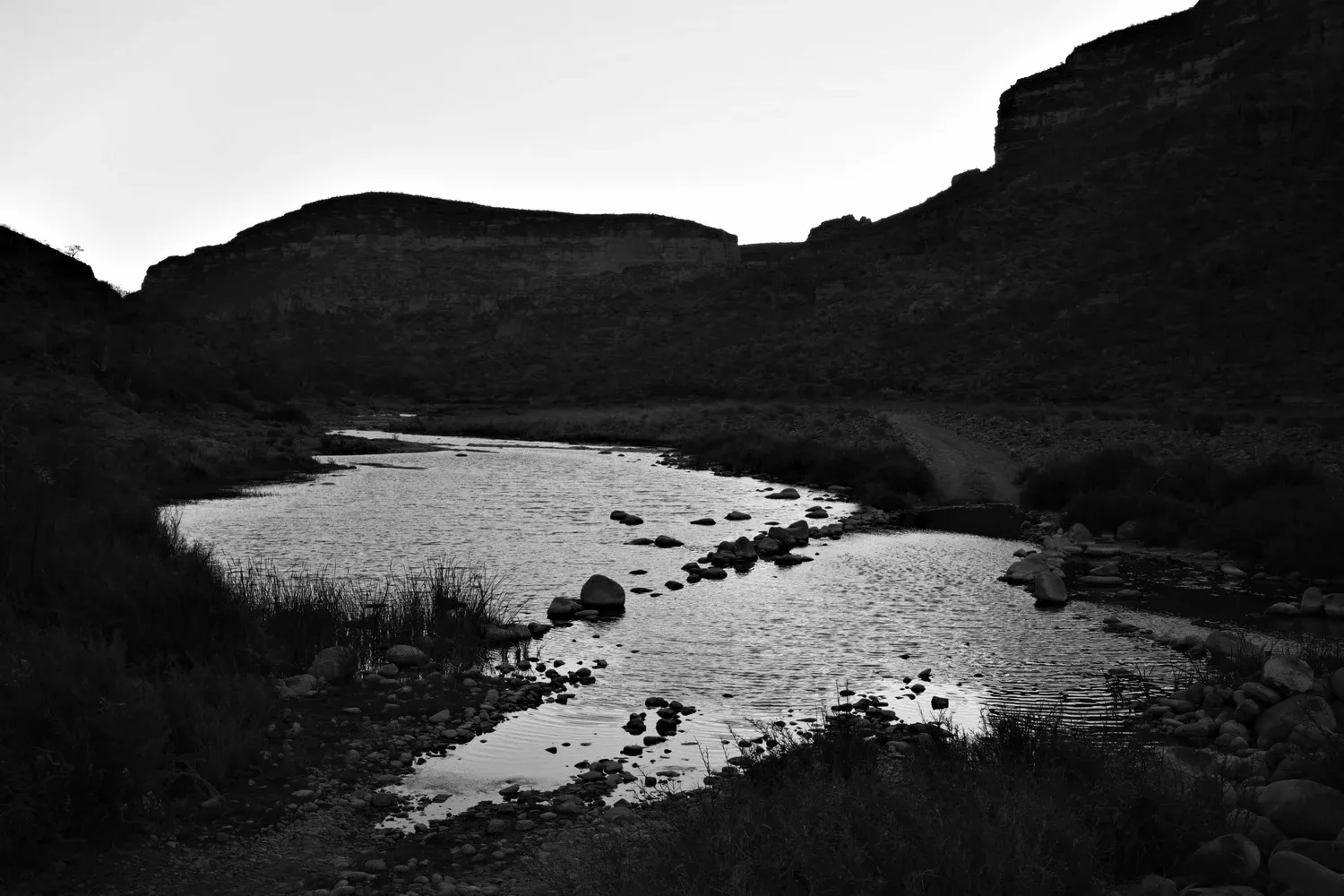
There's more water here, and we have to contend with several non-trivial crossings that are too deep to ride through, but without any good stepping stones. Leah slips on the worst one and plunges her right foot into the water. She is unfazed, stopping only to empty it before she continues on. Each crossing feels like a small oasis, with date palms and egrets surrounding the pools. The contrast of white birds, green water, and red rock walls is special. Bonus points for matching the colors of the Mexican flag.
We pass a few trucks and several ranchos not on our map, advertising camping, food, wifi. It starts to get hot, and the last five miles to the high point are slower, with ultra-steep sections covered in concrete, to prevent erosion. The embedded river rocks give them a bumpy cobblestone look, but at least the traction is good. It's a fun challenge to try to pedal up them at a snail's pace without walking the bike (I fail most of the time).
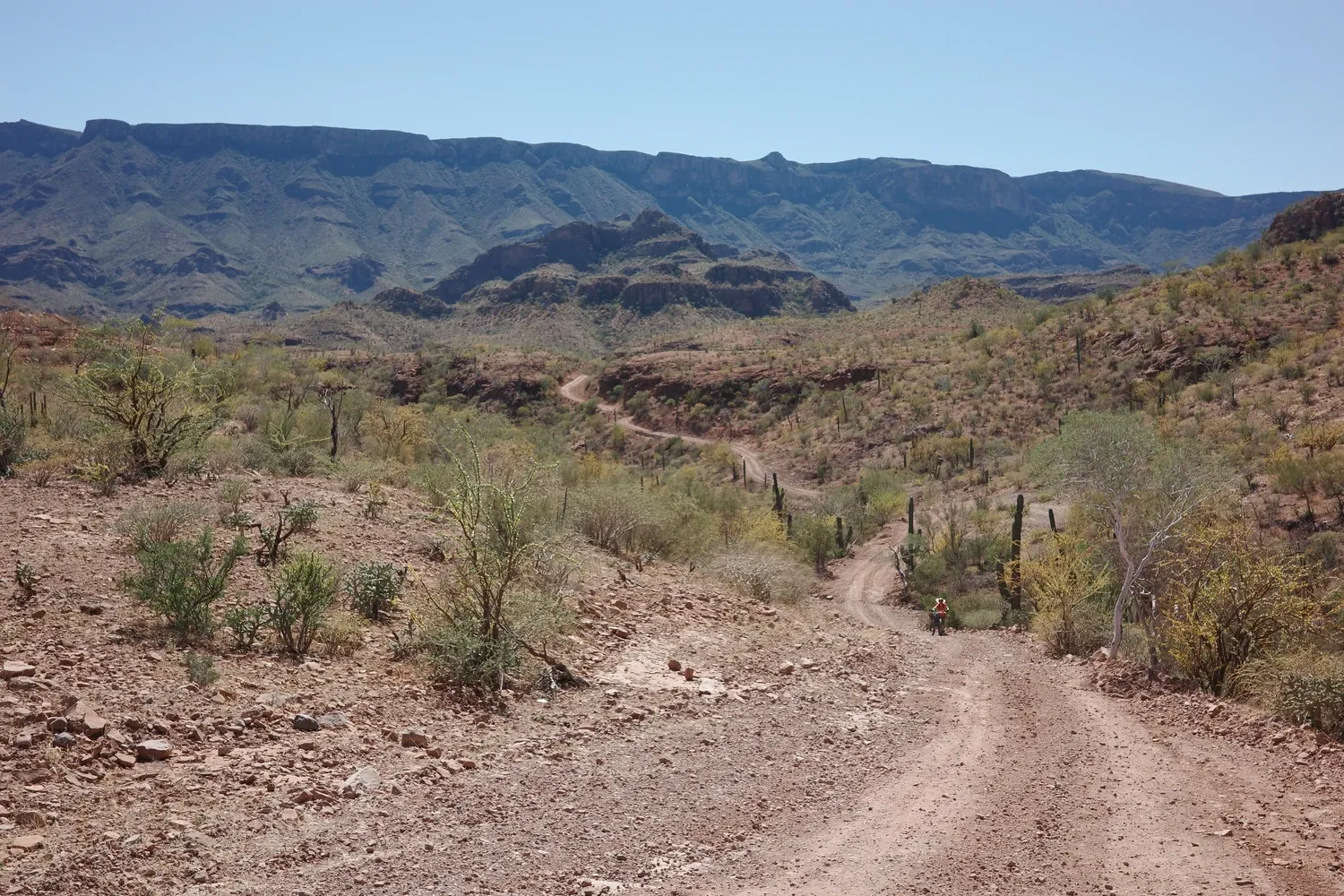
The landscape opens into a valley with steep mountain walls. The river disappears... somewhere, and it feels like we're crossing small passes from one bowl to another. Just before our big descent, a group of ATVs passes going the other way. The last one stops, and an American couple commends us for tackling such a tough ride. It feels nice.
The descent on the east side is way steeper and rougher. Instead of a smooth runout down to the ocean, it's a series of steep drops, loose rocky riverbeds, and short punchy climbs. Despite the net downhill it's a lot of work.
We stop for lunch at a trailhead to more cave art, but do the math and realize we don't have the daylight or water needed to hike and still make it to Mulegé, 15 miles away, before dark. Begrudgingly we continue into the heat, but we know it's the right call.
The road eventually flattens and gets sandy. The afternoon drags on, as it tends to in 90+ degree heat. These 2 PM doldrums seem inevitable, I've decided.And we have a headwind again. Leah, ever the optimist, is happy that the breeze keeps her cool and prevents more heat rash. We're out of water by the time we reach the outskirts of Mulegé and we both agree to stop for the first cold drink we find. A small bluish bird flies alongside us, hopping from fencepost to fencepost, waiting for us to catch up before flying ahead again. It's unexpectedly playful and makes me smile even in my desiccated state.
Ten minutes later I'm drinking Coke from a giant glass bottle on the stoop of a small grocery store. We find a simple hotel, Manuelitas, and pay for two nights. We rearrange furniture to cram the bikes inside then shower and change. We walk around town in the evening light — past the plaza, side streets, and up the stairs to the Museo de Mulegé for a nice view at dusk.
Dinner is tacos — simple and fresh — served by a friendly host who asks about our trip. Next door, an open-air public gym (cancha) is hosting volleyball games. Teams are mixed ages and genders, and it's a fun, lively scene with lots of spectators. For a small town, it's surprisingly busy. It feels nice to do something "normal" in our spare time.
Hot chocolate and a cold beer back in the hotel room.
March 4
Rest day in Mulegé.
I finally get a good night's sleep. We have a decent to-do list for our day in Mulegé. After some AM lounging, we walk across the street to a cute but curious laundromat. The laundromat runs tokens that you have to buy from the register. The tokens for washing and drying are different. The owner is slightly curmudgeonly and insists on doing everything in a specific order. He won't sell us soap until we've put the token in the machine. He won't sell us dryer tokens until the wash is done. But it's close by and it works, and in an hour we have dry, clean clothes, with some of our wool garments hung up to air dry in the small motel courtyard.
We both have some bike maintenance to tend to as well. Leah inspects a suspicious bottom bracket noise and lubes her chain. I adjust my brake rotors and calipers to stop rubbing, and bend the rear retaining clip that somehow got mangled and has been squealing for the last several hundred miles. We walk to a small coffee stand. It's just a young lady with an espresso machine set up against a wall in front of a hardware store who makes us a killer cappuccino and americano. We hunt out a shady bench in front of a kindergarten to do the crossword puzzle on my phone. It's a slice of my old home routine that I'm insisting on, for comfort.
We eat what is now brunch at Doney Mely restaurant. It's around 10:30 so we have the place all to ourselves, save for the very kind staff. I watch workers across the street putting a new door on the telecom shop. There is a store advertising aluminum doors and windows about twenty feet away, so the worker walks in, comes out carrying a door, and sets it in place in a matter of minutes. He and a younger guy go back and forth getting it aligned perfectly. Yay for shopping locally. Leah is a bit distracted, taking advantage of the consistent internet (compared to the motel) to catch up on writing her blog posts.
We walk to the Museo de Mulegé which is housed in the old town prison from 1902. Prisoners were allowed to roam in town and hold jobs, and were called back to the prison by someone blowing a conch shell, which is on display (maybe not the original??). The bright walls and nice breeze make the space seem almost welcoming.
Back at the hotel I notice my front bike rack is bent at the joint where the rack frame meets the lower supports, and the rack has cracked slightly in that spot on both sides. Leah suggests sliding the stays farther into the rack to strengthen the joint, and moving the supports up to higher fork eyelets. After some grunting and fussing, a borrowed pair of pliers ("pincers") from the hotel staff and - good teamwork - it's done. Fingers crossed.
We check in with our host, trying to arrange a boat ride across the bay with her husband who is a fisherman, but he won't be back until much later at night, so we need to wait until the morning and hope it works out.
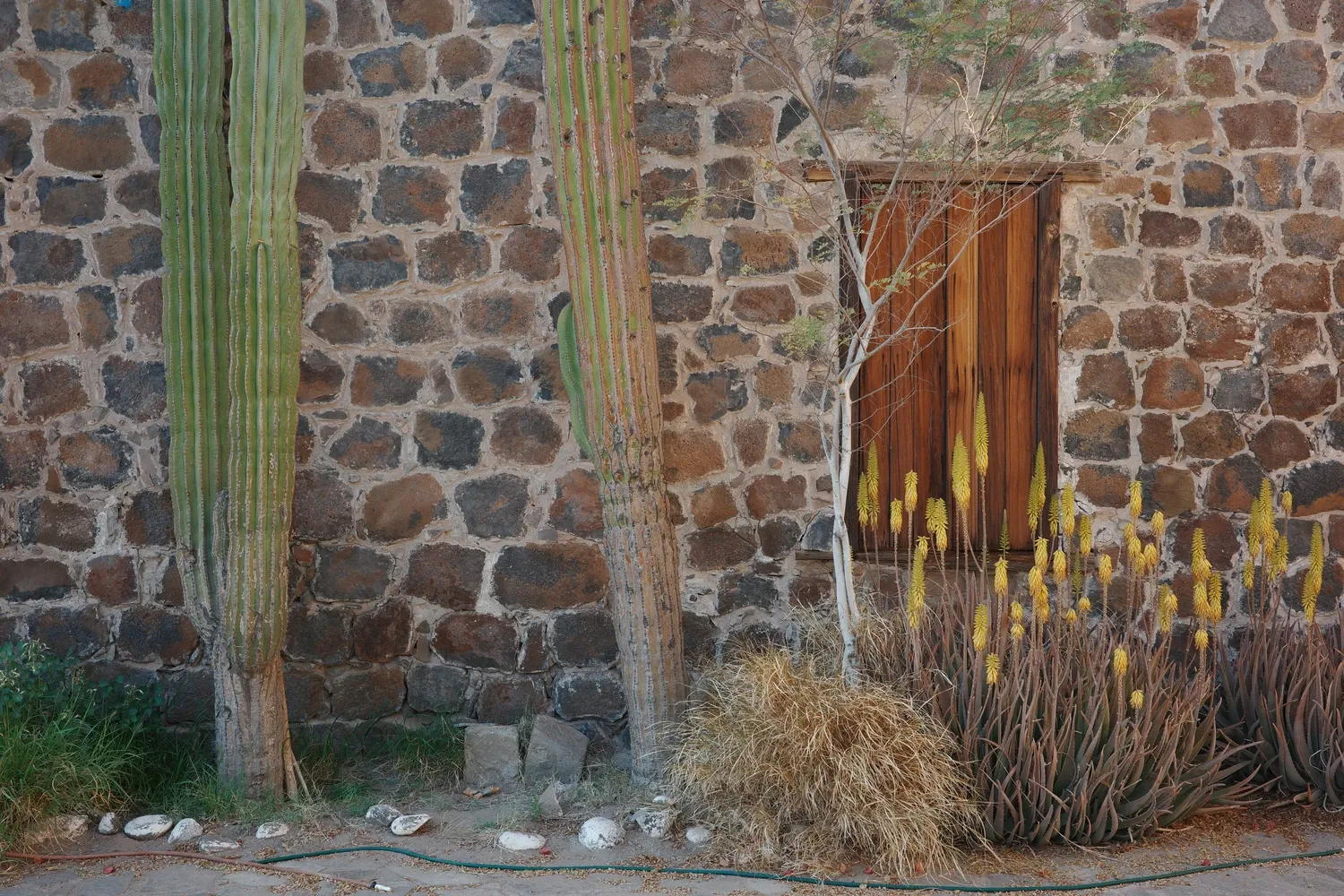
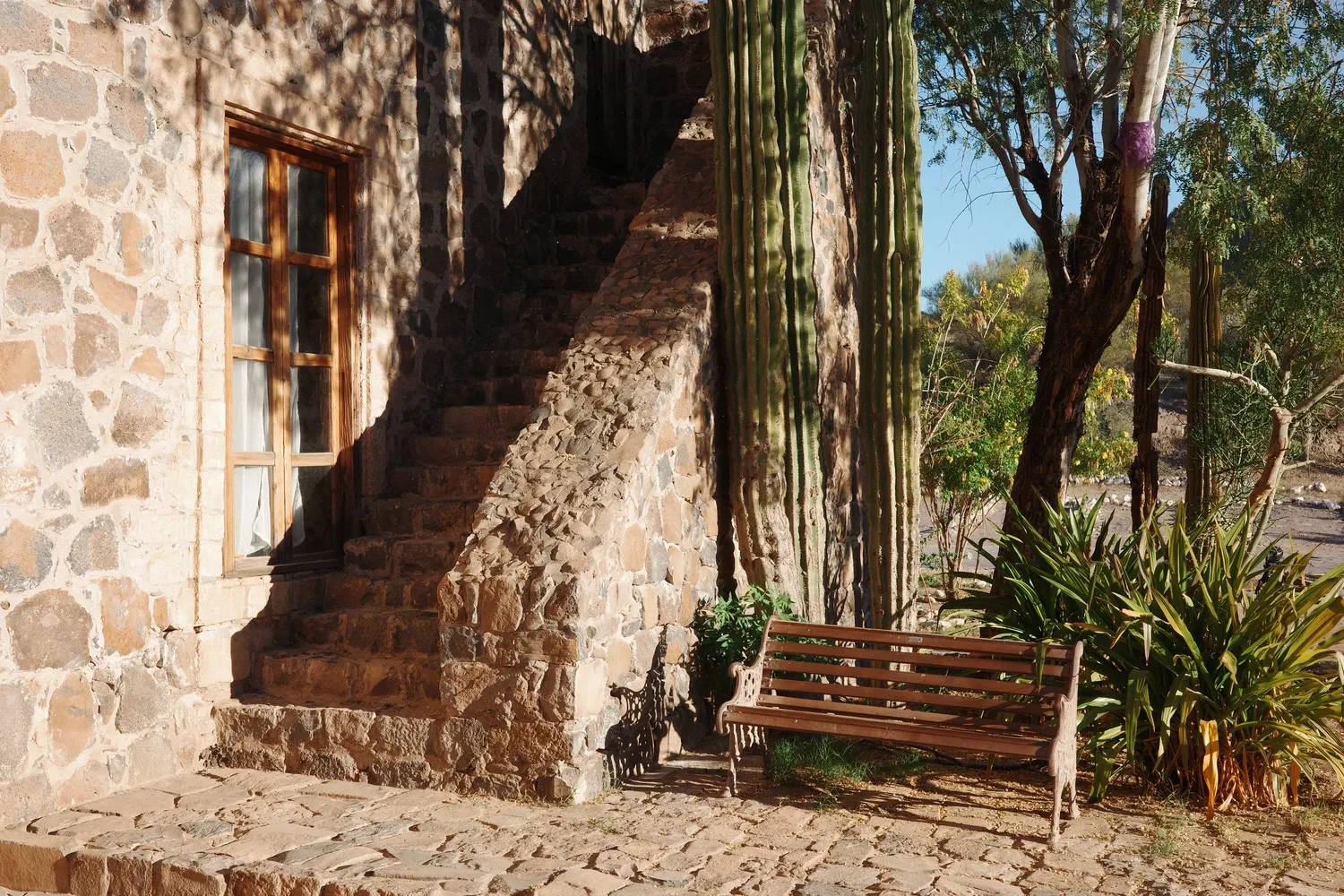
We put the bikes to work (not intensively) by riding a few miles to the coast to look at the Sombrerito Faro (lighthouse) of Mulegé. It's gated off, so we can't get close, but we have a backup plan: the beach. I sneakily change and wade in. The water is warm enough that Leah even decides to dunk herself under, which leaves me legitimately surprised. We drip dry in the sun, then ride back across town to the Rosalia Mission of Mulegé. The interior isn't open, but there is a nice garden and a sign about its history. Curiously, it was finished in 1766 but the mission was relocated only five years later.
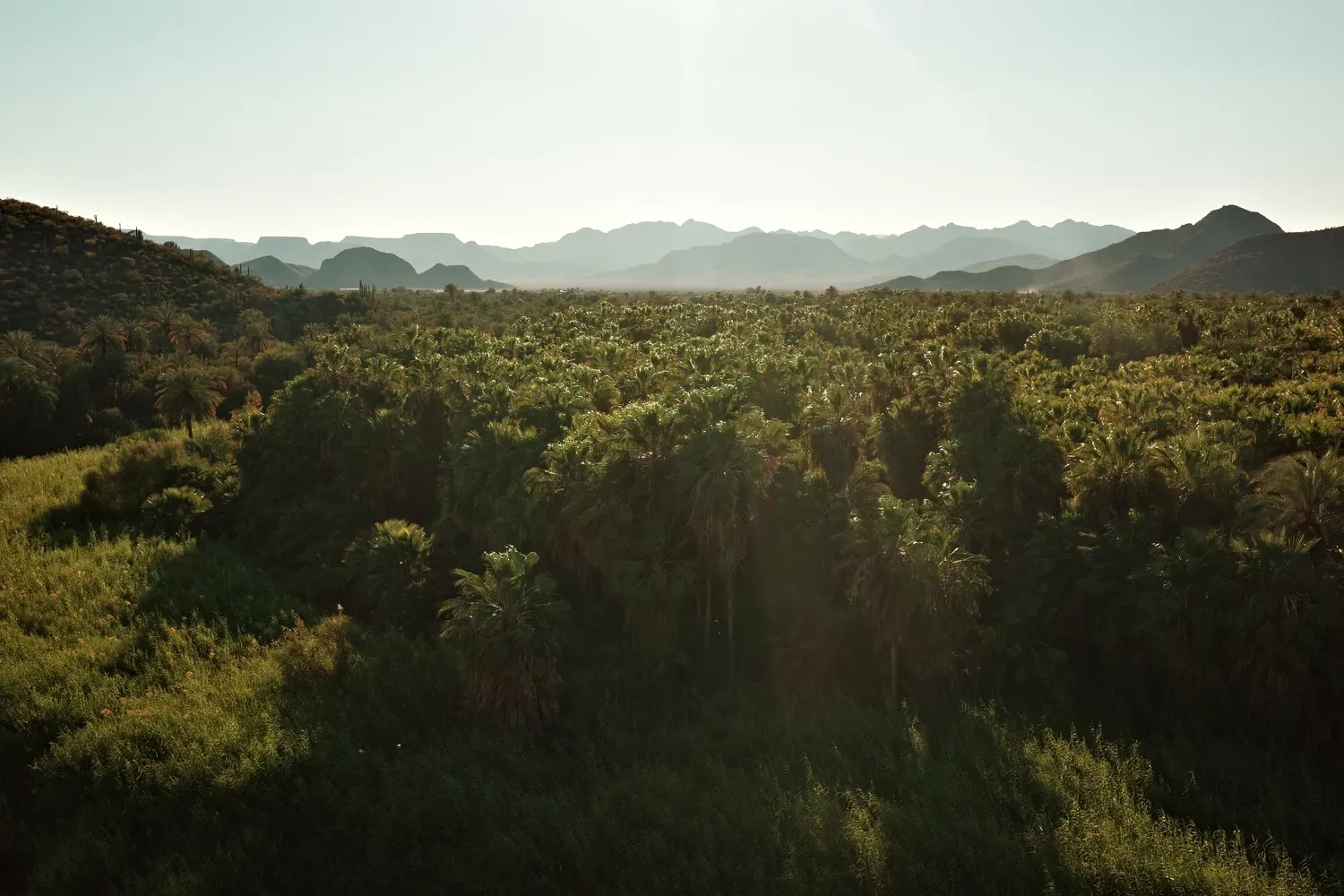
We take a short walk to a promontory (mirador) overlooking the town and the valley of palms and the river to the west. I can't get over the contrast between how lush the area looks here versus how sandy and hot our ride into the city was. The foliage shimmers in the low sun, shiny and sharp. Green palms, a bluish river, and dark green mountains fading in the distance. It looks like a jungle. We walk back to the misión and sit in the garden admiring the plants and birds. I see a Hooded Oriole (?) with beautiful yellow and orange feathers and a black mask across its face.
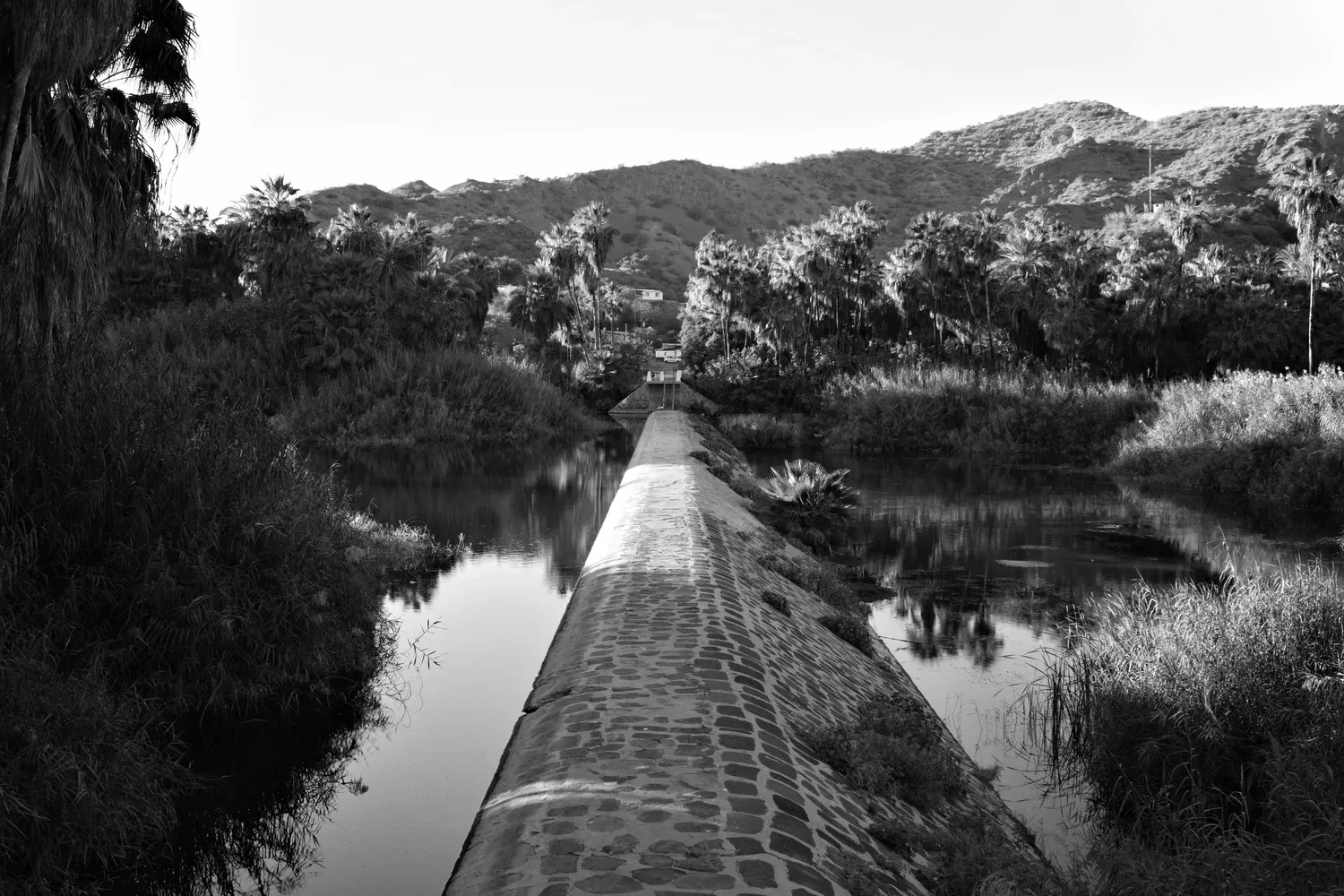
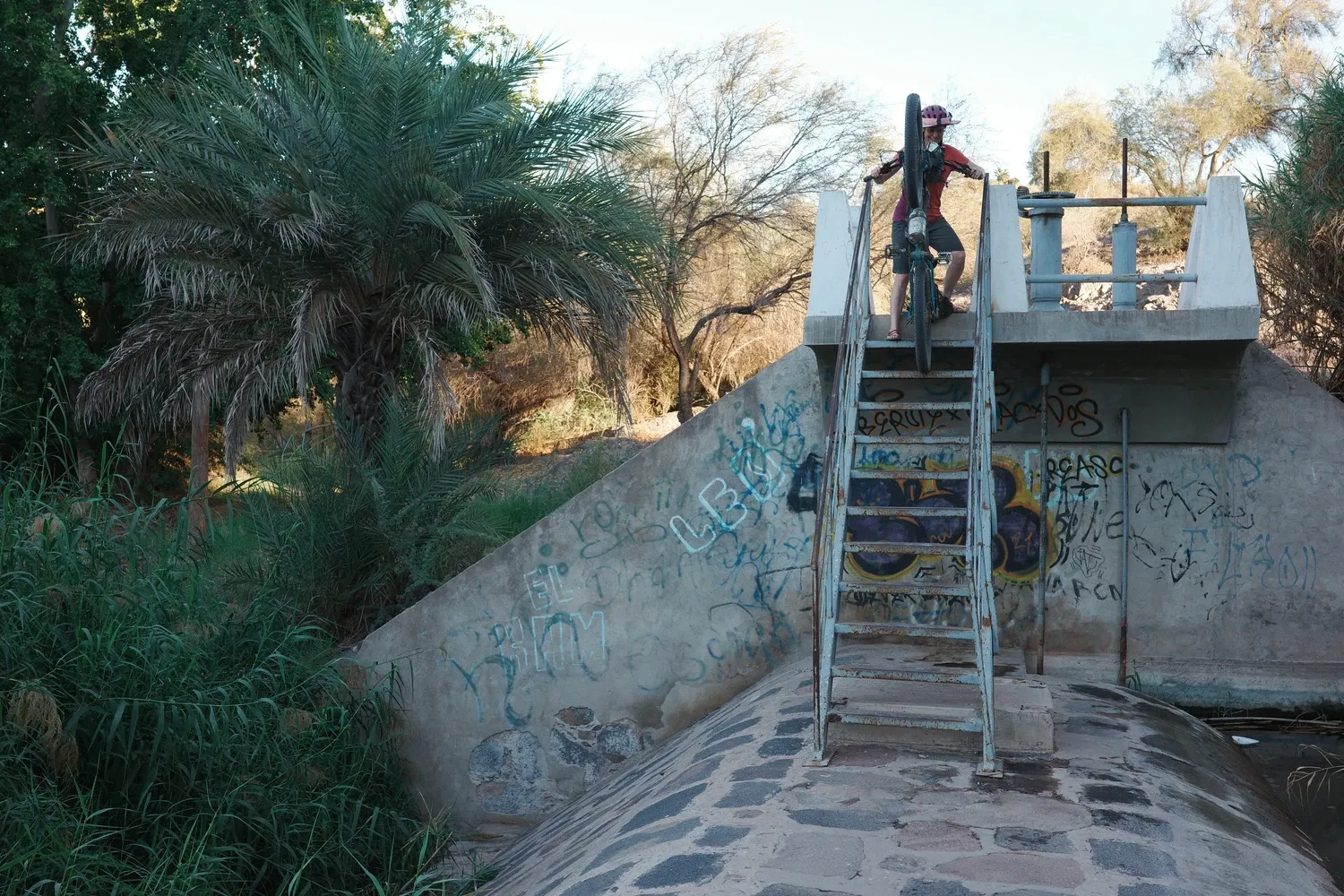
We push the bikes down some stairs and across a small dam and back up the other side, taking a shortcut to get back to the motel. We walk to get dinner (passing the telecom store with its new door), then get groceries for the next few days. None of the markets has oatmeal or granola, so we take a gamble on cream of wheat.
March 5
I didn't to read the cream of wheat package entirely and forgot it needs to be boiled (I should've remembered, it was my favorite childhood breakfast). We cold soak it for twenty minutes in the hotel room and force it down our throats, soupy and gritty.
The father of the family who runs the hotel is a fisherman and can bring us across Bahía Concepción in his boat today. Or so his wife and daughter have told us — we haven't actually seen him, since he's been fishing late hours. A little after 8 AM we meet and chat with him, and he agrees to meet us at the fishing beach in 40 minutes.
A woman selling empanadas stops by the motel and we buy two — the perfect remedy for our own yucky breakfast. We pack up and pedal up the street to the coffee stand we found yesterday. The empanada lady is here walking her daughter to kindergarten, and she asks us if we came through the mountains. She is Carmelo's daughter — he mentioned us over the phone to her, so our bikes were a giveaway. Small town.
We pedal several miles on the highway and take a side road toward the beach. Another man in a truck drives by and asks if we need a ride to Hornitos, the beach on the other side, but we tell him we already have one. We wait an hour at the beach, and two more people ask if we need ferrying to Hornitos. We're wondering if we should take them up on it when our guide finally appears. He tells us his car had a flat tire.
I lay my bike down and my clothing bag accidentally catches on the L-bracket on Leah's rack, tearing a clean right-angle rip in the fabric. My puffy jacket peeks out at us. Damn. I'll sew it later tonight or tomorrow — no time right now. We load the heavy bikes into the small boat, and I resign myself early on to getting wet shoes as part of the process. It's a quick eight mile ride across the bay. The chop of the waves makes the boat bounce up and down, and I try not to worry as I watch our bike racks sway and bend under their weight, probably not designed for this kind of off-axis torque.
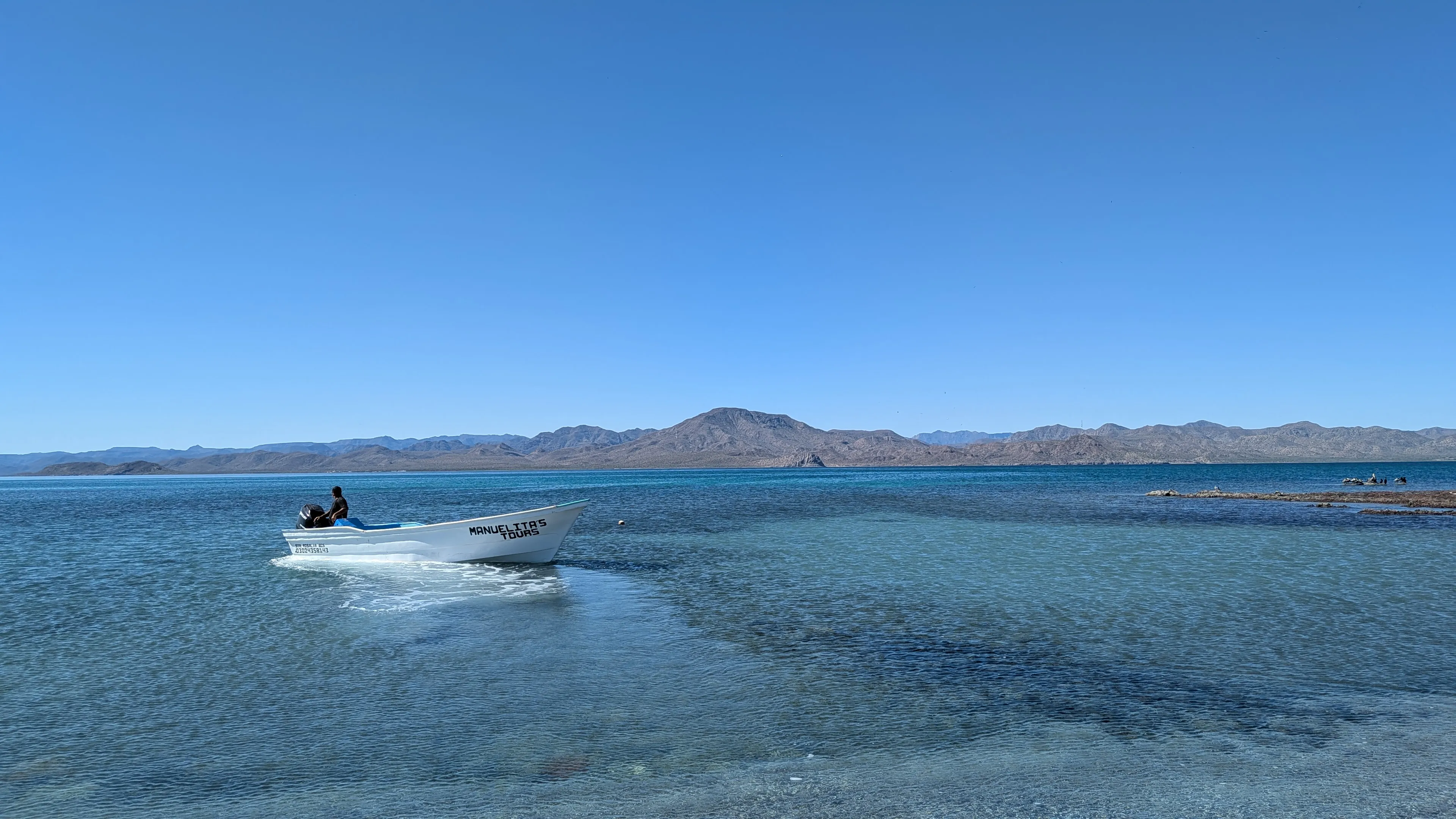
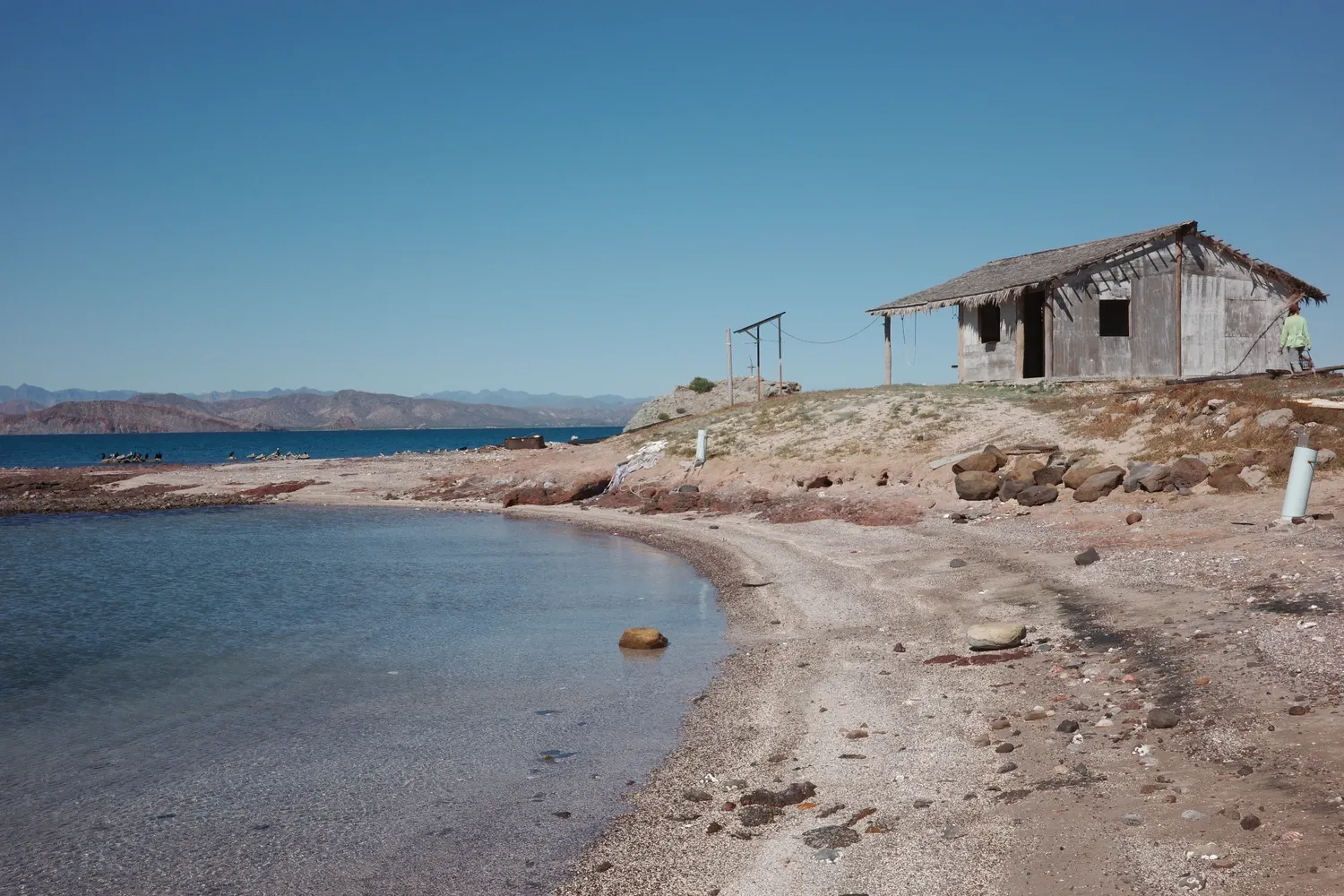
We land at a small rocky beach on the north end of the peninsula and I hop into the water to help unload the bikes. There is an empty shack here (with a solar panel, of course) and a sailboat in the next cove down, and not much else. A moment of panicked excitement strikes me as the boat pulls away. We're pretty far out here, and we've just put a giant body of water between us and civilization.
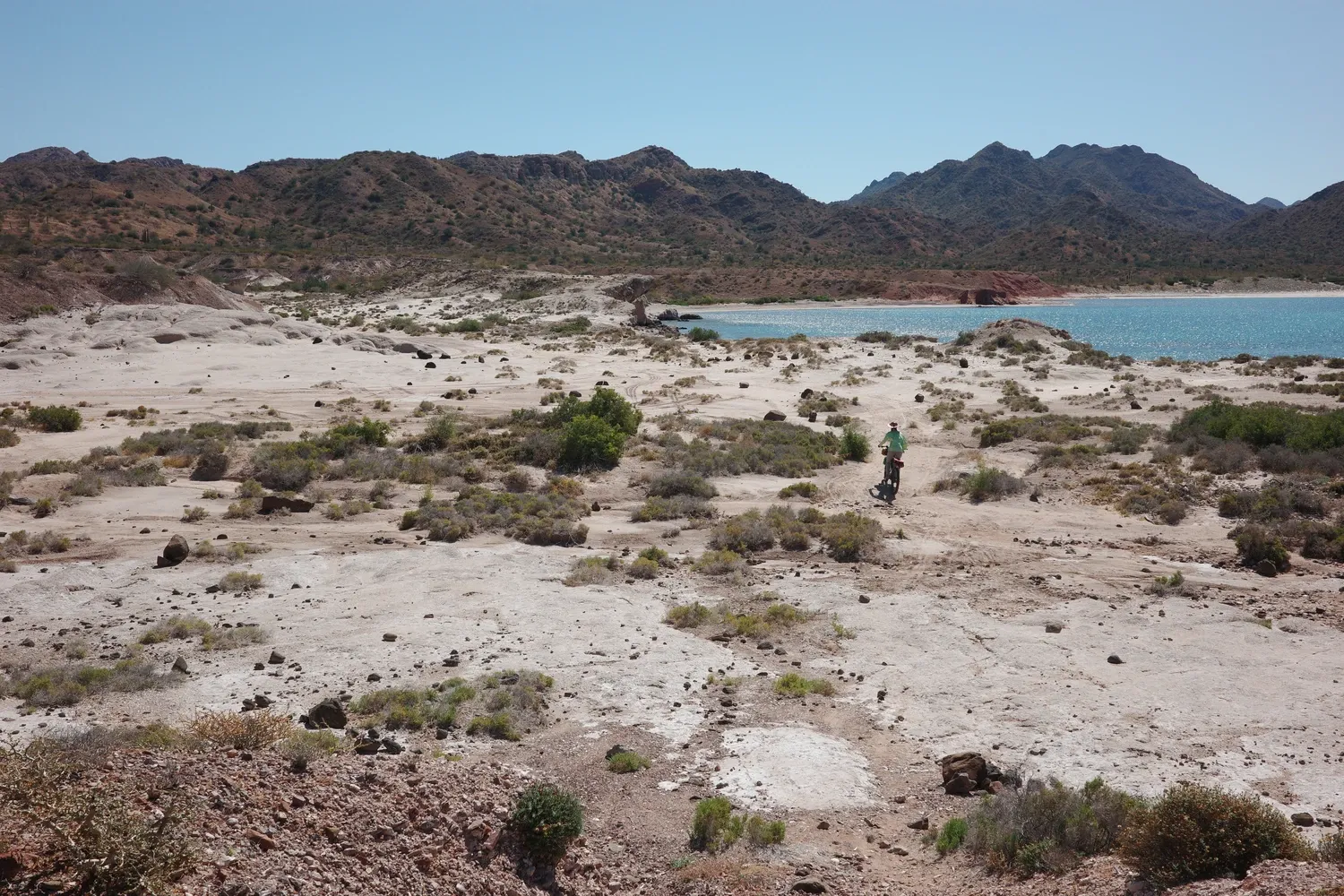
We follow a footpath that appears and disappears in the sand, bushwhacking a half mile or so before it becomes a steady trail, then widens into double track, twisting in and out of arroyos that drain into the bay. The peninsula itself is fairly mountainous, and I'm thankful we're creeping along the very edge of it and not venturing farther inland. The air is warm but a nice breeze carries off the water, which we ride next to for most of the day. The road improves bit by bit as we head south — sometimes sandy or rocky but mostly better than expected given our remoteness. My bike is loaded down with 16 liters of water, though, so I try to enjoy the silly factor and dampened steering. A few sandy patches nearly take me down.
The mountains, cacti, rocky beaches, and bright blue water unfurl in front of us all day — the contrast of desert and ocean never more obvious. The opposite side of the bay is a thin white strip of beach, intermittently visible through the haze as we ride parallel to it from a distance.
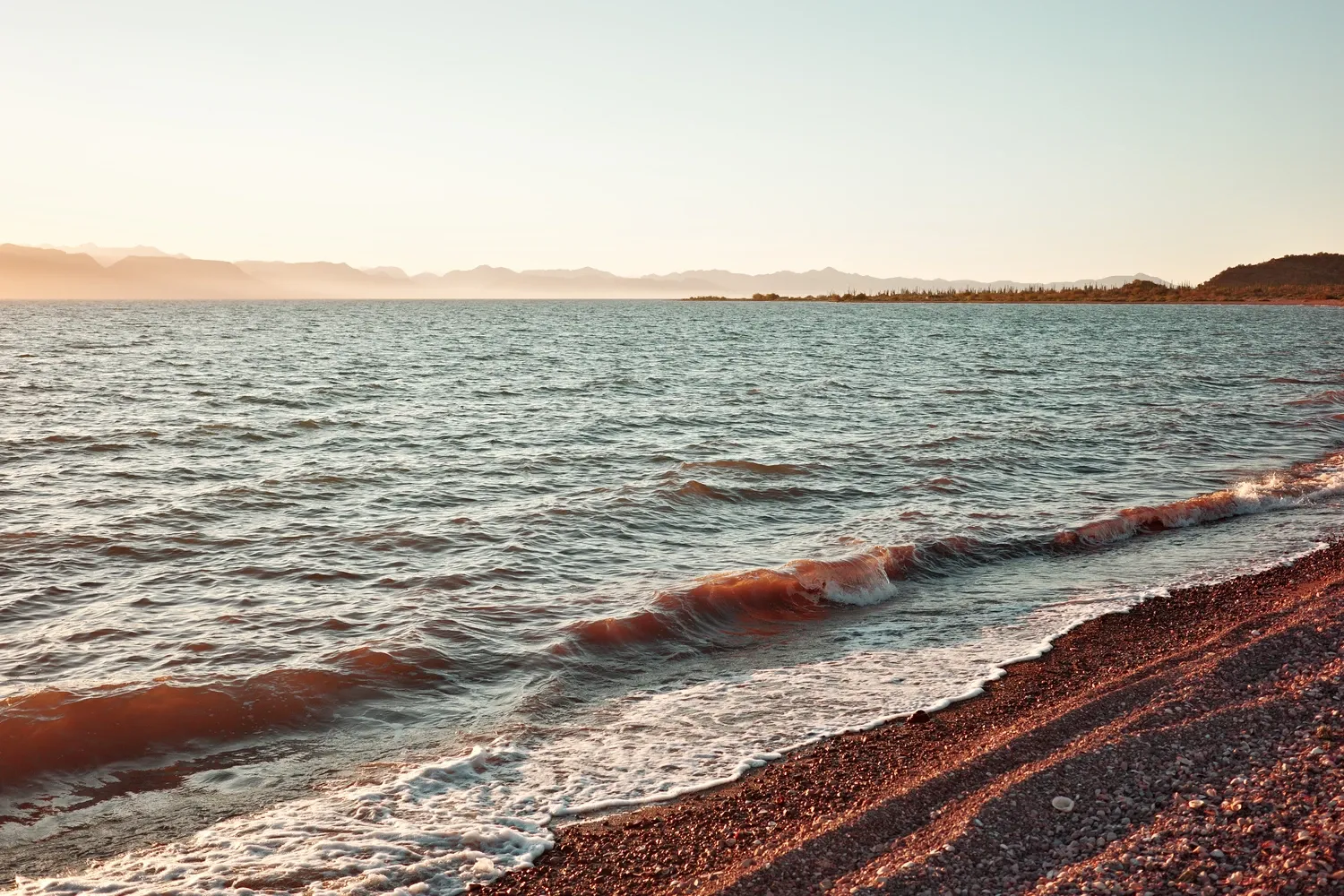
Our shortened day of riding is uneventful but pleasant. Remote but beautiful and relatively easy compared to previous days - cooler, smoother, and with almost zero climbing. We set up camp early, wanting to sleep by the ocean before the trail cuts inland toward San Sebastián at the end of the peninsula.
Two cows slink by our camp in the dark, munching and clomping through the shrubs, giving us a momentary scare.
March 6
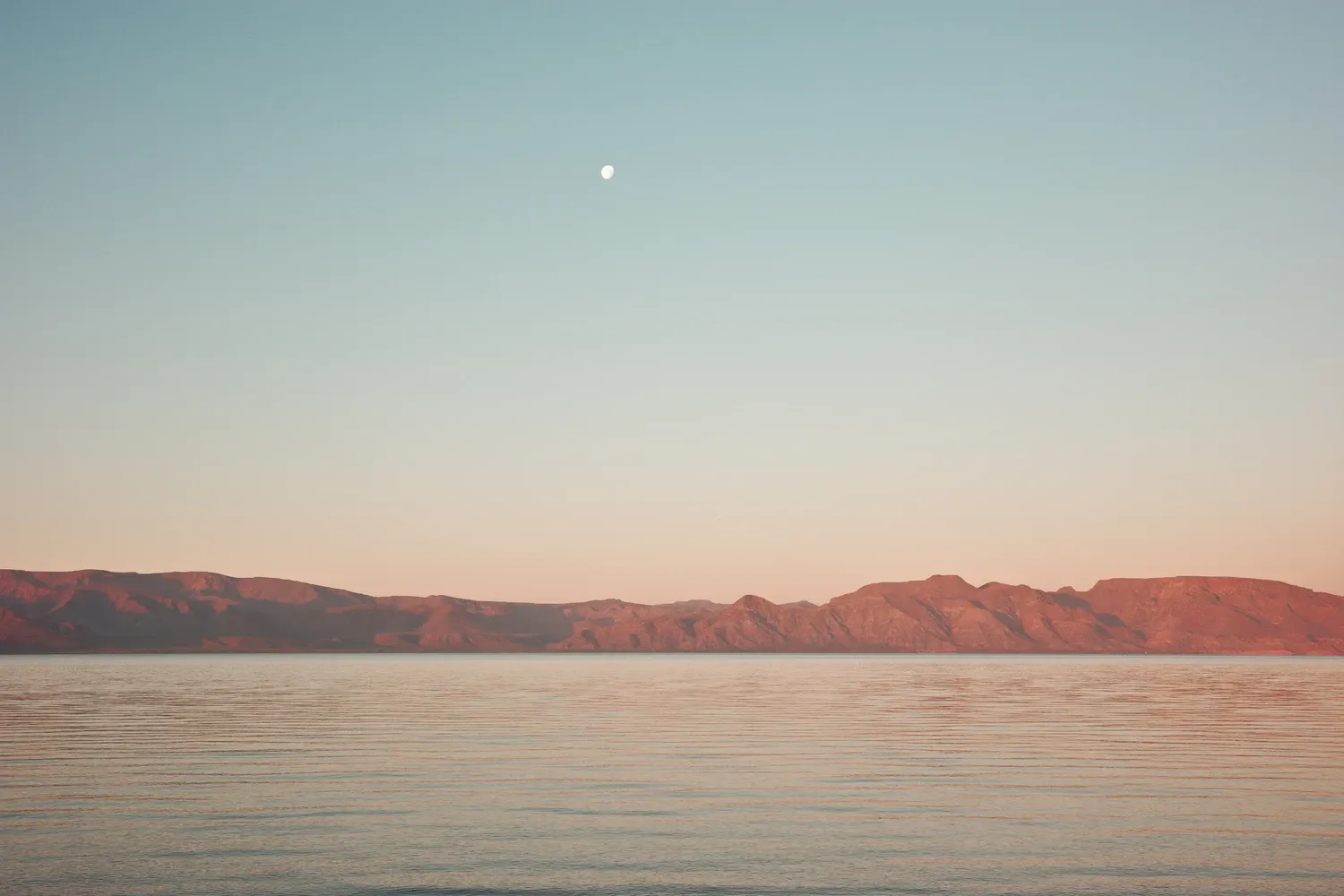
I take some time in the morning to sew my clothing stuff sack with floss, and photograph the bay in the morning light, so we don't start pedaling until maybe 8 AM. The road is twisty and scenic as it turns in from the end of the bay and cuts across the peninsula. The interior is now, thankfully, only low rolling hills instead of mountains. We gain elevation slowly on a road that's in decent shape.
Toward the other side of the peninsula we pass three groups of people in ATV side-by-sides, all Americans, presumably residents of San Sebastián. They are friendly, seemingly giddy about wherever they are going on their own dirt road adventures. One more zooms around the corner, slows down for us briefly, then tears off in a cloud of dust and small rocks. Meh.
Our route forks off and immediately becomes a rocky, narrow, hike-a-bike. Leah somehow glides up it — I'm not sure what's gotten into her, but today she makes even the hardest climbs look trivial. At the top we get a view of the coastline to the south, full of rugged cliffs. There is a funny huge rock formation far off that looks like a hat. The sign at San Nicolás suggests it might be Península El Púlpito (?)
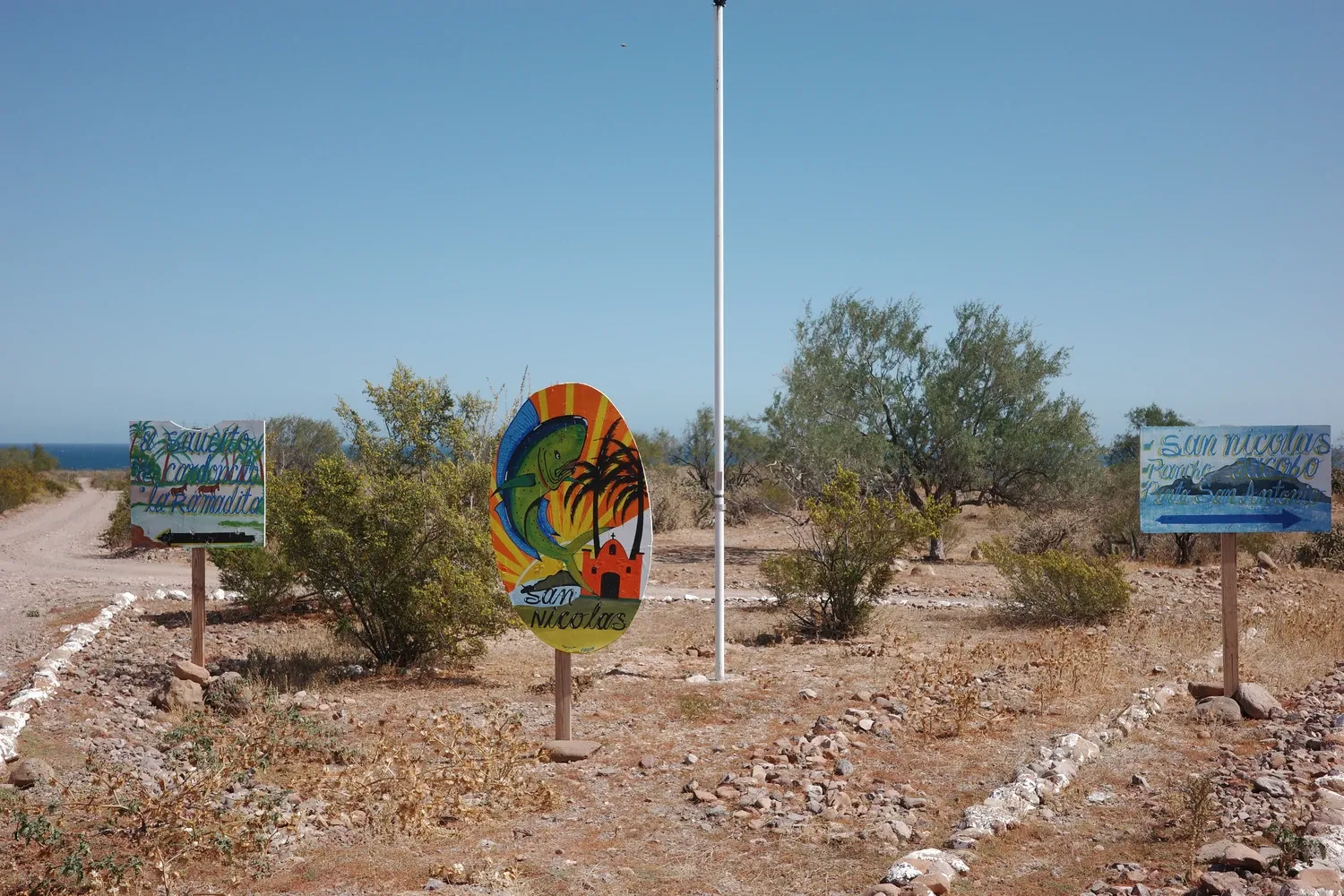
After a series of chunky down-and-up arroyo crossings, we pass through a fish camp and the road improves for the last four miles into San Nicolás. I startle a huge white egret that flaps across the road right in front of me. We ride into town, which is a small sprinkling of houses situated on dust and sand, among huge palm trees. We ask directions to a store, and they point us to the side of the house where a small government tiendita (Bienestar) is. It only has three shelves, but we easily find enough to get us to Carumbuche tomorrow.
The hills get larger, with long winding approaches and small ups and downs breaking up the climbs and descents. The road is pretty smooth and the scenery is interesting. From one high point we can see both Bahía Concepción to the northwest and the Sea of Cortez to the east.
We're about 45 minutes from Rosarito and I want to take a snack break, but Leah vetoes it and I get salty, and we ride most of the way in silence. We arrive at the highway and meet two cyclists heading south: Mark and Rick. They are riding the section from Mulegé to Loreto and met one another last year on a different part of the route. They continue on, while we lament the fact that the truck stop restaurant/snack store in Rosarito has been destroyed in a flood.
We sit on a crumbling log by the highway, across from the abandoned thatched hut building that used to be the restaurant, surrounded by trash, and make our lunch burritos. We refill water from the small creek draining out of a pond and under the highway, which the cows fled from when we first arrived. Chemical filtration drops for sure.
We load up and ride toward Carumbuche. My front tire feels heavy and squirrelly under the water weight, which is becoming a familiar feeling. Also, our own trash pile is accumulating, as many small towns don't have public trash bins, and I can't bring myself to throw it on the side of the road or in a pile like everyone else (even if it's the unofficial solution).
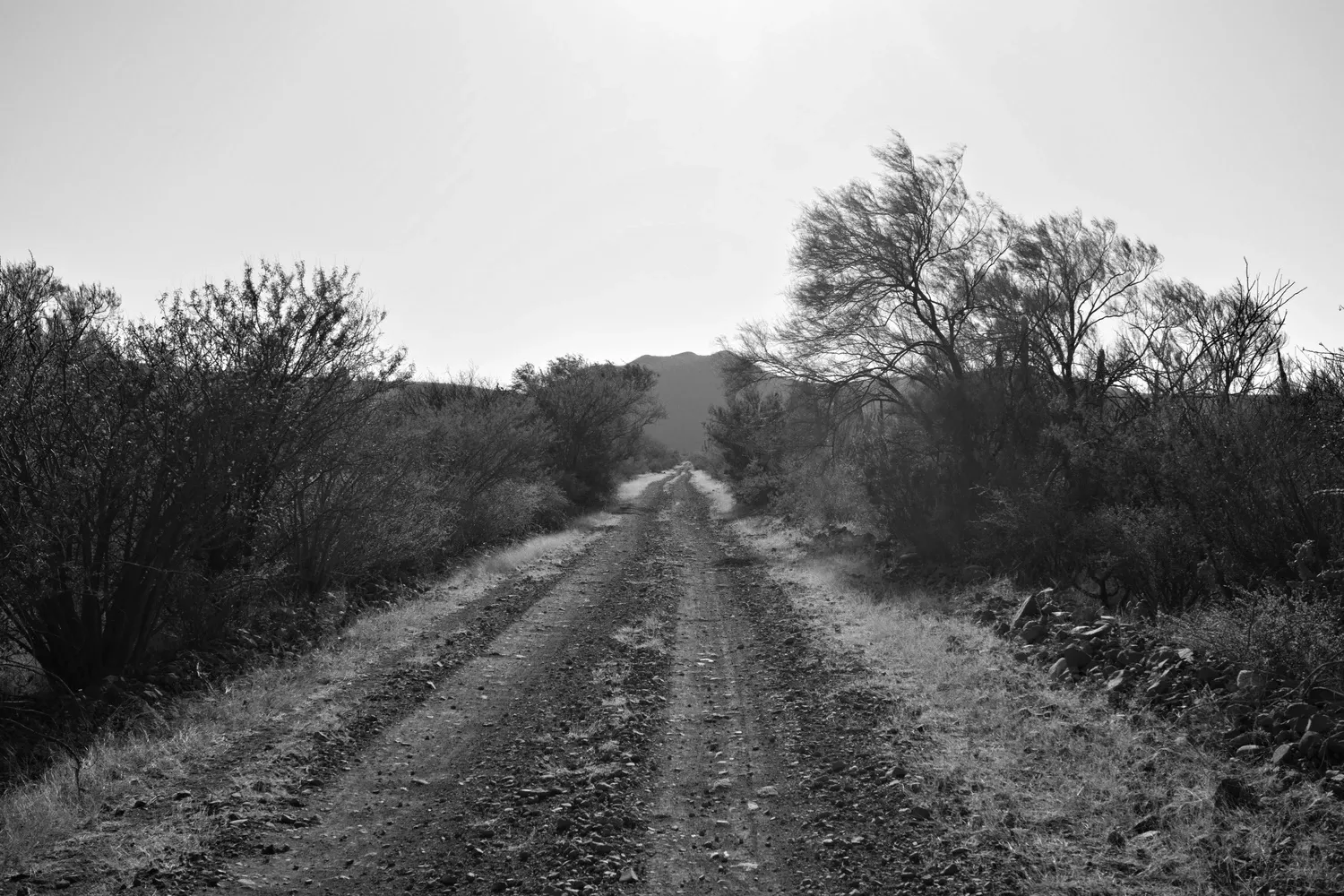
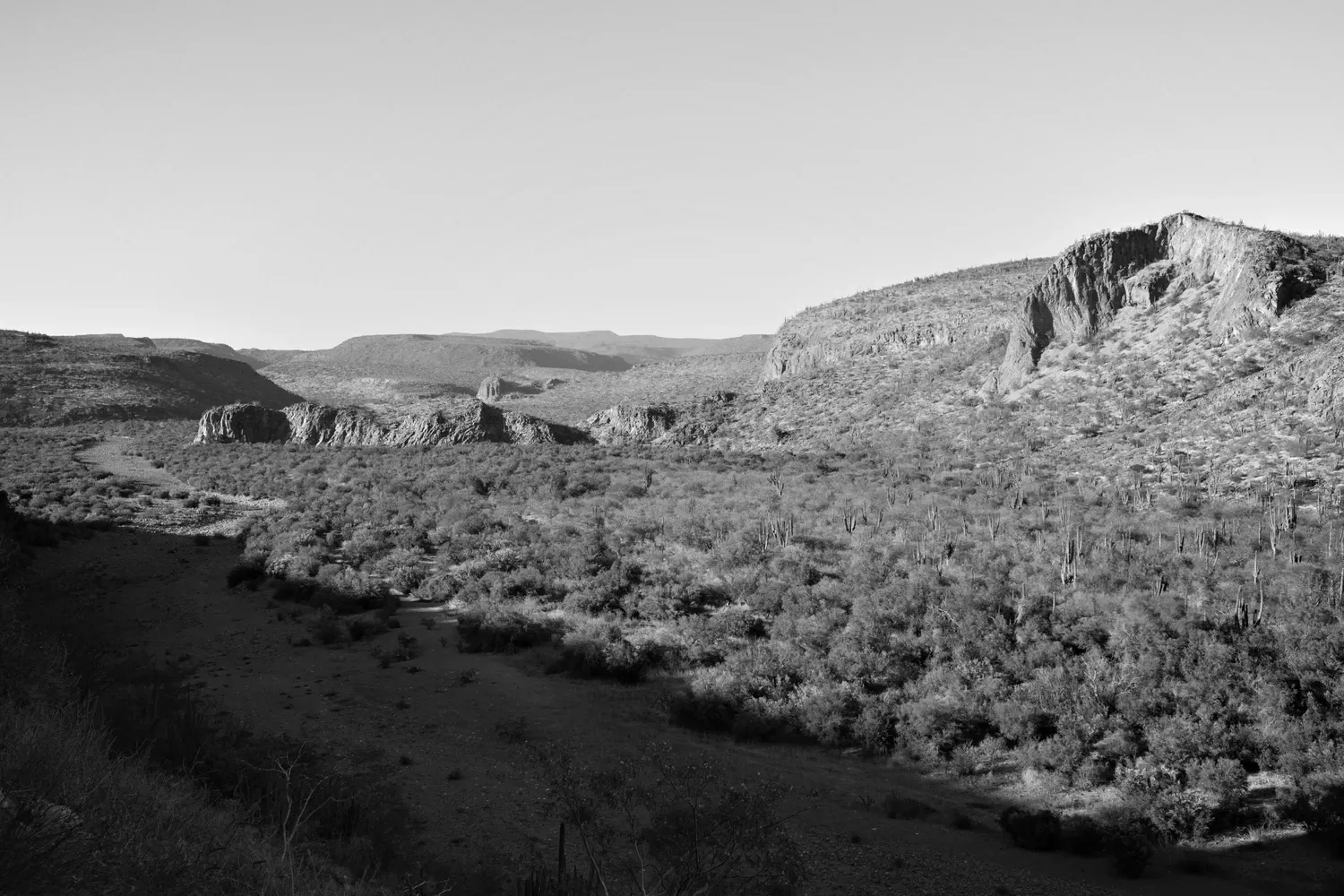
The road is a straight shot for several miles that goes quickly. Soon we start climbing and the hills become small mountains until we cross a small pass. On the other side is a huge valley split by an arroyo, carpeted with cardónes. It's quite dramatic in the late afternoon light, and we stop for pictures.
Leah calls out to me about a snake on the side of the road, which I of course didn't notice. Then another one. Clearly I am not looking at the road very well. We stop and settle for a rocky but flattish camp spot on the valley floor, dense with underbrush. We marvel at the zillionth clear night sky in a row, and at how tired we both are, and head to bed early.
March 7
I wake up tired and thirsty. It feels like I could sleep for another half day. Borderline head cold. It's chilly this morning, and while I'm thankful for the cooling weather, it makes it harder to leave my sleeping bag.
We take our time breaking camp, with none of the usual pressure of a hot day looming. No sooner do we ride a hundred yards than we pass Mark and Rick at their campsite. It's much flatter and less rocky than ours. We stopped too early. We chat about tires, the route (they're heading to the coast to skip the climb to San José de Comondú), Loreto recommendations, and birds. Rick plays the song of the poorwill and shows photos, which I find fascinating. He also explains the "whooshing" song of Costa's hummingbird, which has a vivid purple coloring on its head. Now that I know what to listen for, I start noticing the call constantly throughout the day.
We pass our (approximately) 1000th mile of riding and celebrate with a selfie and the last two of Leah's cookies. A bit later, we pass a couple in an old blue Ford van going the other way. They skip any greeting and launch straight into a dramatic retelling of their drive from... I don't even know where. They talk loudly, over me and over each other, and very little is actually communicated other than that they thought the roads were hellish, the towns are empty, and we shouldn't continue that way. I finally reassure them we'll be okay, manage to pry myself out of their rant, and we continue.
The remaining twenty miles to Carumbuche are pretty fine. Some bumpy and steep sections, a few ups and downs, but nothing too notable. We eat lunch near some goats, and a few trucks of friendly local farmers pass by.
I'm having a hard time mentally and physically because of my tiredness, and I'm starting to get nervous that the road will be awful and we'll run out of food or water if there isn't a good resupply, like there was supposed to be at El Rosarito. Leah is patient and helpful and supportive, and I'm in a slightly better mood — though still with a lingering headache — when we arrive at an epic viewpoint overlooking Carumbuche. The huge arroyo splits the town and the palm trees on one side from cliffs and rows of mountain ridges in the distance. It's stunning.
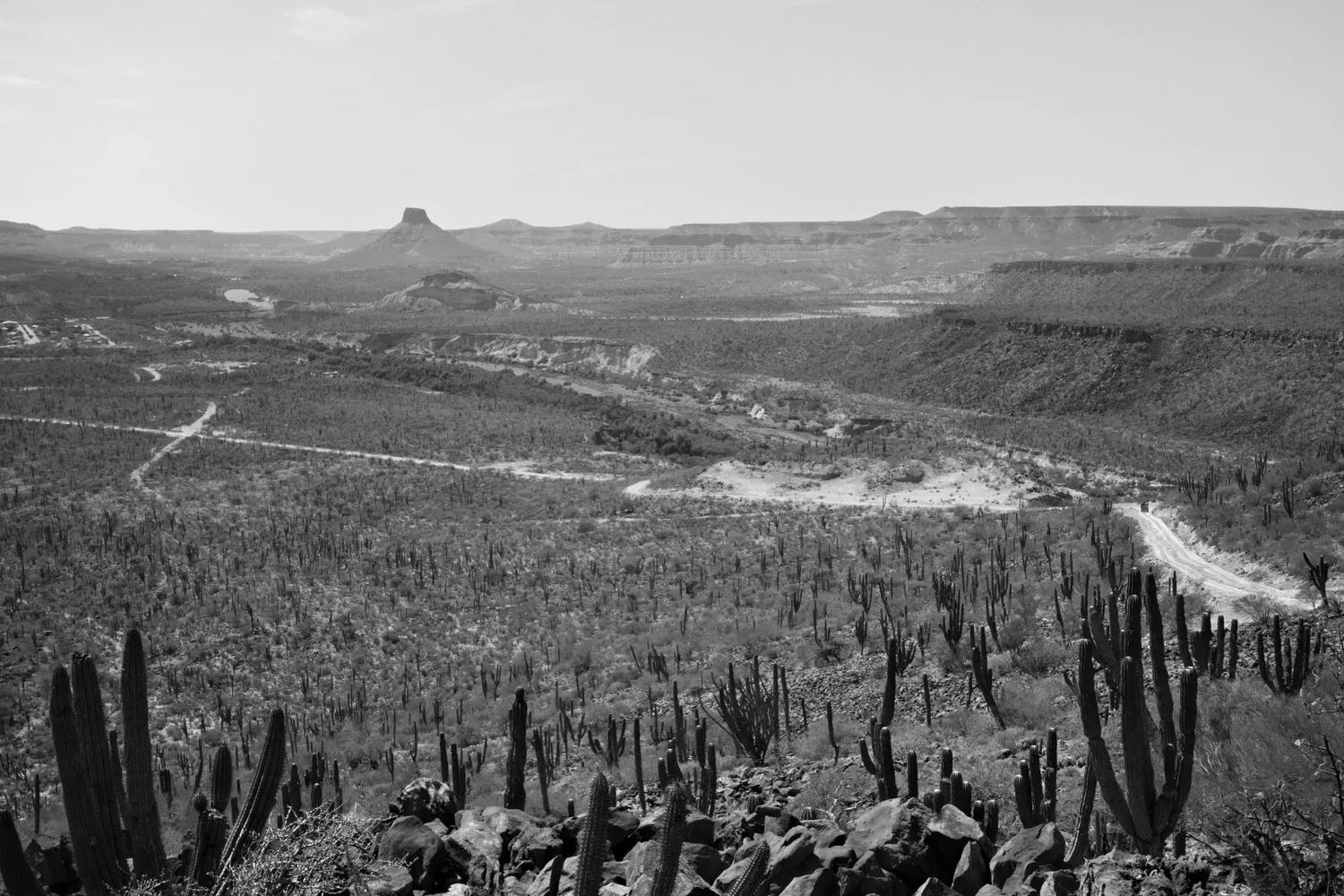
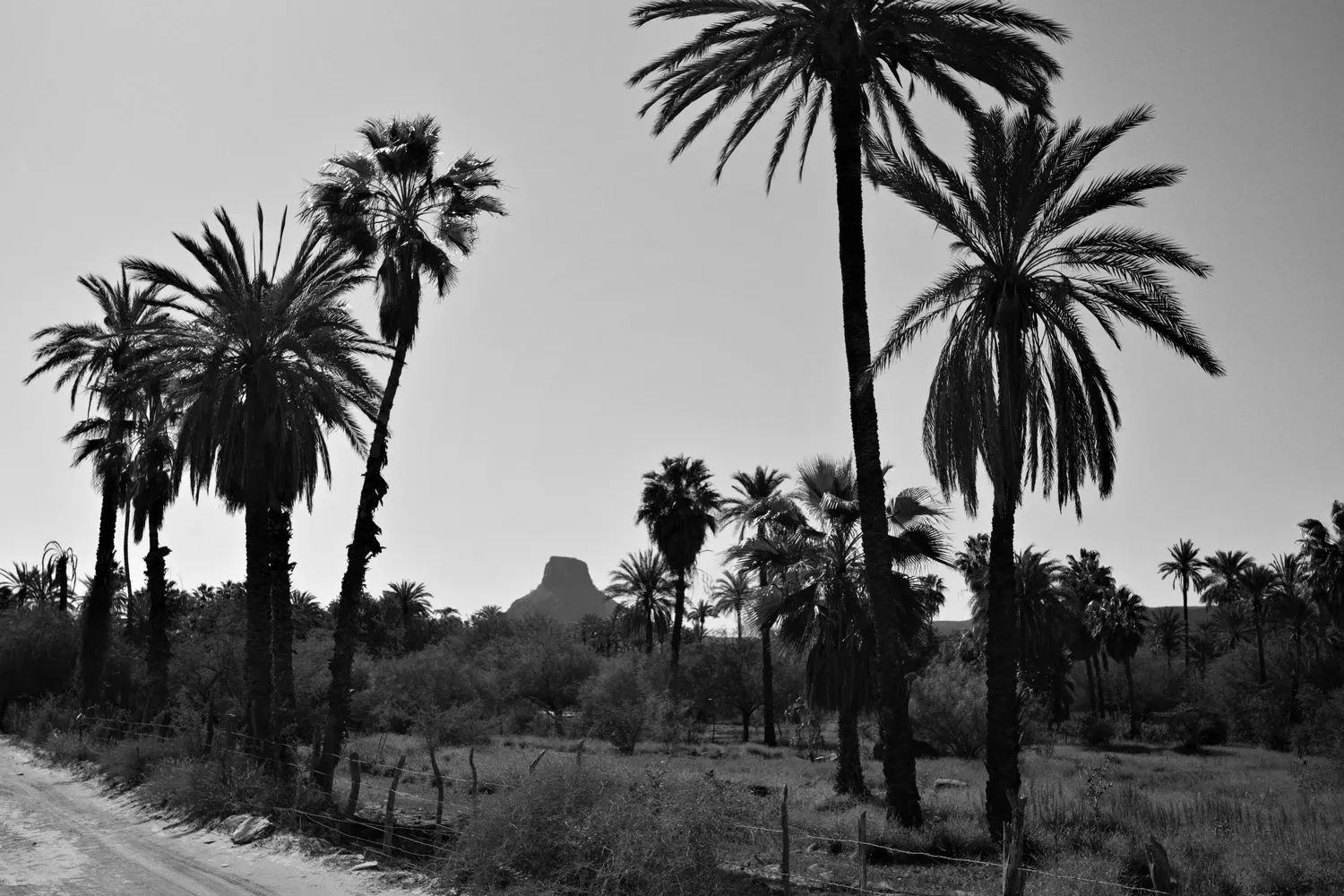
We drop hundreds of feet in under a mile, and roam the empty streets of Carumbuche. The two stores are closed - one permanently, the other just for the weekend (I didn't even know it was Saturday, I've lost track of time). So we continue down a spur road off our route to San Isidro. Luckily, it's a quaint and populated town with several paved roads, a cute park, and a few stores. We easily get food for the next day and a half. The ride in and out is a beautiful straight road lined with huge palms, small houses, and lush backyard farms. We fill water at a small aqueduct/acequia running alongside the road, since there's no purified water dispenser in town.
Finally back on the route, we climb out of town in the late afternoon sun. The view leaving is just as spectacular as entering, and after a few miles of good progress (at least with regards to elevation), we wander off the road to find a campsite among extremely rocky terrain. We watch sunset and listen to a shepherd bring goats home for the day, his calls and commands mixing with periodic song and the clank of their bells. We climb a small rocky outcropping and spot the line of goats in the distance before they disappear.
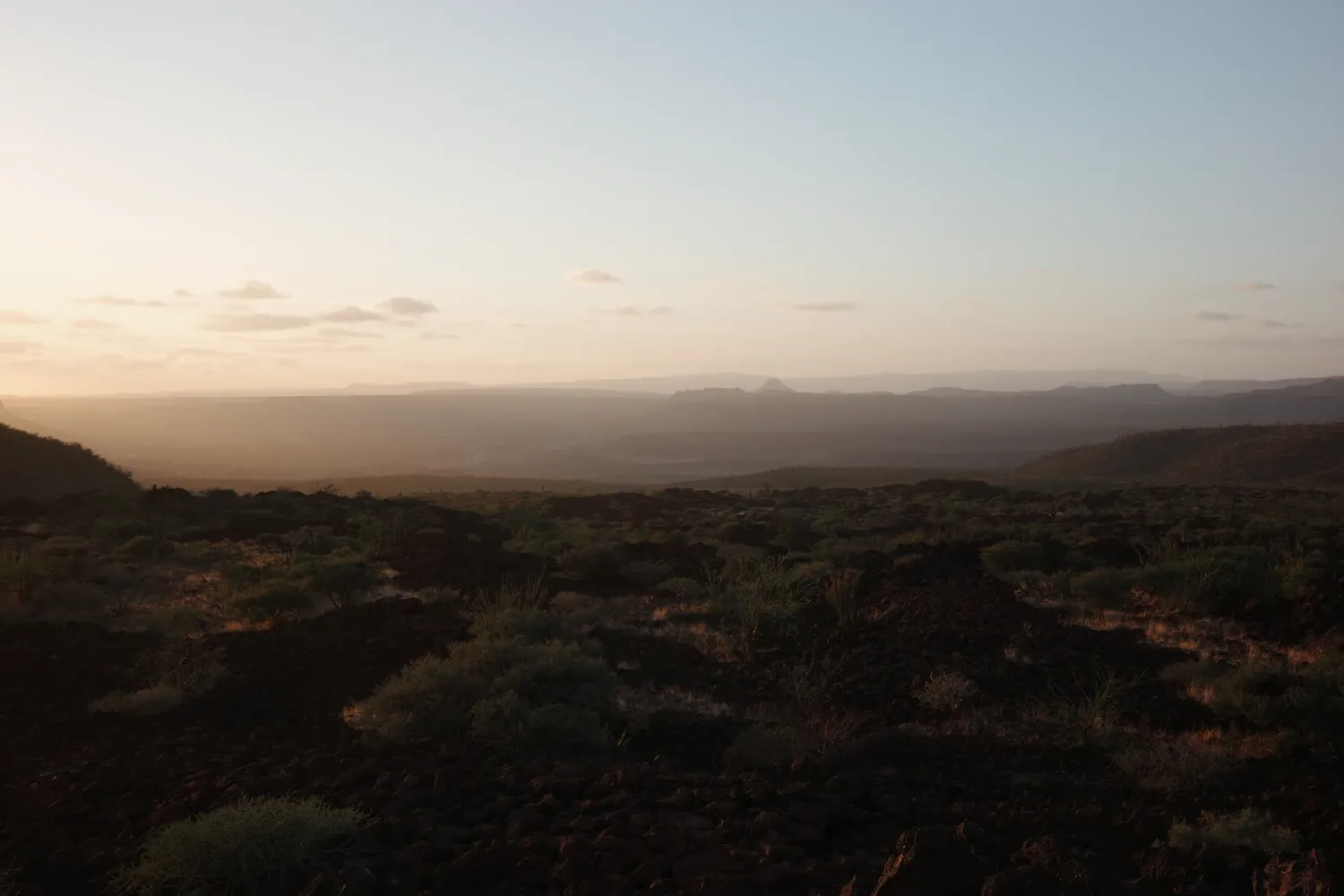
The landscape fades as the sun sets and layers of ridges, mesas, and mountains overlapping into the distance. Dinner is molé, two packs of ramen, zucchini and beans, served with totopos, and it is way better than it sounds.
March 8
We sleep in until 6:40 and breakfast on cold soaked oats (note: instant oats get too mushy if you cold soak them overnight, regular ones work fine). I'm feeling more energized and alert today; a decent long sleep and a good dinner must have helped.
We pedal past a small house not far up the road, with baby goats on both sides of the road. A man waves from the yard, smoking a cigarette. Maybe he is our goat herder from yesterday evening.
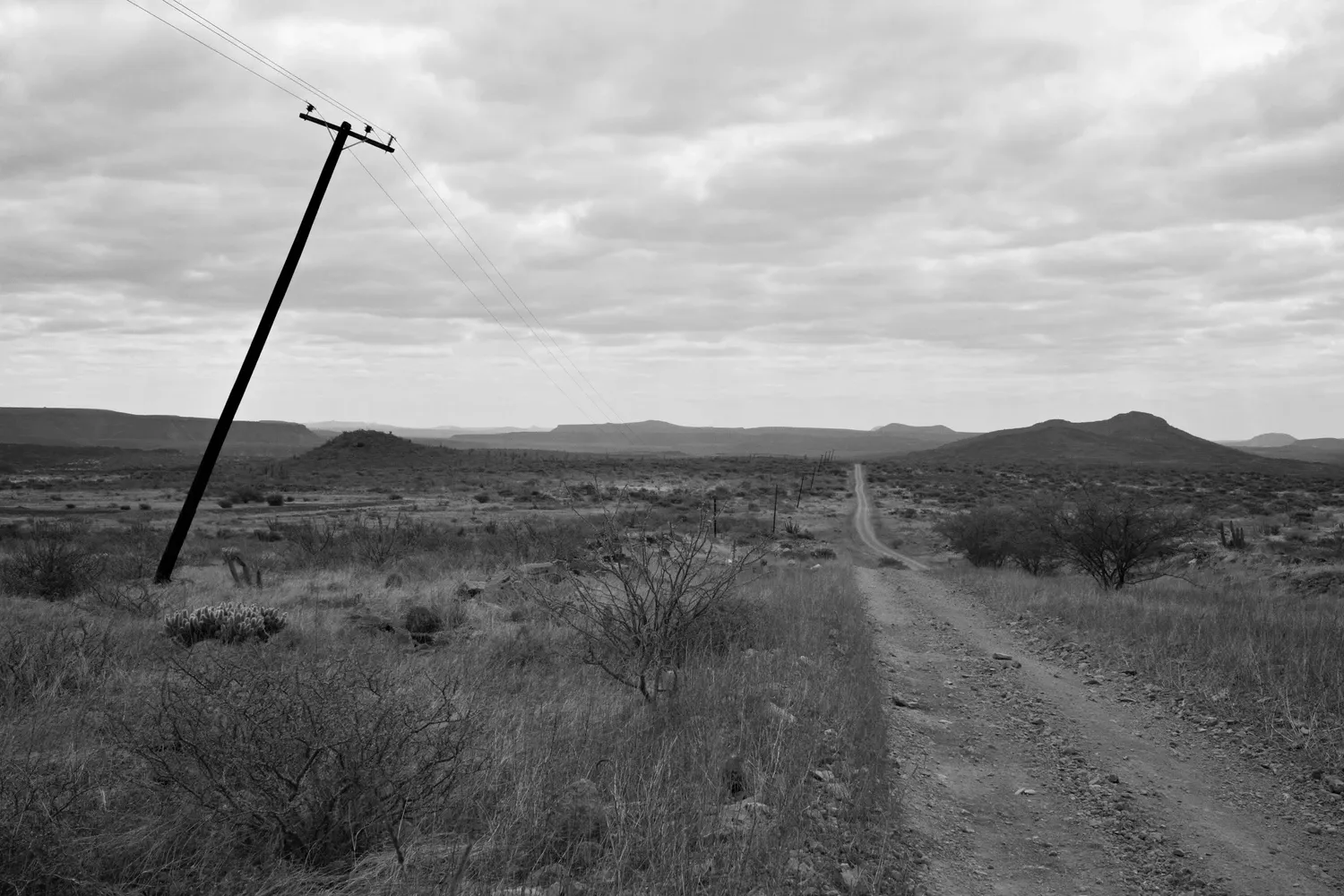
We finish a long climb toward San José de Comondú. There is definitely some hike-a-bike and Jeep-road-ish terrain, but not much. Overall it's a pleasant surprise from what we were expecting. Larry and Mark and Rick all decided to detour or skip this section. Perhaps the roads have been in worse shape in past years. The landscape is increasingly dramatic, with deep wide valleys and small distant mountains and mesas in every direction. The weather today is partly cloudy and breezy, probably the coolest it's been in weeks, and it feels wonderful.
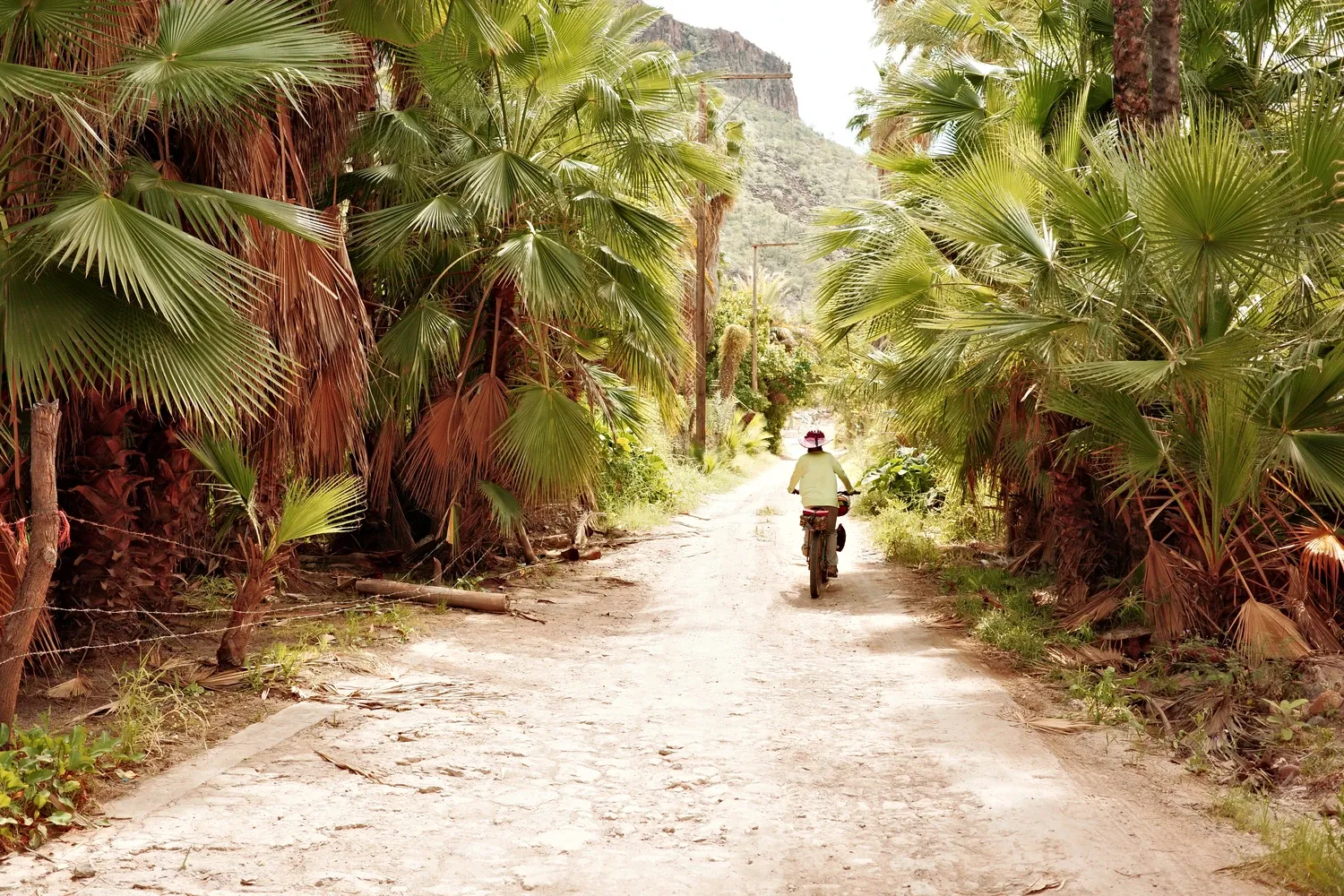
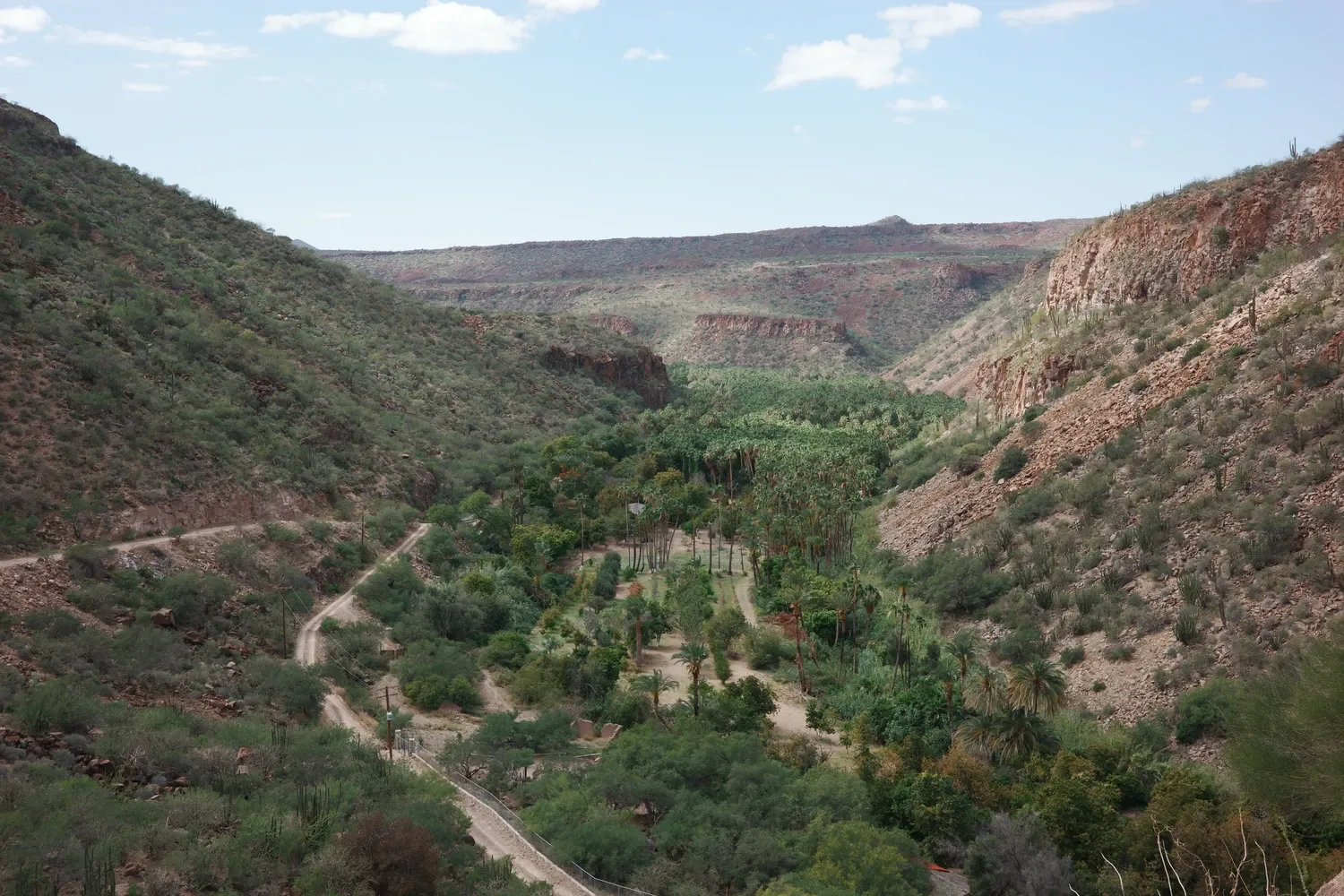
The downhill is rolling and chunky, so it never feels like a true descent until the end, when we plummet into the oasis mission town of San José de Comondú. Town is cute but small, with a single paved street. It's Sunday, so things are pretty dead, and we feel lucky to find a small store open. We make do with the very limited selection, and stop for lunch at a restaurant down the road, which also sells pan dulce, to go. We buy a dinner-plate sized disc of it for breakfast. I'm not sure what flavor it is — I think the sign said dátil (dates).
We check out the mission. All that remains is a small building that was likely housing for the pastors, now functioning as a church. Despite being the largest mission in Baja at the time, the original mission was destroyed in order to repurpose its materials for private residences and a school. Interesting. We get water from a public tap at a playground next to the mission. The playground is old and falling apart, but everything is painted a different solid vivid color. Blue swings, orange monkey bars, purple teeter-totter, green slide.
The climb out of San José de Comondú is narrow, rocky, and steep. Maybe this is why those other riders skipped it. Soon we pass a house with a Caterpillar bulldozer parked in the yard. An auspicious sign for the upcoming road conditions? After three miles it levels a bit and becomes more rideable, but it still demands attention most of the way. We drop into a beautiful valley and immediately start up a huge climb, zigzagging steeply up the side of a mesa. It's a tough, sweaty way to end the day, but the views of the valley as the sun sinks are some of my favorite of the entire trip. I snap photos in between walking my bike up the hill and running back down to get Leah's.
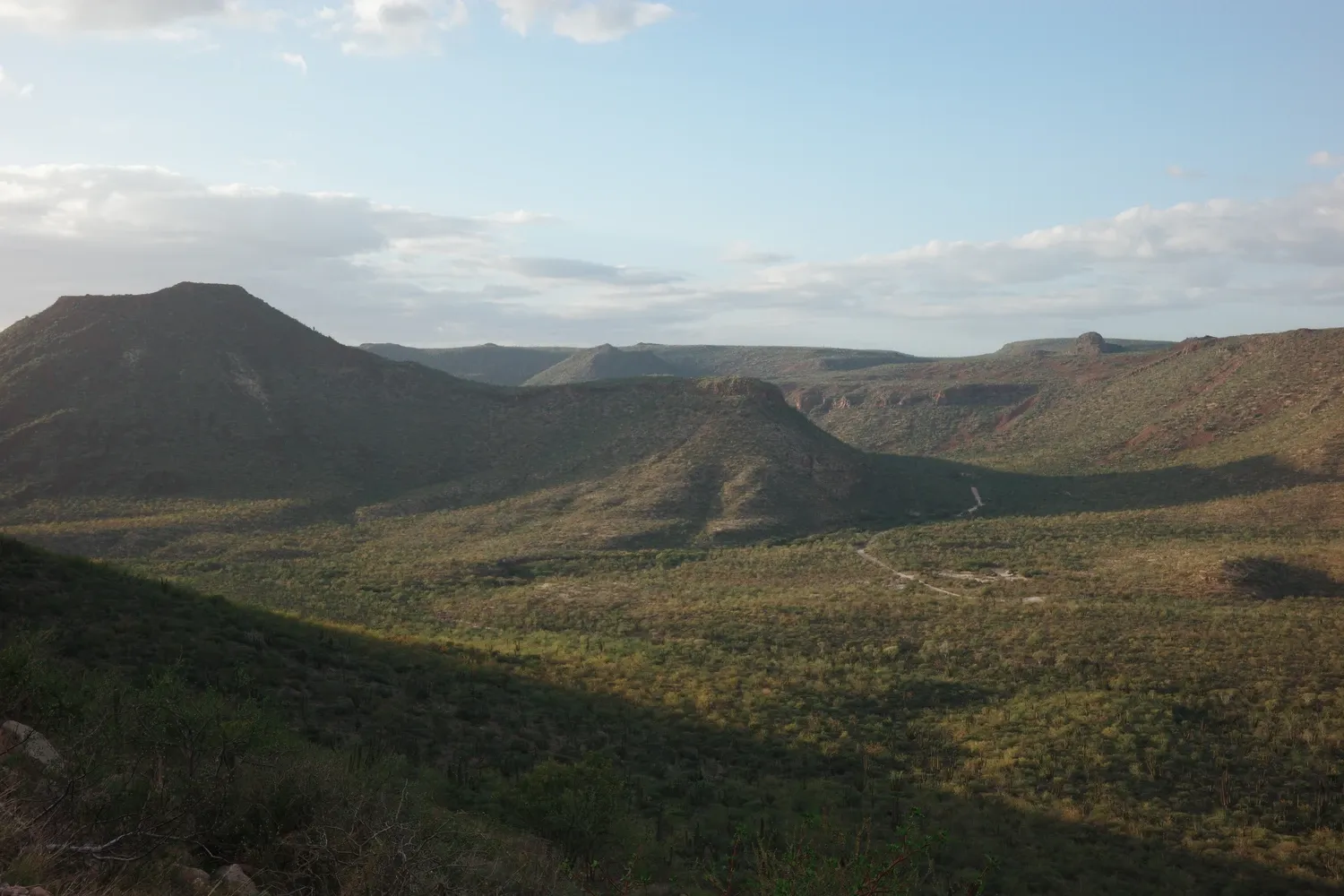
At the top we hustle to find a campsite in the rocky, overgrown landscape. We see a small rocky patch we could clear, but it is home to at least one tarantula and I think we can do better. We don't really, it turns out. We set up down the road in a rocky barren area just off the road, with weeds and lots of almost-but-not-quite-flat spots. After some light terraforming we have a campsite. Riding late means dining late. In bed by 9:45 PM. Good progress today though, we finished all the big hills on this section without pushing ourselves. We should have time to visit San Javier tomorrow, then backtrack and ride down into Loreto by the end of the day.
March 9
The mud day.
Morning drizzle turns to steady rain while we prepare to leave. We try to wait it out for a half hour, then decide we should just get going no matter what.
After rolling about thirty feet I come to a halt. My tires are caked with "peanut butter mud". Each tire has gained about three inches of mud and rocks, and can no longer spin through my frame and fork. It's impossible to move the bike. I try to carry it, which is exceptionally hard - in its mud-covered state it has gained another twenty pounds. I resort to cleaning the mud off by hand, then rolling it another few yards before repeating the process. It's still raining.
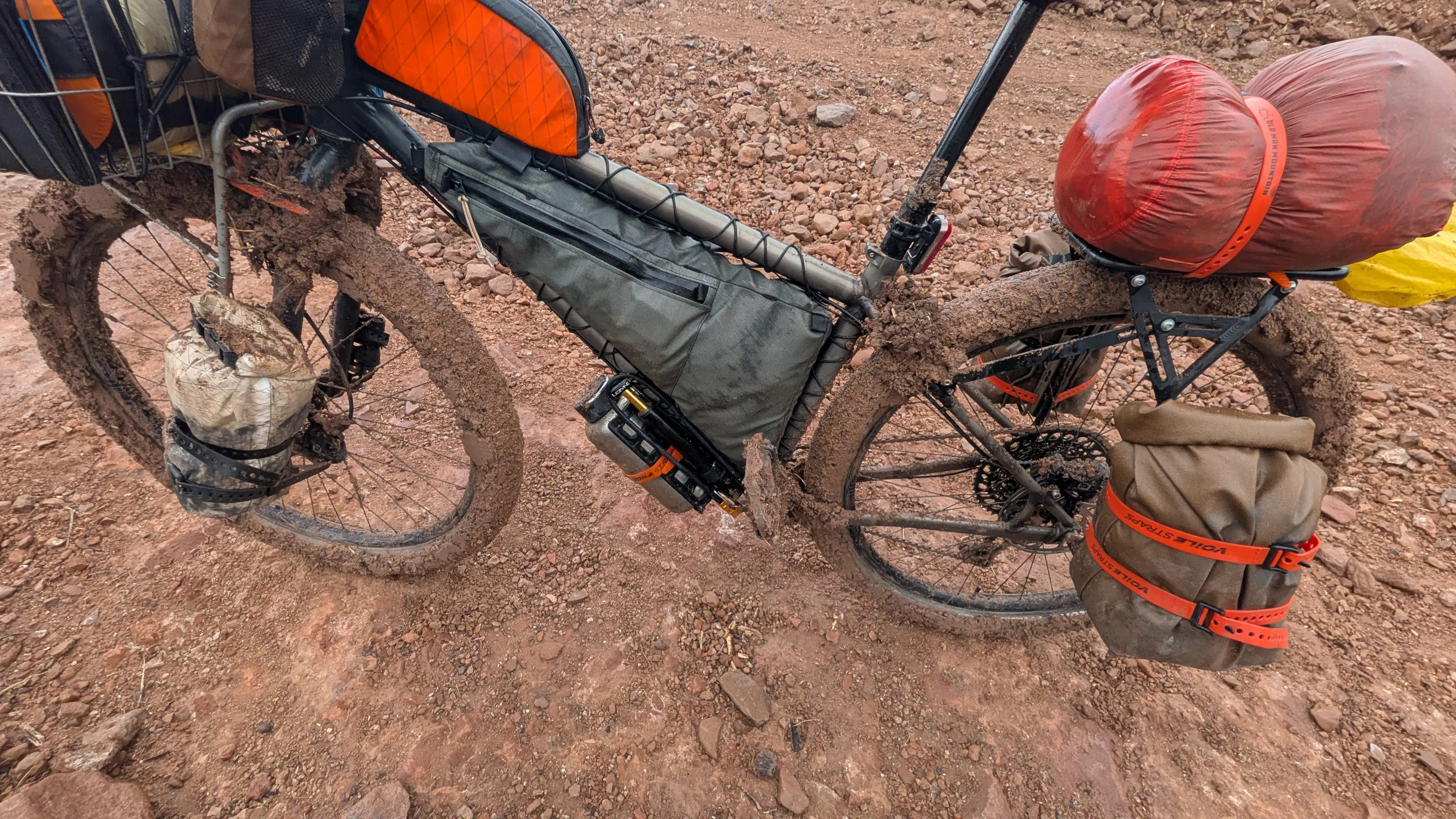
This won't work for thirteen miles (until we get to pavement), let alone one, and I start to despair. Leah remains positive, brainstorming how we can work together to make it better, and carries the back of my bike while I lift the front. She is faring a bit better. Her frame is purpose-built for such off-road adventures and has much wider tire clearance, so she can at least roll her bike through much of the mud. We are leaving comically wide, chaotic tracks in the surface of the road.
My feet suffer the same problem as my tires. After a few steps each one has gained giant clods of earth and rock stuck to the bottom, weighing me down. I start to panic a bit. We're miles from pavement, it's raining, and we have maybe one day of food left. Is our only option to set up camp again and wait out the rain? But it's supposed to rain more later in the day. What if the road only gets worse as we wait? How long can we hole up?
Leah says we should just try for an hour and see how it goes. I drop the bike and walk ahead (clomping along in my mud-covered shoes) to check the road, and it seems the surface in some parts is a different, firmer mix of soil, which gives us hope. Leah notices that if we ride on the rockiest parts of the road our tires pick up less mud. I push, clean, and grunt my way forward, and eventually reach a point where the bike can roll. I try to pedal and the chain drops off immediately, mud and rocks pushing it out of line. After scooping more mud off my tires, I can actually ride down a small hill and pedal up most of the other side. The ground is drier, firmer, and miraculously the sun is poking through. The worst suddenly seems over.
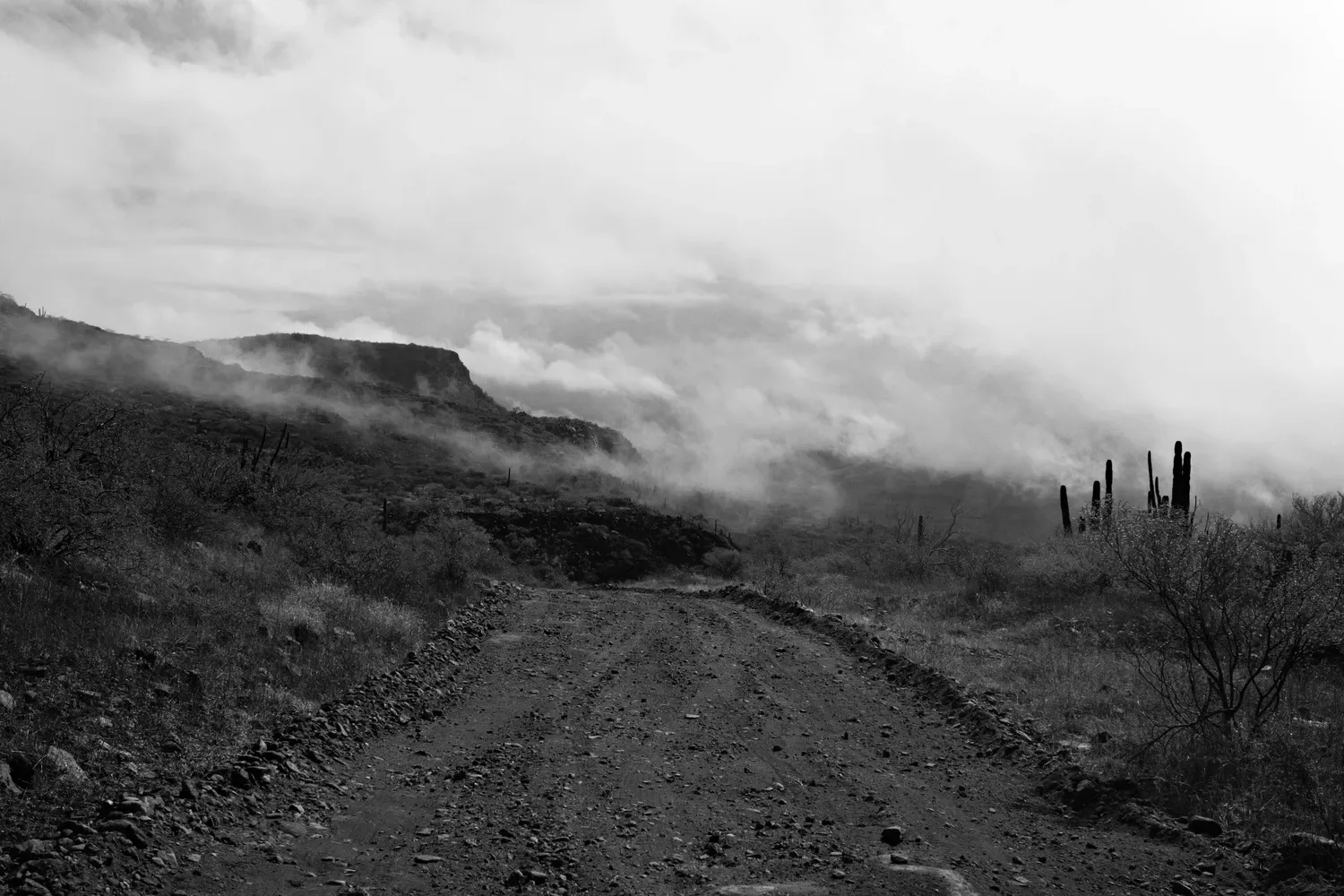
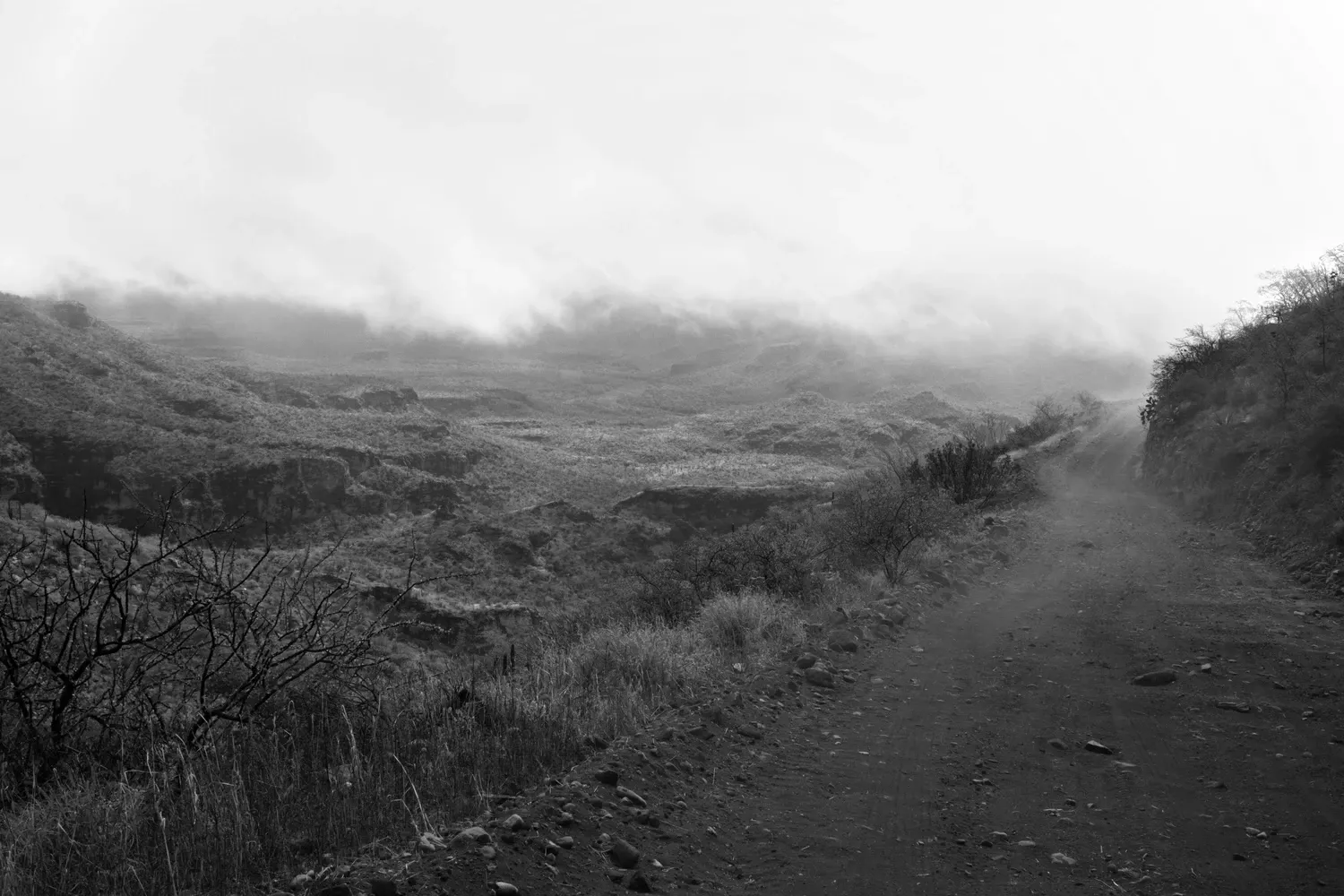
We're at the high point of the day, and a huge valley of sharp steep cliffs spreads out before us, the mountains shrouded in the mist of the lingering rain. It's breathtaking. I am torn between wanting to stop and photograph everything and speeding down the hill to make progress while the weather cooperates. I go with the former.
We start our long descent winding down the contour of a big valley. Leah hears a hiss when we stop for photos and finds a small hole in my tire, but it seals itself after I quickly pump it back up. The bike pump is making bad noises — it's also been covered in dirt and clay, like our tires. It sounds like a laughing pig.
Small ranches appear at the bottom of the valley; one has a scary dog but the owner calls it off. We progress quickly up rolling hills, the ground and sky mercifully dry. One last big climb and then we are at the highway. We decide to ride out to see the mission at San Javier. It's only five miles down the road, but it's an out-and-back, so it adds ten miles to our trip to Loreto. The weather is threatening rain again. As soon as we start pedaling, the rain starts, and I'm soaked from the chest down by the time we arrive in San Javier. Then the rain stops, of course.
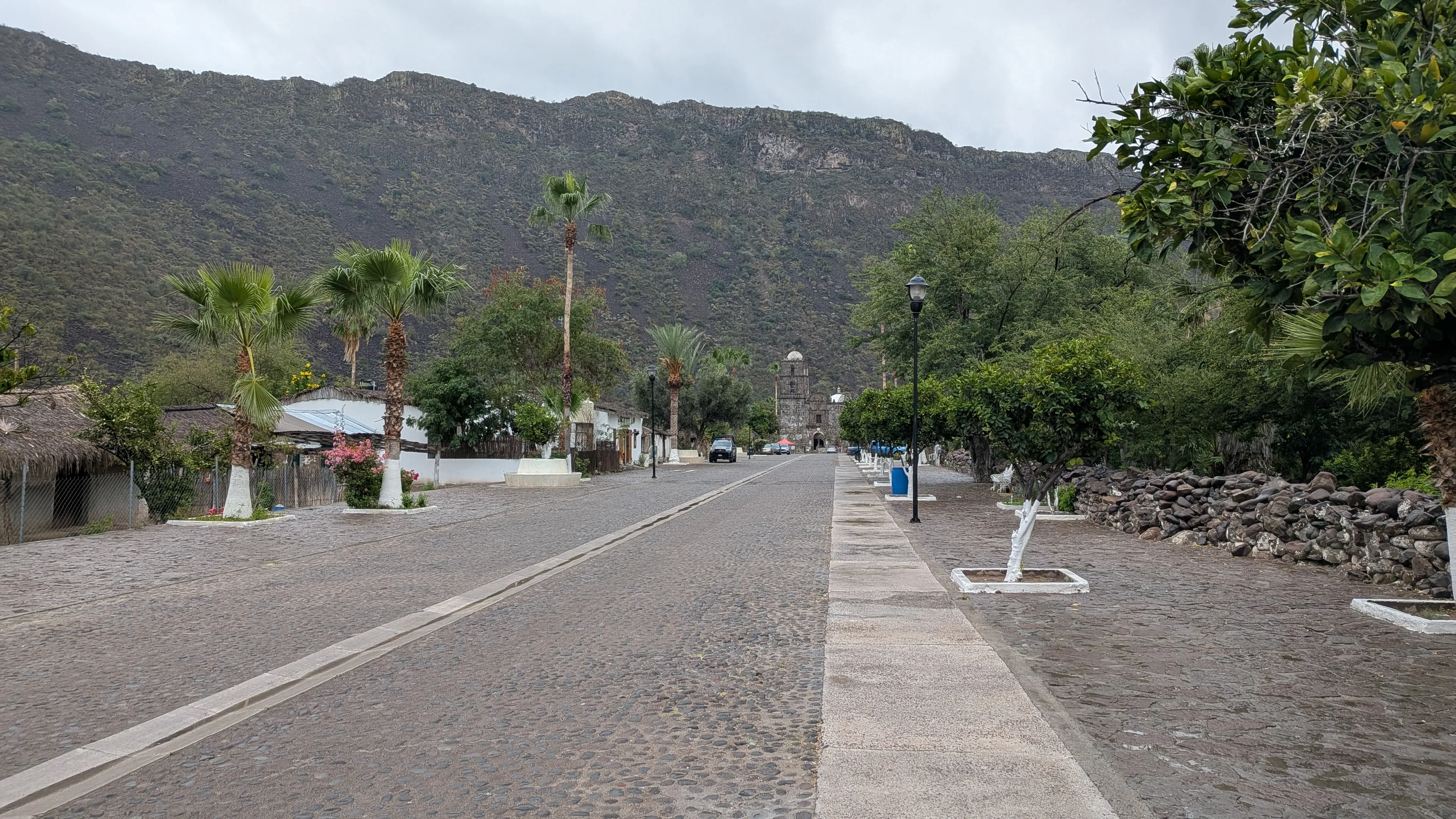
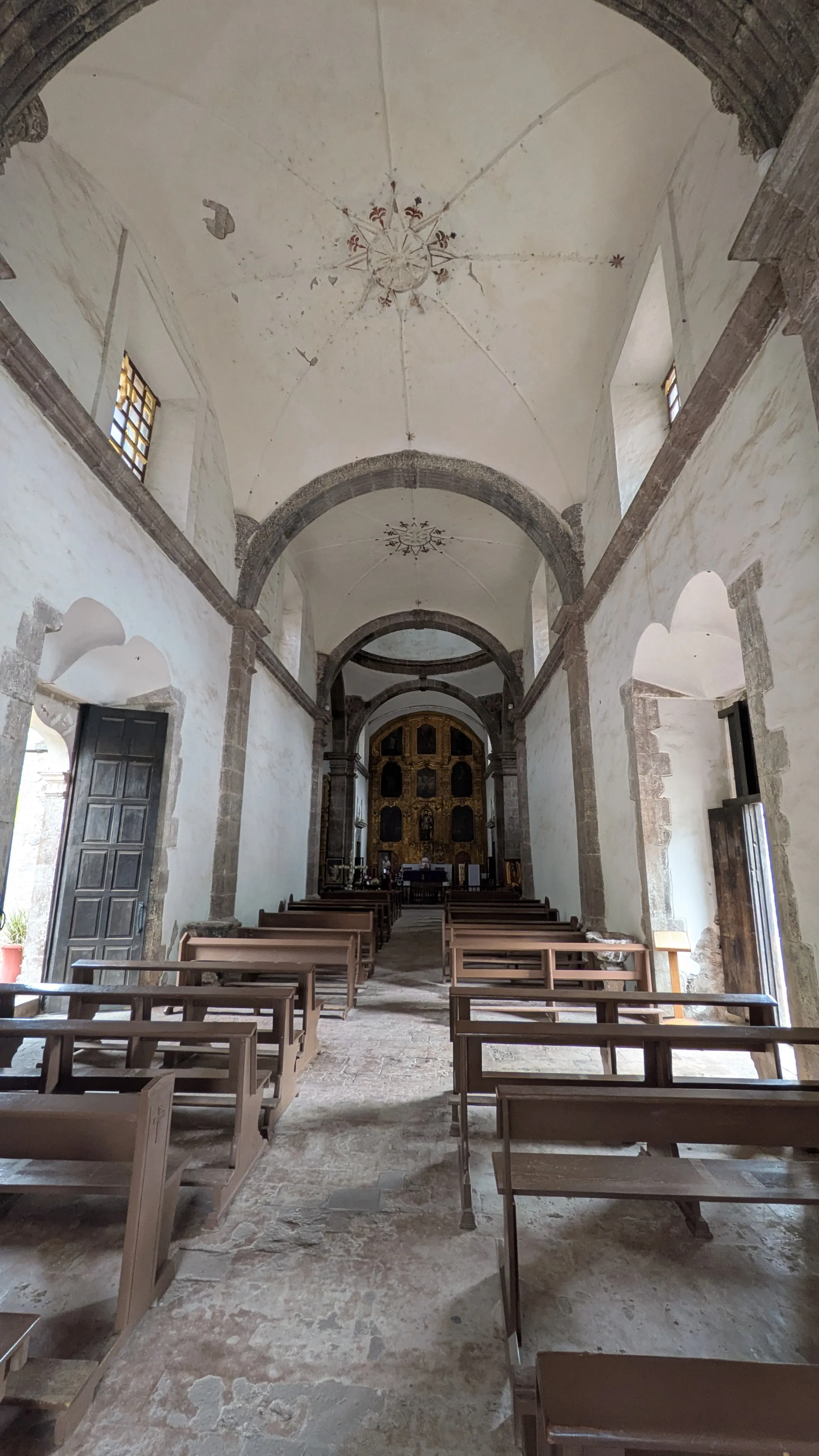
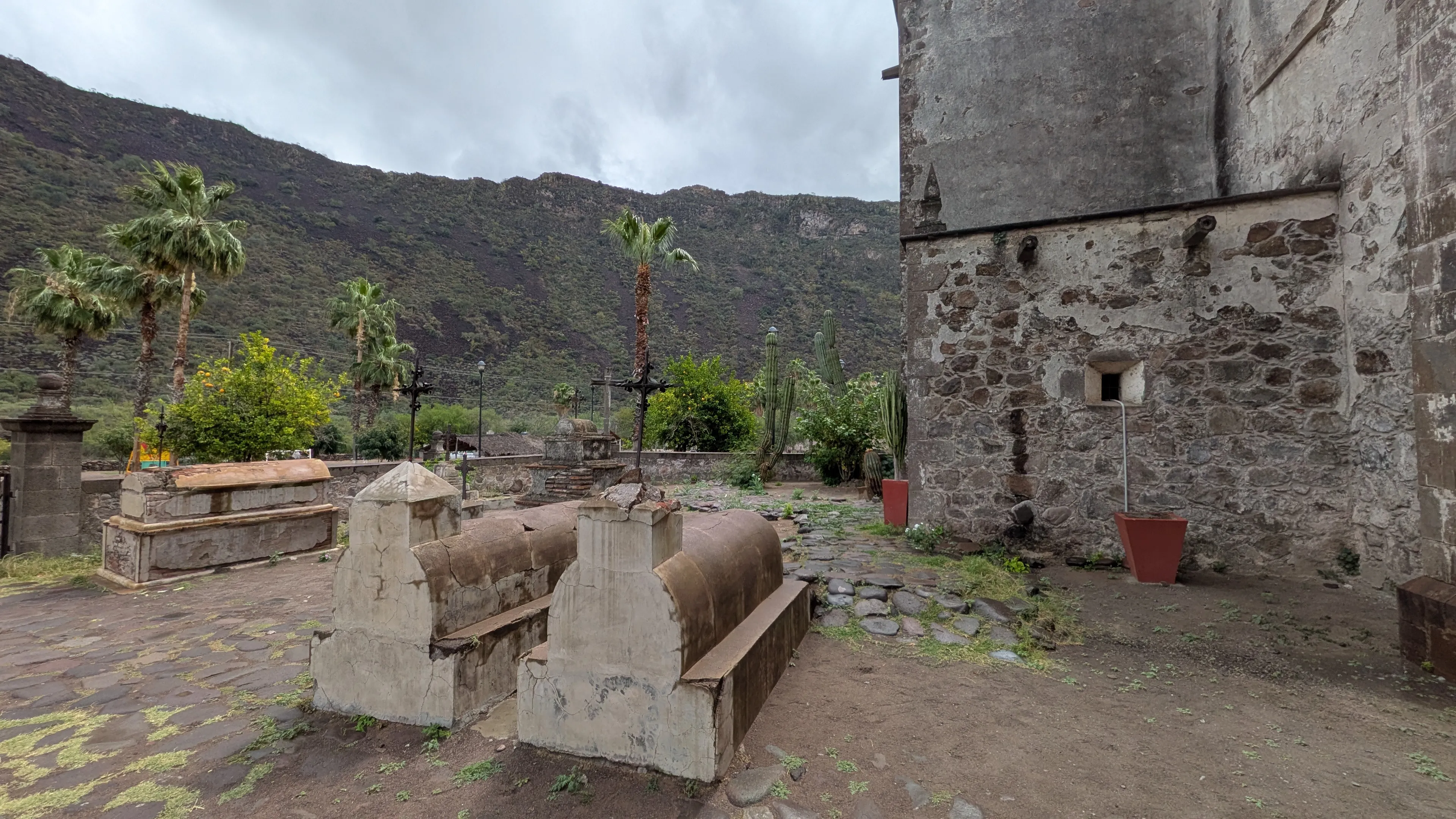
San Javier is tiny, built around the old stone mission (the second one in Baja California, circa 1699), with a palm-lined cobblestone street and the usual assortment of lowkey tourist stores and a few palapa-covered restaurants. We wander through the mission and grounds. The mission style is beautiful in its simplicity. I find the asymmetric three-tower layout a bit quirky and charming. There is a small museum in the rear of the building, and we scrounge up the $20 peso entry fee and wander through, looking at old artifacts (a bible from the 1700s?!) and reading walls of text in Spanish. My mind keeps wandering to the weather. I hope it's not raining again.
Outside we encounter Jose Flores, another cyclist riding the Baja Divide, who others have told us about meeting. He is seventy-something, short and thin and very lively with a great white beard. We chat briefly and he gives us some stickers. We wish each other luck. He's headed toward Ciudad Constitución and we're headed to Loreto, so we probably won't cross paths again (spoiler: we will!). We eat an uninspiring lunch at one of the restaurants; it seems premade, and we're chilly and wet with a breeze blowing through the palapa. But glimpses of sunshine get our hopes up. The ride back up the road is clear and breezy, and the weather holds for the rest of the day.
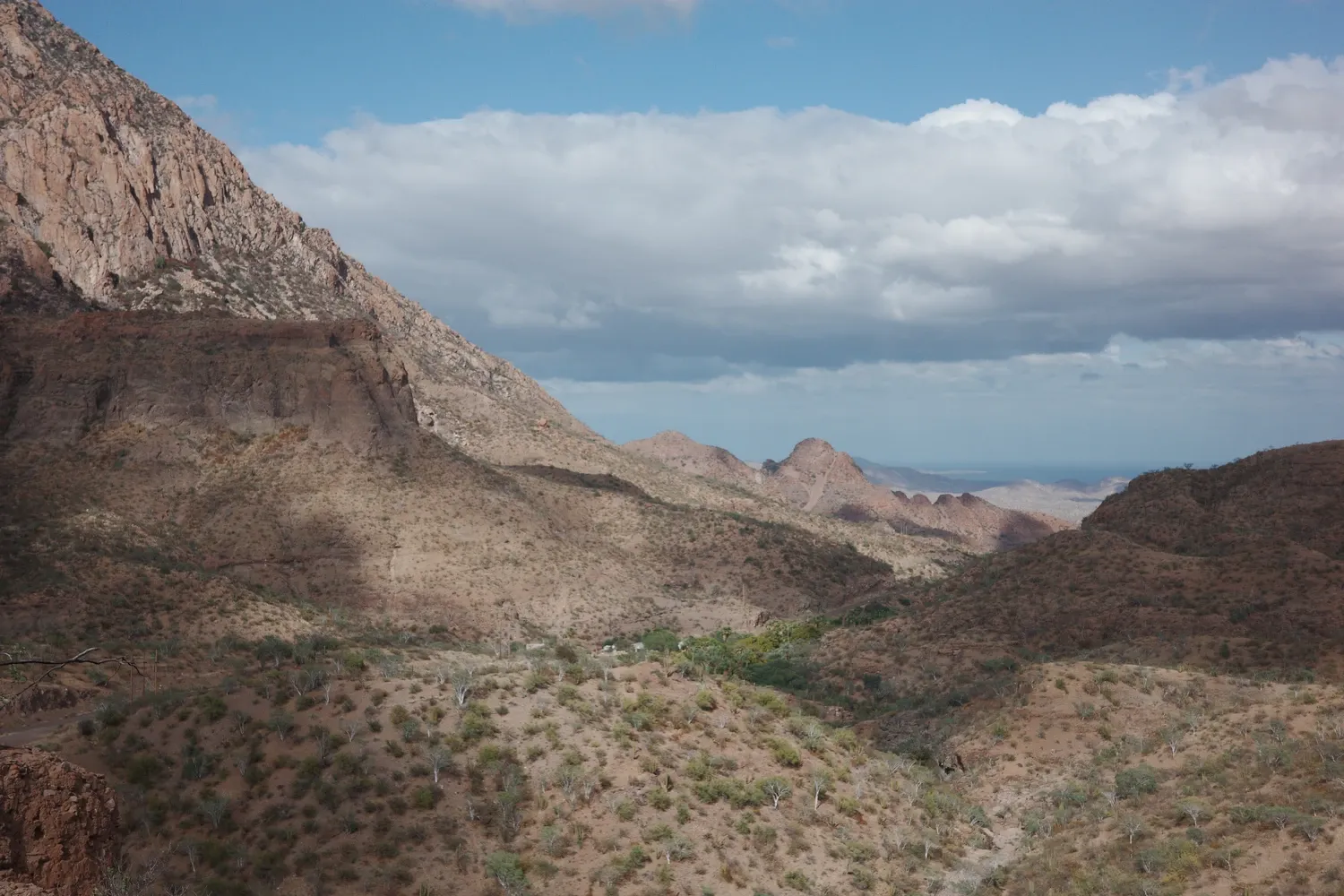
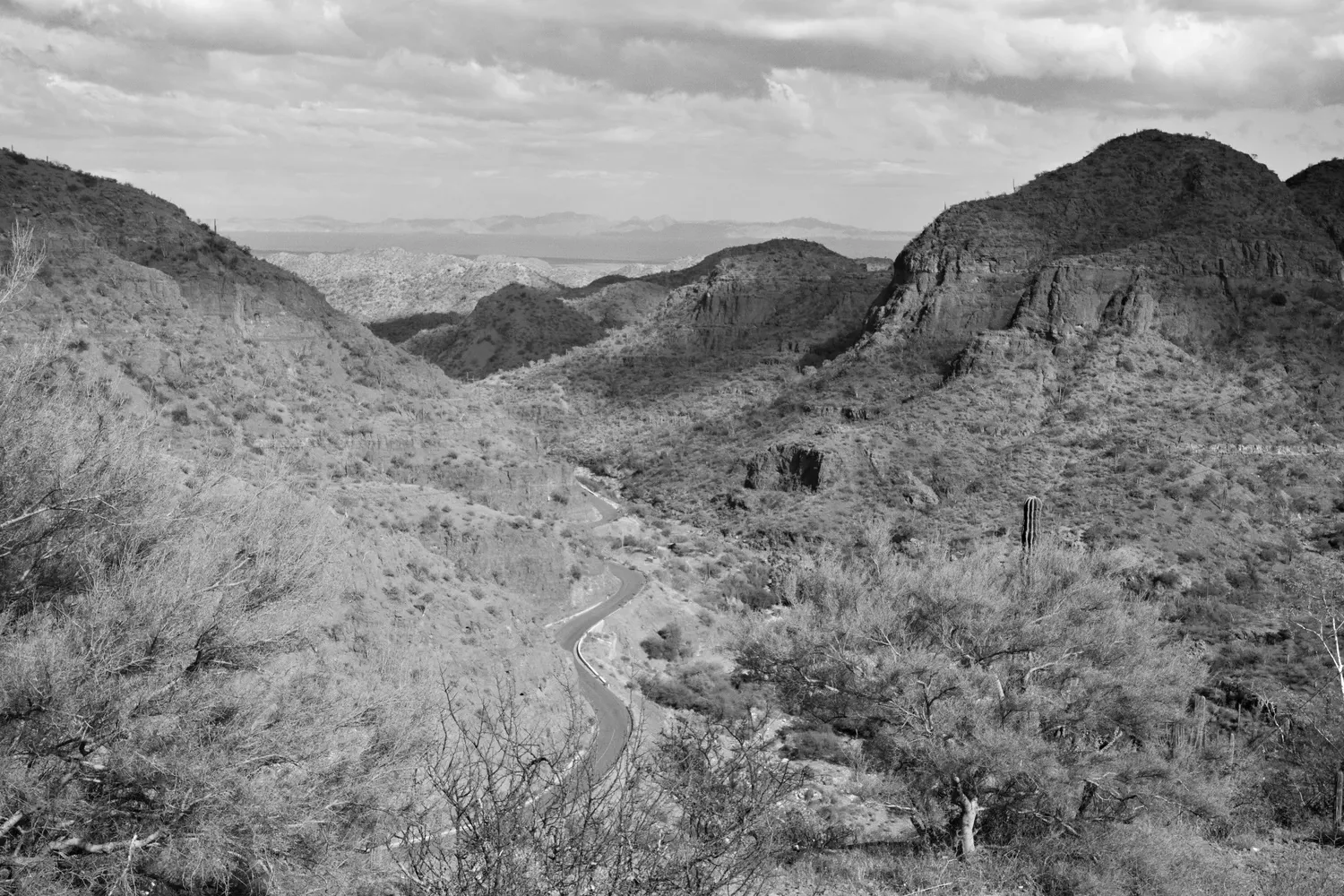
We pass the dirt road we came in on and continue toward Loreto, enjoying the pavement and a strong tailwind. The last twelve miles are a crazy descent down a canyon, with epic views of sheer, sharp mountaintops receding into the distance. We're holding the brakes a lot, and the occasional crosswind combined with the weird weight distribution of my bike yields a few moments of puckering up. But mostly it's a blast.
There are a few punchy climbs toward the end, and Leah gets a sudden and total flat tire that also surprisingly disappears once we close the valve stem and pump it up.
In town (city, actually) we stop at a small cute nice park to look up hotels under the pavilion, then ride into the centro via a pedestrian walkway. The first few hotels we try are full (!?), but we end up at El Moro. It's cheap but fine, and familiar in its quirks: gaps under the door, neighborhood noises at night, bright lights and curious wiring. We walk to El General for tacos. Pork belly, al pastor, camarón, topped with habanero onions, pico, and red and green chile sauces. We stop at a heladería on the way back for ice cream cones: cream cheese pineapple and Ferrero Rocher.
March 10
Rest day in Loreto
I immediate brew coffee in the hotel coffee maker, mostly because it's there. We walk to the nearby Loreto Mission, and then next door to the Missions of Baja Museum, detailing this history of - you guessed it - all the Spanish missions in Baja California.
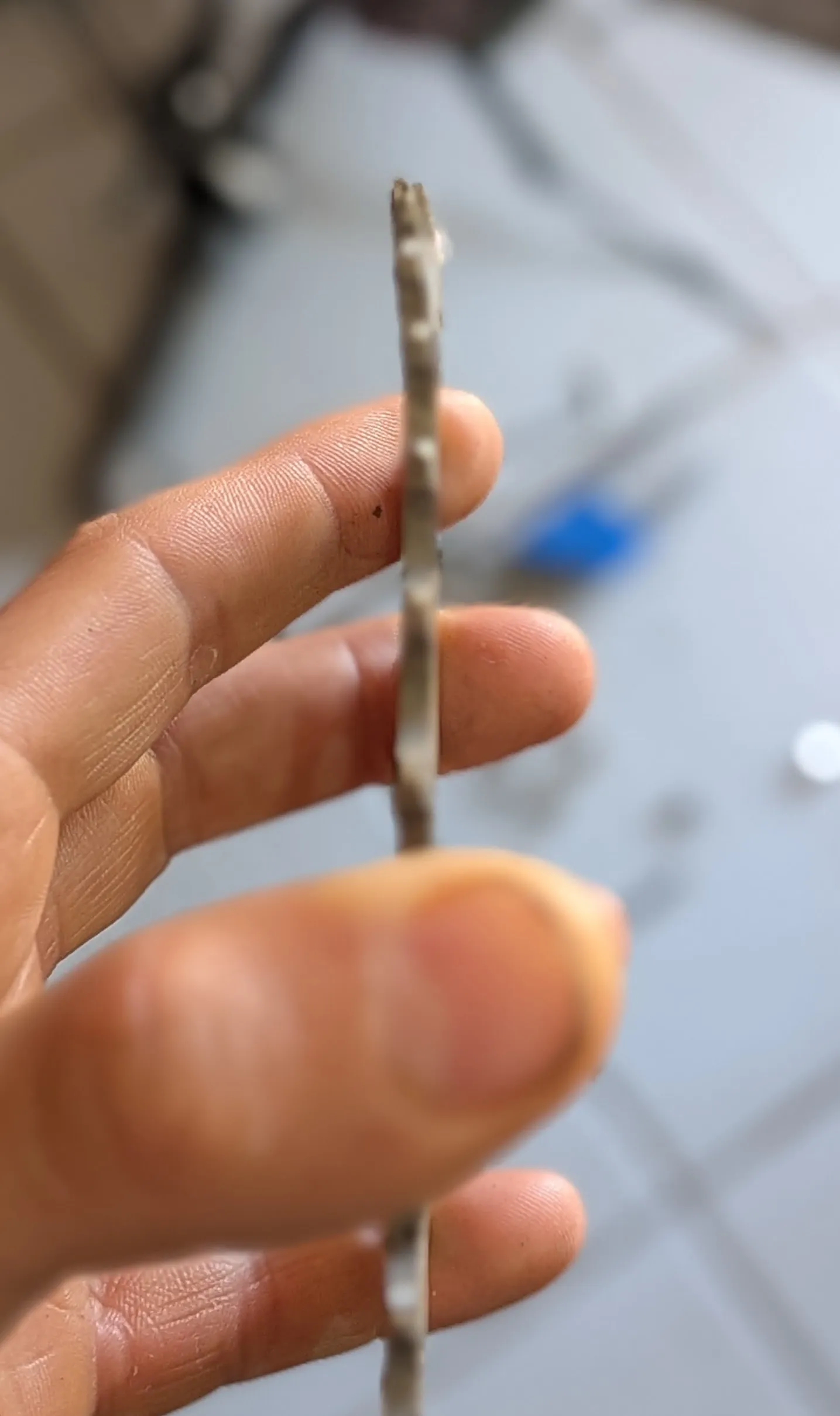
We return to the hotel room for some much-needed bike maintenance. Leah finds out why her bike can't backpedal more than one full turn - several teeth on the chainring are bent wayyy out of line. She asks around the hotel and, with help from another guest - "Baja Bob" - and a hammer, is able to straighten it out again. Hurray! It was in such bad shape before that I can't help but laugh. It must have happened when the mud squeezed some rocks between the chainring and the frame.
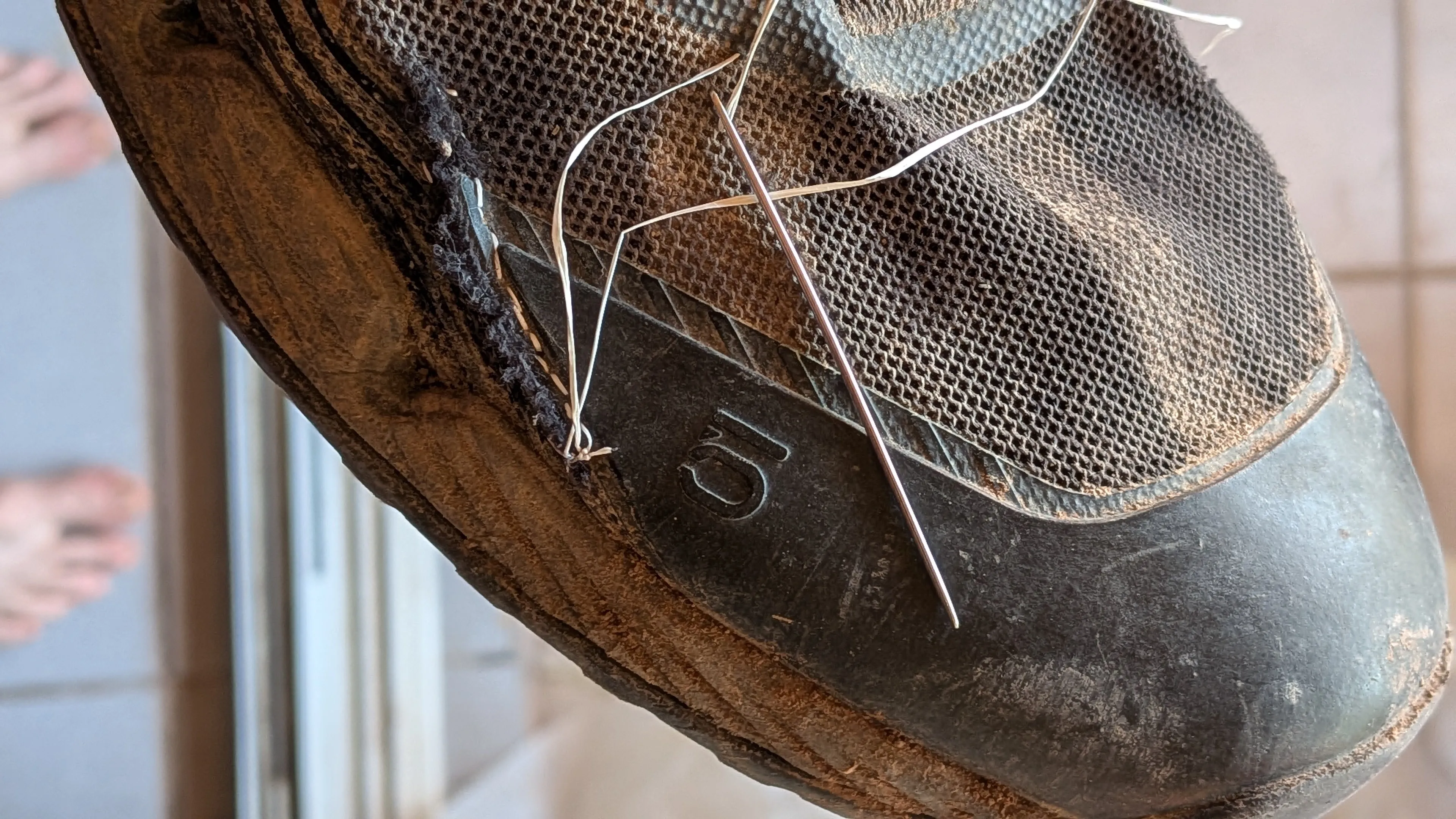
I disassemble the bike pump, clean it, and lube it with our wax chain lube. It's not oil, but probably an improvement over clay. Using dental floss, I sew a hole that formed in my shoe, and another one in my stuff sack.
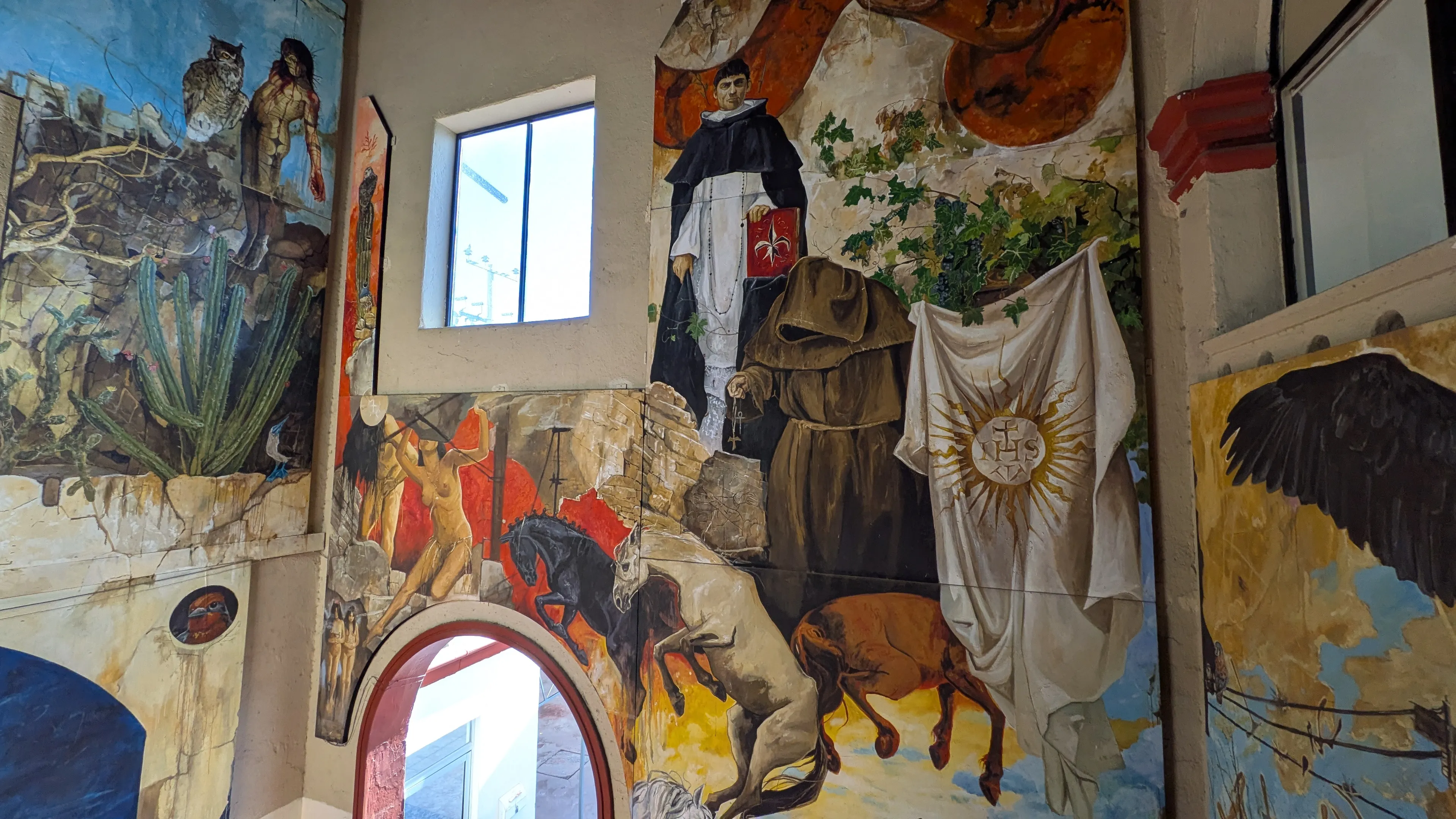
We take a quick walk through the capital building (Loreto was the state capital of the Spanish Province of the Californias until 1777). There is a beautiful mural that covers four walls and two stories near a staircase in the rear. It juxtaposes ancient and modern symbols of Mexico — indigenous people, modern youth, different religions, birds, trees, power lines, phones, vehicles, native animals, cacti, and more. The style is sharp, dramatic, and colorful. I love it.
We buy tickets for blue whale watching tomorrow, only to get a text later that the trip is canceled because the marine port is closed due to high winds.
We walk to the malecón (boardwalk), admiring murals of dogs and whale and sea turtle statues along the waterfront. Sunset behind the steep mountain peaks to the west is blinding and beautiful as we walk back away from the water. We stop at a candy store for Leah to find chocolates. It is impressive, dense, and colorful—eight-year-old me would've been in heaven.
We return to the room, rest, then go for a walk again. Watching Leah eat chocolate must've softened me up for sweets, because I look up a bakery on the way to the sports complex and we stop in. I buy a small cake and some cream-filled pastry.
We walk to the basketball courts and sit and eat cake, watching young kids play 3-on-3. Then we go next door to a rec league baseball game, sit in the bleachers, eat pastries, and watch a couple of evenly matched teams go back and forth for a few innings.
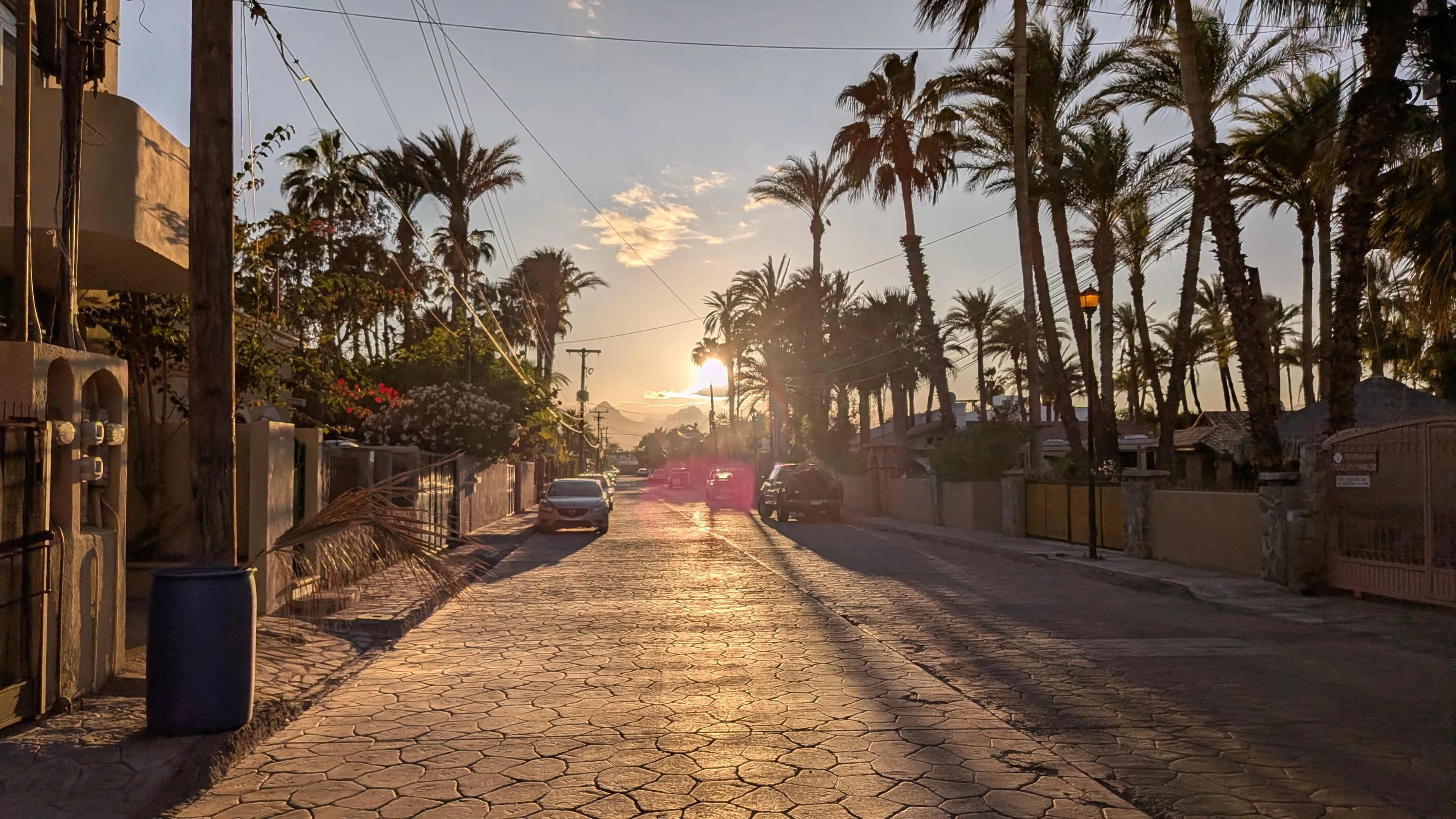
March 11
Given our time constraints (Leah needs to return to work in a few weeks), we won't be able to ride the entire remaining Baja Divide route. So we've decided to take a bus to La Paz and ride the cape loop from there. We've seen amazing scenery in the Sierra Giganta, and heard that Ciudad Constitución isn't as inspiring as La Paz, so we have few qualms about skipping the next couple hundred miles.
But first, further leisure. We walk to get fancy coffee, then to the bus terminal to check the schedule to La Paz. I eat a huge breakfast of chilaquiles divorciados at a small diner. Leah decides to treat herself to a massage in town, then we do laundry in the hotel.
We eat ceviche and bar drinks at El Calorón, a sleepy upstairs dining spot on the malecón. The breeze is just right. Birds are bold and hop around inside the restaurant.