Baja Divide
February 18
We set an alarm and are up and moving by 6:15, aiming for an early start out of Cataviña. The tent is dry, so packing goes quickly, although organizing all the gear in its new configuration takes some time.
We pay and head to a small market to fill water. There
are two new women working, along with the one from yesterday. All are wearing
pajamas. We fill every bottle for 48 pesos, giving Leah
about five liters and me seventeen. The bike is heavy and the steering is rather wonky with
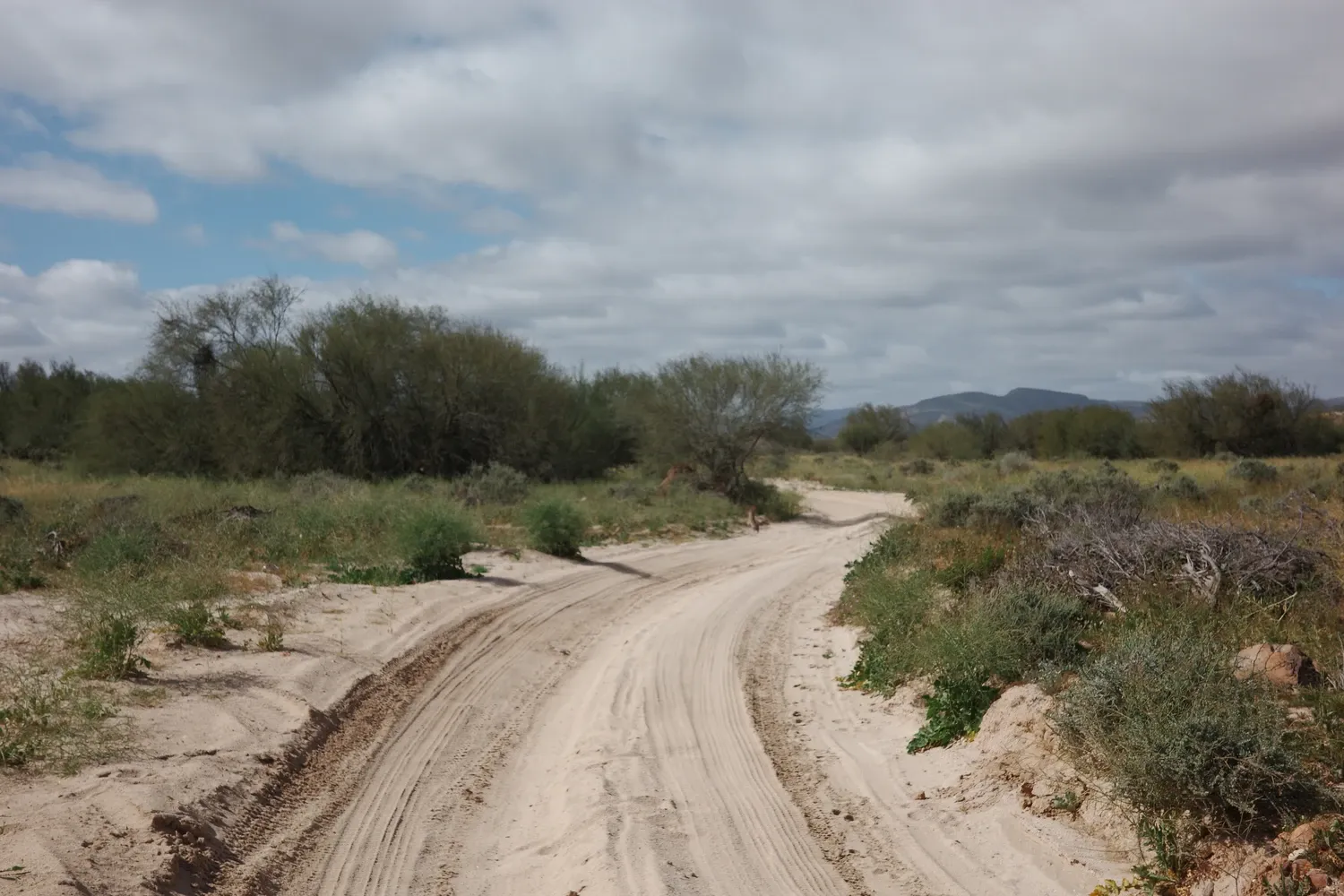
We ride five miles back up the highway, then turn southwest onto a sandy track. It's mostly downhill and some sections roll well, but others are deep sand, badly washboarded, or both. There's also a steady 15-20 mph headwind, so it never feels as fast as it should. Leah's panniers — packed with my lighter snack food — aren't sitting well, so I move the totopos, chicharrones, and a giant roll of cookies into my front basket. Now my basket is piled comically high; I am peering over a small mound of junk food as I ride down the road.
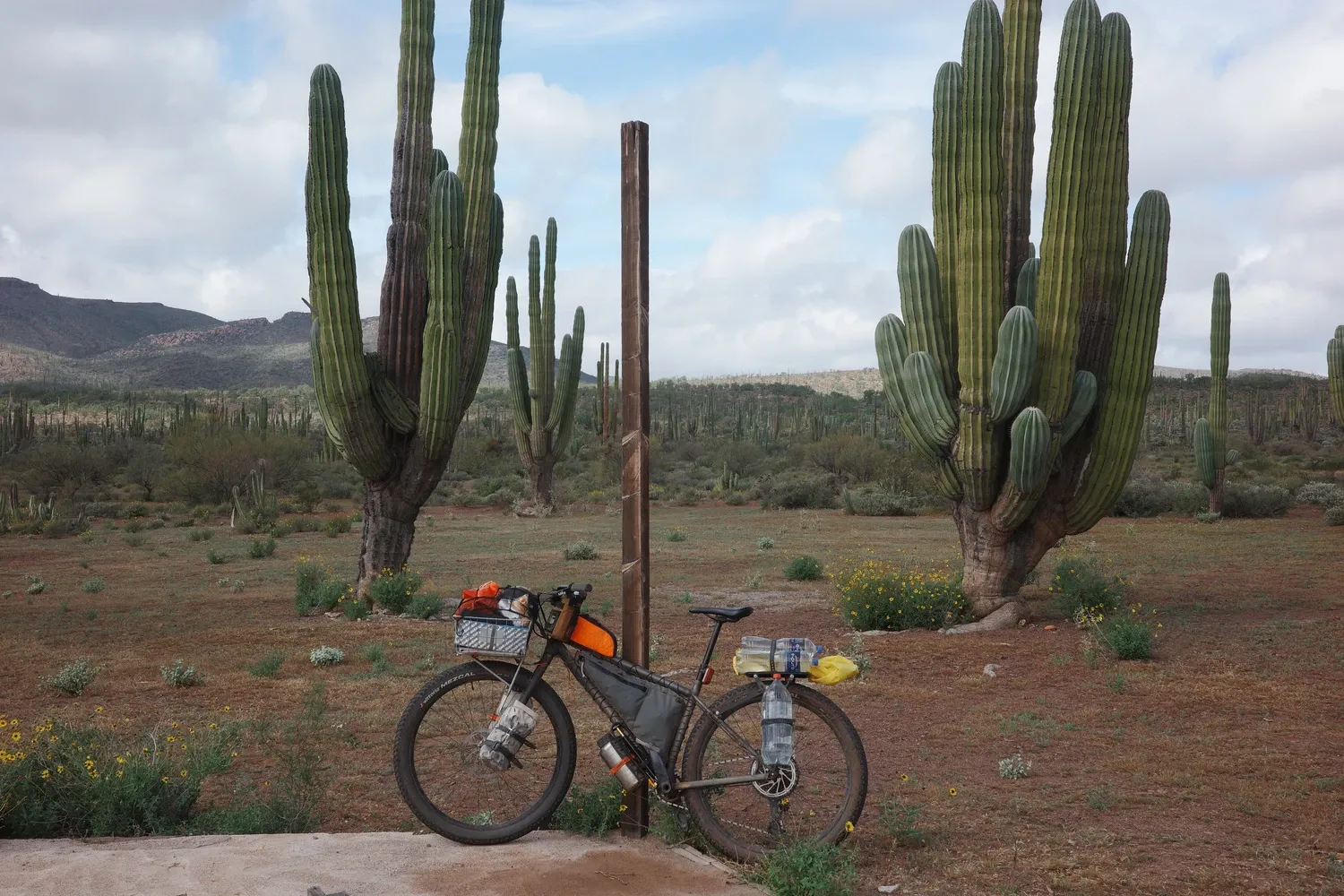
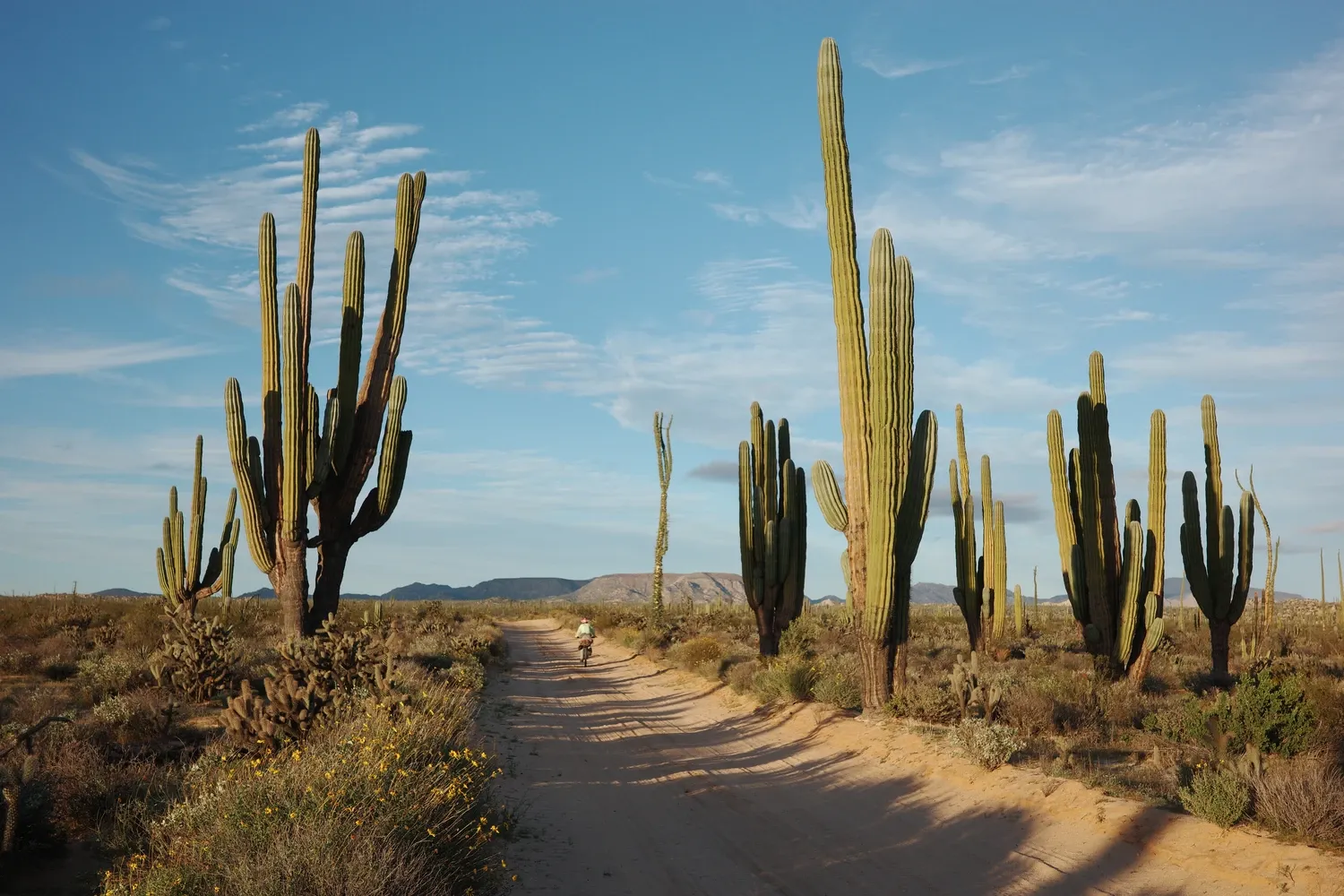
The scenery makes up for the effort: dense clusters of cirios and cardónes mixed with huge white boulders. After a few miles, it opens into a more spread-out landscape with yucca, agave, ocotillo, and scattered flowers. We stop for lunch at what looks like an abandoned rest pull-off with piles of wooden construction materials. We drag a picnic table up against the outer wall of a bathroom structure to get out of the sun and wind, which also gives us a backrest. The setting is a wide valley filled with massive cardónes.
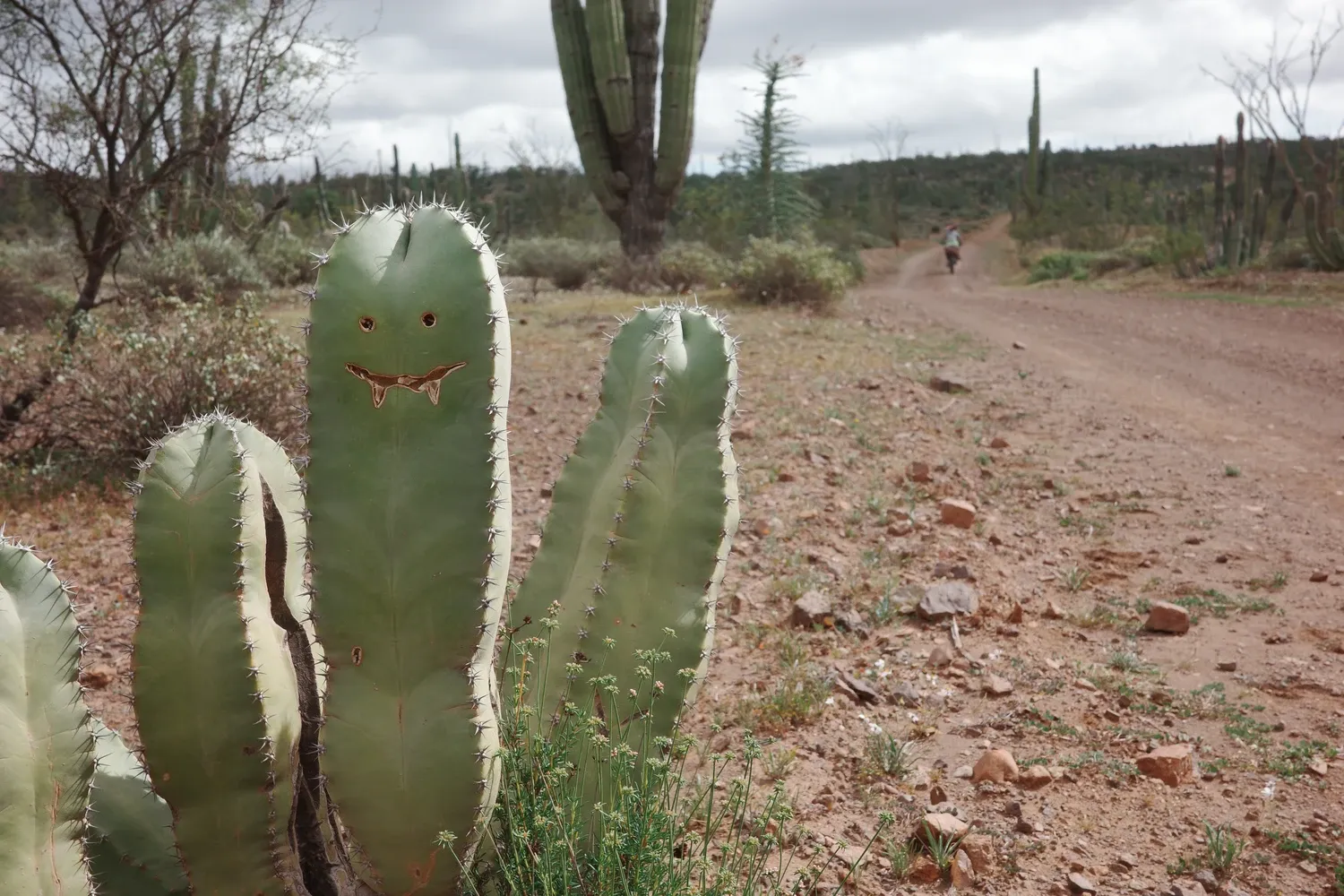
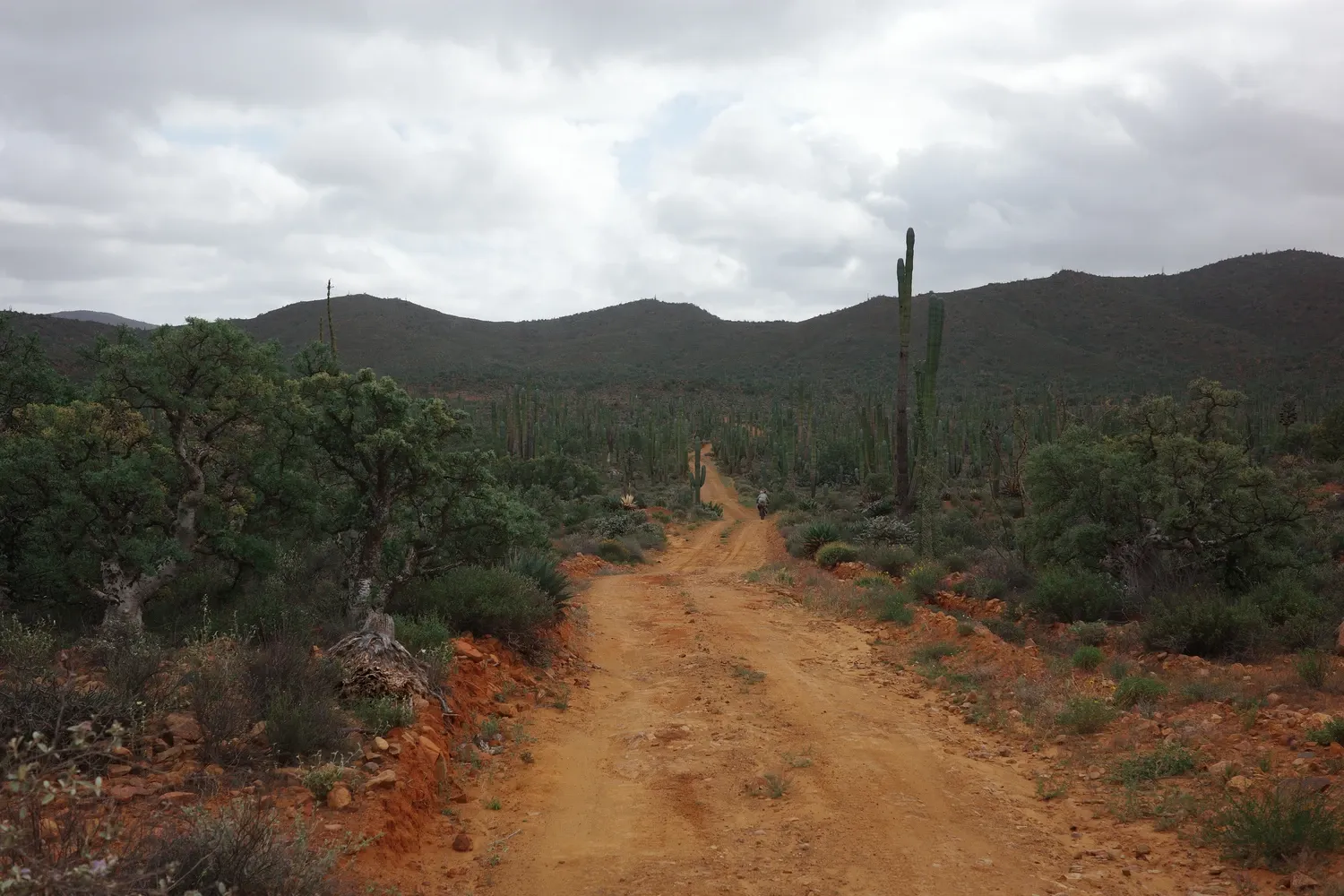
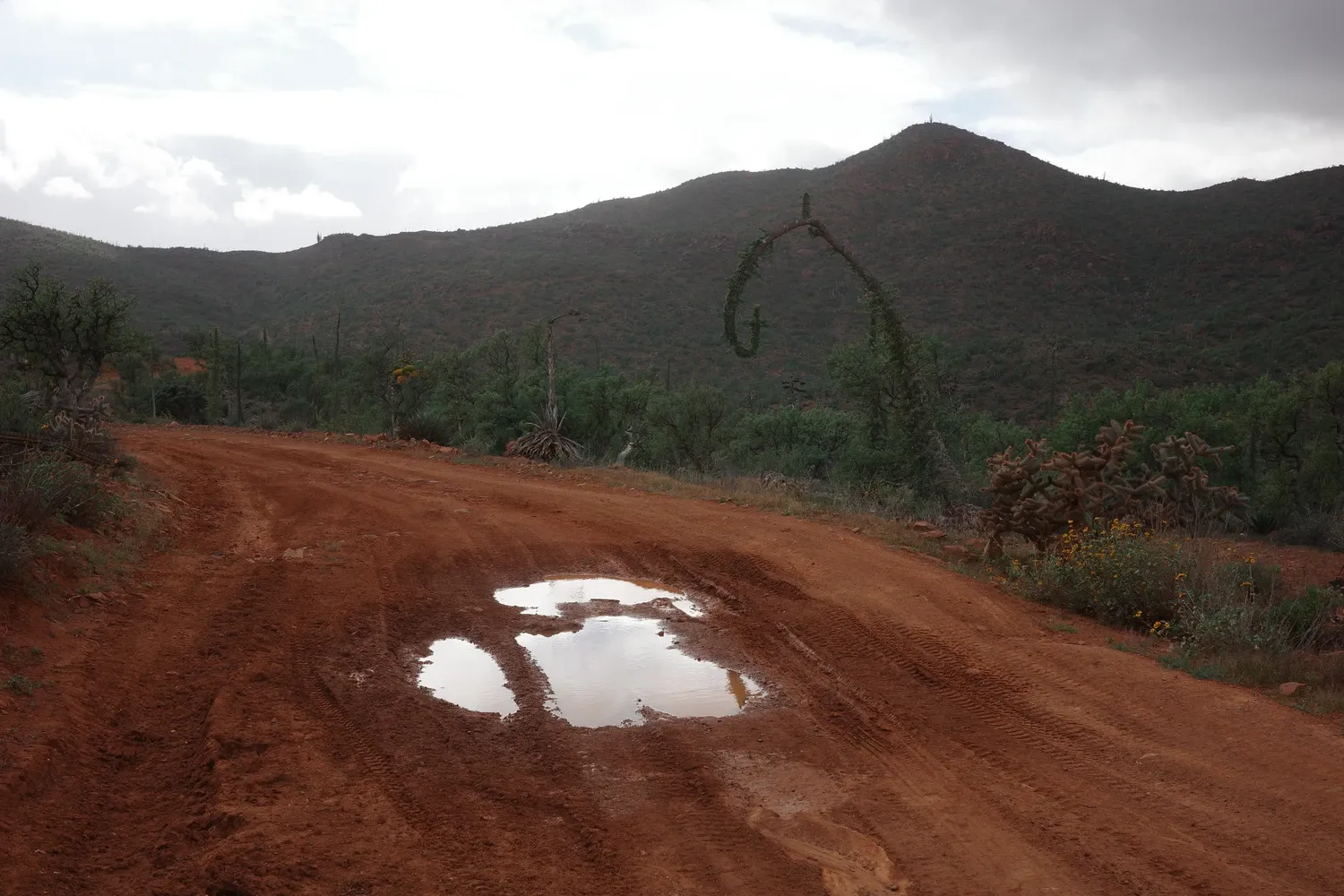
After five miles of gradual climbing, we hit a stretch of about seven miles of smooth, consistent downhill. It's the best road of the trip so far. The road eventually drops and begins winding through small hills, climbing and descending in short intervals. The coast is getting closer, but it's late, so we stop at a small flat spot among the cacti near the road to camp.
Around this time, my camera starts intermittently failing — likely grit in the lens retraction mechanism. It's not surprising, but frustrating. One of my 3-liter water bottles has also developed a slow leak from a crack at the bottom, likely caused by bouncing against the metal cage. We transfer the remaining water into the bottles we've been drinking from.
We finally add the bagged mole to dinner. It's pretty tasty, with a bit of heat. After dinner, I manage to crack another bottle by dropping it from the bike. First the camera, now this. Things are breaking. Not good. At least we're still intact after a long, windy, 43-mile day. It feels good to have made a solid dent in the 120-mile stretch ahead. We didn't see anyone all day after leaving Cataviña.
The stars are spectacular. Most of the constellations we recognize are hidden behind a large palm tree, but I can still pick out the Pleiades and the Big Dipper without much trouble.
February 19
Leah awakes with a not-yet-serious but urgent health concern (details omitted, sorry). We need to get to a pharmacy pronto. We make a plan: turn around and retrace yesterday's 43 miles back to Cataviña, then try to find a bus either north to Vicente Guerrero or south to Guerrero Negro — both over 120 miles away.
We dump some of the water we won't need, then start pedaling, eating snacks constantly to keep energy up. I'm still tired from yesterday and don't want to dig a deeper hole for my body. Progress is slow but steady. We stop at the same abandoned building for a break, and Larry appears coming the other direction. Possibly the last time we'll see him. We take a few photos together.
Rolling away, I hear a tick-tick-tick noise and find a cactus spine, with part of the plant still attached, stuck in my tire. I pull it out, add air, and let the sealant do its job. A few miles later, my rear tire starts feeling soft. Leah helps find the leak. I try a bacon strip, but the hole is too small. It stops leaking for a bit, then goes squishy again by lunch. A Stan's dart pops loose and rattles around inside the tire, and I try not to rage. I jam in a bacon strip and it finally holds for the rest of the day. Dealing with flat tires in the middle of our mini-crisis is frustrating.
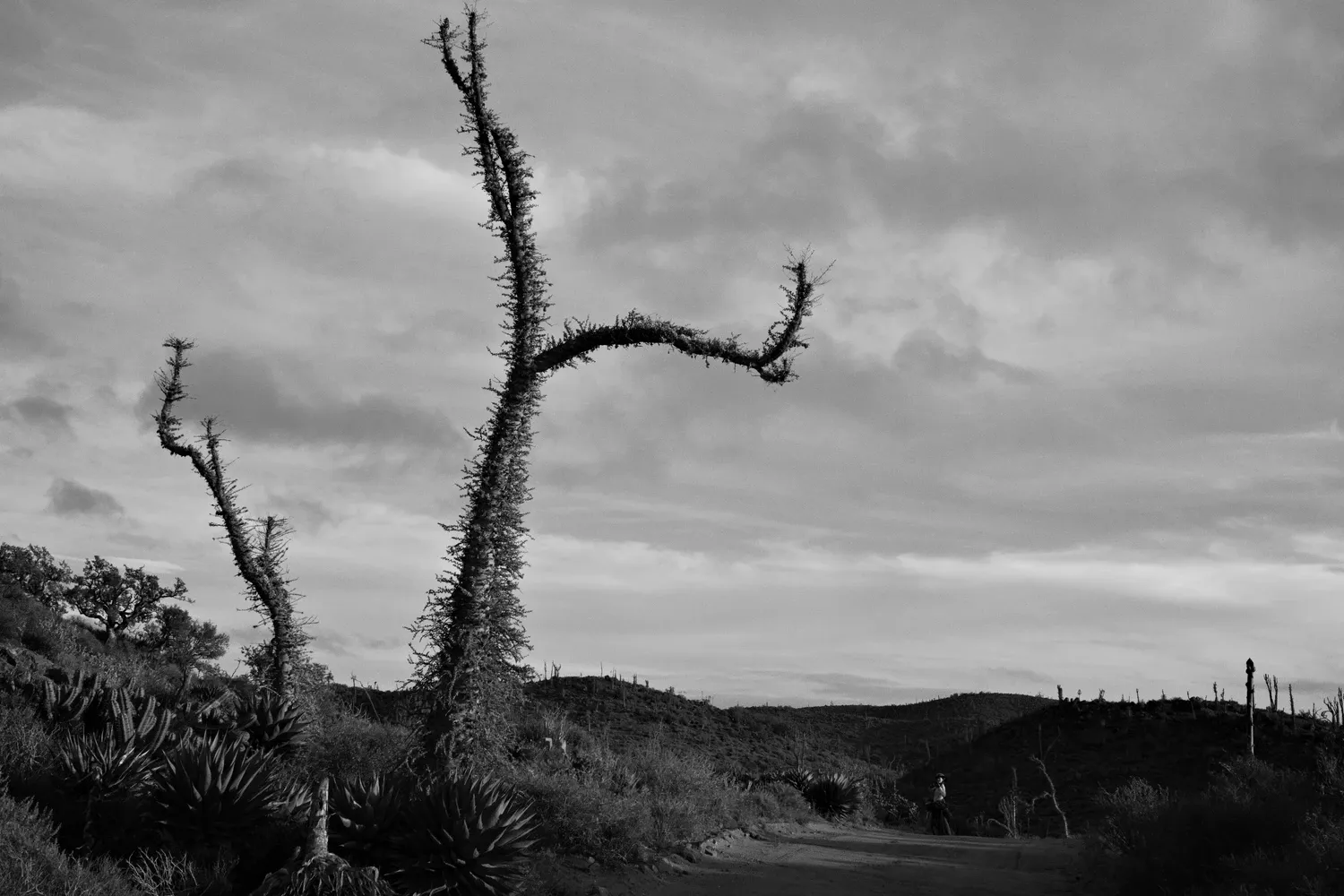
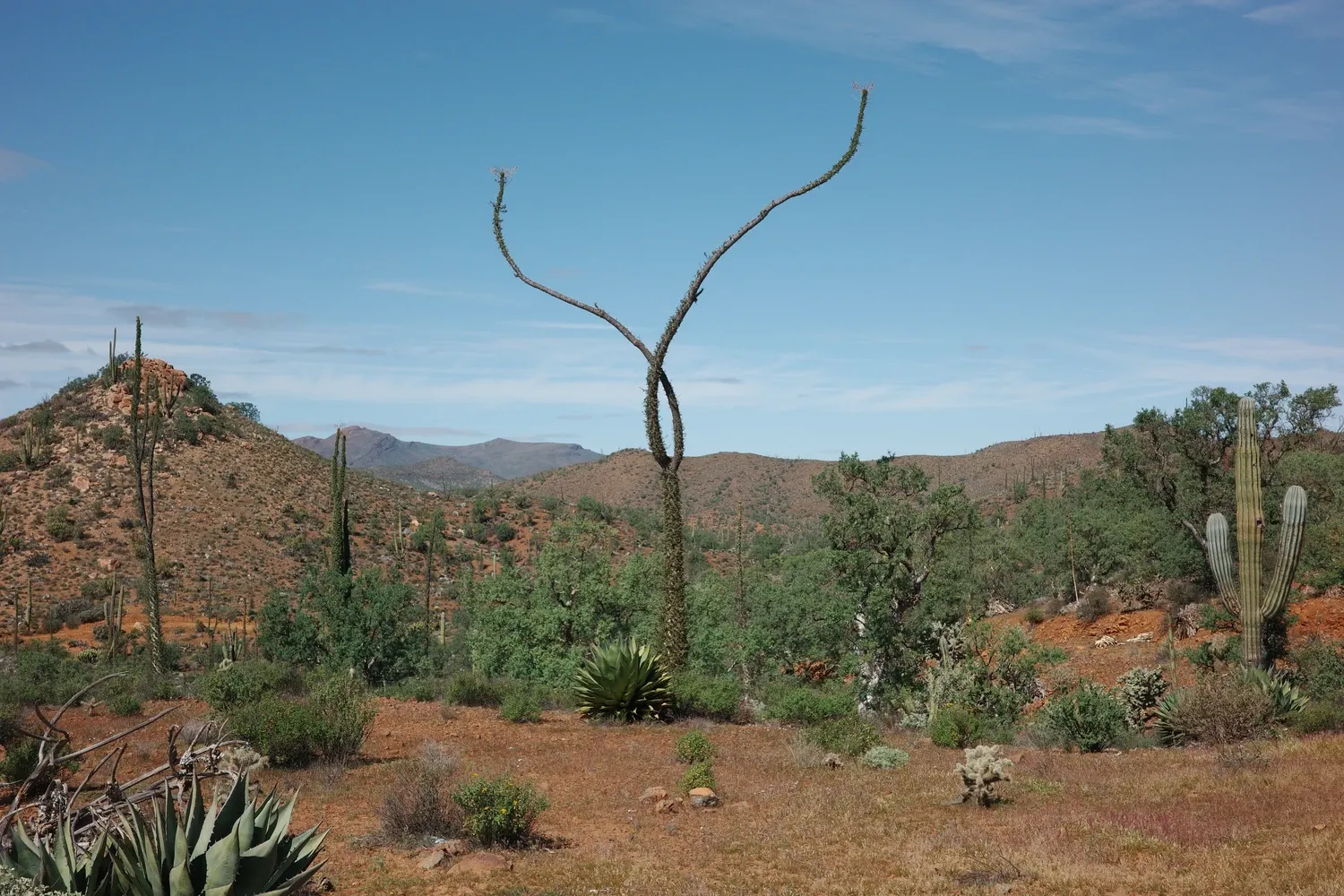
The terrain feels different in reverse. There are more rolling hills and small valleys than I remember. I keep trying to remember what's around the next turn as we backtrack. I'm almost always wrong.
My mind drifts to why I travel at all — not in a negative way, just turning it over. Backtracking to catch a bus feels like it contradicts the idea of a bike trip. But is progress really the end goal? Solving problems and dealing with the unknown is really just another aspect of adventure, right?
We eat a late lunch at the same picnic table as we found on the way in. There are still 16 miles to the highway, plus another five to Cataviña. We'll likely be riding into the dark.
We pass several trucks heading the other direction. Everyone asks why we're going north when most riders go south toward San José del Faro. I try to explain we turned around because Leah is "a little nurse." Oops. I mean, a little sick. They offer flu medicine. She clarifies her medical self-diagnosis in Spanish, with more success than I had.
The riding after lunch is rough — more sand, washboard, and climbs. A truck full of guys stops and yells something like "mira al león?!" as we glimpse a cat darting from the bushes. Bobcat? Cougar? Short tail. Very fast.
With five miles to go to the highway and the sun setting, two middle-aged men driving north stop and offer us a ride. We gratefully hoist the bikes into the back and squeeze into the small cab. The driver is a mechanic who wants to be a cowboy, working in Guerrero Negro; the other guy is a friend. They talk with each other and with us, twisting around in their seats as we bounce through sandy ruts toward the highway.
What a relief. Our bad days always seem to be tempered by just enough good luck. They drop us at the cheap motel on the edge of Cataviña — we're back! — and refuse any sort of payment. We check in and ask about the bus to Guerrero Negro. The host says 5 AM and 10 PM.
We wedge the bikes inside the simple room and take long showers. After a minute of alternating between scalding and freezing, I find the sweet spot and rinse off a couple days of sand. We walk to a tienda for snacks for the early bus and try to confirm the schedule. One person says 10 AM, but maybe there is no afternoon bus? Another says 5 AM and 4 PM. Back at the room, we do a bit of laundry, hang socks and underwear in front of the fan. We decide there was near-consensus on a 5 AM bus, so we set an alarm for 4:30 and go to bed.
February 20
Alarm at 4:30. I didn't sleep well; I kept waking up worrying I'd overslept, and dreamt about oversleeping. I also feel a cold coming on. We pack quickly in the cold room. By 4:50 we're outside in the dark with headlamps, bracing against a 20 mph wind and watching for the bus.
A few semis pass. Then some cars. 5:15. Nothing. 6:00. A northbound bus goes by and we almost flag it down — wrong direction, but at least it would take us to Vicente Guerrero. We hesitate, and it's gone. Time passes slowly. Every few minutes, another vehicle. By 8:00, I'm trying to keep from spiraling into frustration, instead focusing on the sunrise, the birds, the dogs barking to each other, the town gradually waking up.
We move closer to the gas stand and market and adjust our plans — we'll try to hitch a ride south. Leah gets coffee from the market. Spirits improve. Eventually, an older man in a large passenger van stops. He's heading past Guerrero Negro and offers us a ride. We rearrange the seats and wedge the bikes inside—wheels and bags removed. He helps, patient and calm.
His name is Antonio. He lives in La Paz and makes this drive regularly — flying to Ensenada, buying used cars, and driving them back to sell. He talks with us - mostly Leah, who understands more - telling stories about different parts of Mexico, the landscape, the highway, and his family. He points out large eagle nests on power poles along the way. By early afternoon, we're dropped off just outside Guerrero Negro.
We immediately find a seafood restaurant and order everything we've been craving: octopus, shrimp and lobster ceviche, fried shrimp, fish, tostadas, hot sauces. It's excellent.
A block later, we find a pharmacy. Within ten minutes, Leah has everything she needs. Cheaper and quicker than back home. Mission accomplished. The bus station is on the same block. We confirm that there's a 9 AM bus north to Nuevo Rosarito, where we can rejoin the Baja Divide route.
We find another hotel - set back from the road, quiet, comfortable. We were supposed to have a rest day yesterday, but spent it in transit (or trying). Now we actually will. We walk the main street, noticing things the indicators of a "bigger" city. Coffee shops, gyms, nicer clothing stores. Discretionary retail.
We get groceries and cash for the next stretch, then wander through Ballena Colectivo, an indoor market space with artisan shops, a small museum, and a modern food court. It feels a bit too polished — too much like brewpub food courts back home — so we skip it.
Back near the hotel, we stop for tacos and tortas at a small corner spot. Classical piano is playing from YouTube on the TV. I think it's Clair de Lune (note: I was right)
February 21
It's a five-minute bike ride to the bus station. We wait while the driver assesses the cargo situation, then tells us to go ahead and load the bikes. We have to remove the front wheels. Another passenger tries to talk with me, but I'm distracted by the task and probably just confuse him more. Why are we going north if La Paz is our destination? Leah got a bit sick so we had to go to a pharmacy. Isn't there an easier way to remove the wheel? It's stronger this way, I say. Oops.
The bus is a large, comfortable coach. We ride north for about an hour to Nuevo Rosarito. At a military checkpoint near the Baja California Norte border, everyone gets off and waits while bags are checked for agricultural products or other no-nos. I don't mention the red pepper or zucchini in the bags on our bikes. One passenger offers a Snickers bar while his bag is being searched. Yesterday Antonio offered gum to the border agent. Is this common? Just friendliness, or a subtle bribe in case something turns up?
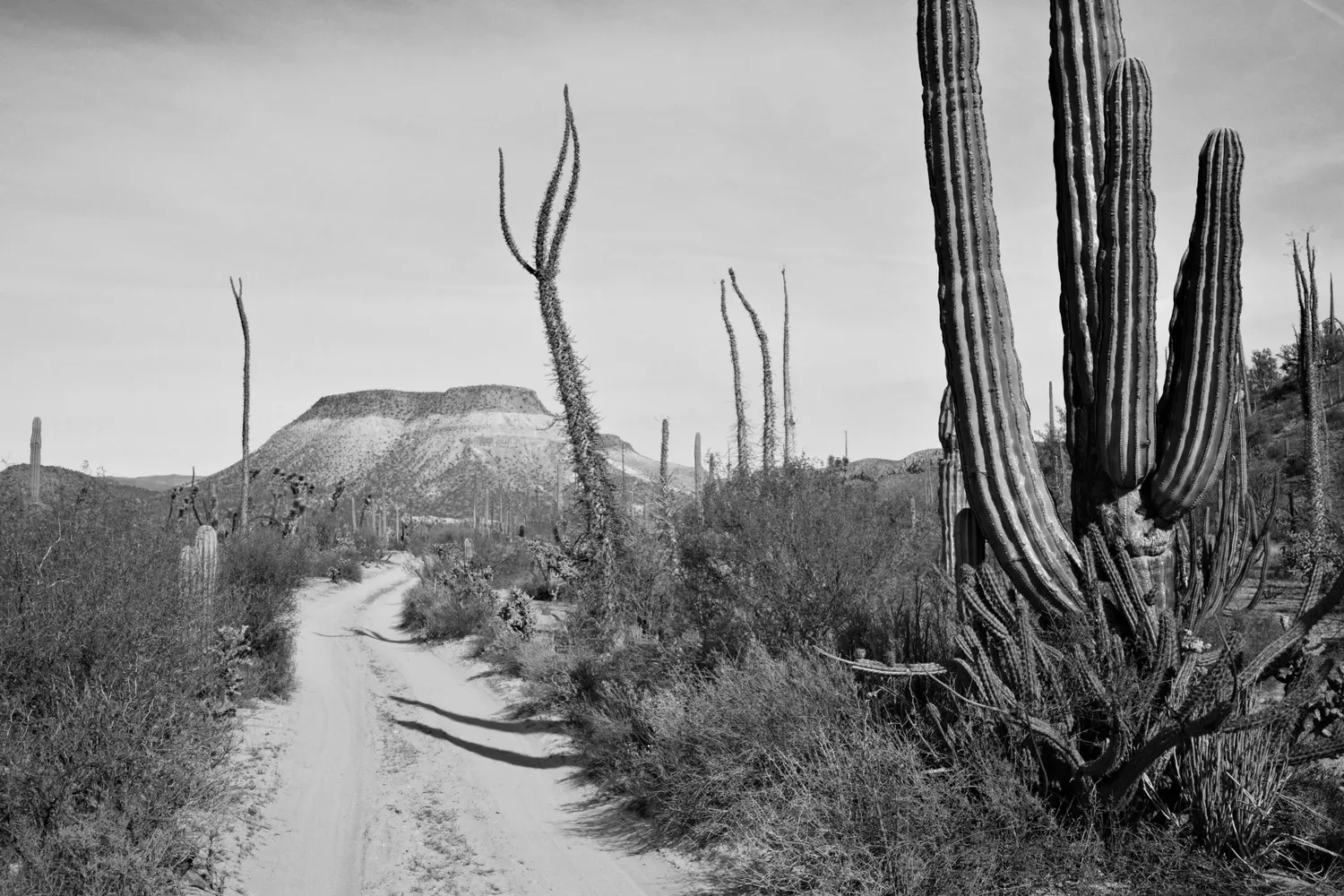
We unload the bikes in a big dirt lot by the highway. In the rush, I have left my bike tool on the bus seat. Uh-oh. Leah has a spare set of hex keys, thankfully. We get water and start the gradual 22-mile ride to Misión San Francisco de Borja. The wind blows in our faces most of the way, and the road is lightly washboarded. The landscape is mostly dead trees and cacti, and not especially inspiring. Surprisingly, every turn for the mission is clearly marked, so we don't need to check the map at all.
We stop for a snack and a pee break but are greeted by barking. Three dogs lie in the shade of an elephant tree just off the road. We're at least ten miles from anything. Where do they live? We ride another half mile to give them space. The land becomes greener as we approach the mission—denser, with more cardónes and cirios. The mission itself is a large stone building, almost intimidating, surrounded by a fence. There's a big sandy area bordered by houses on three sides, with the mission forming the fourth.
A pack of local dogs greets us, followed by a woman who seems unsurprised to see us. We ask about a tour of the mission and she gives us a few minutes to rest (she's clearly used to cyclists), then shows us around.
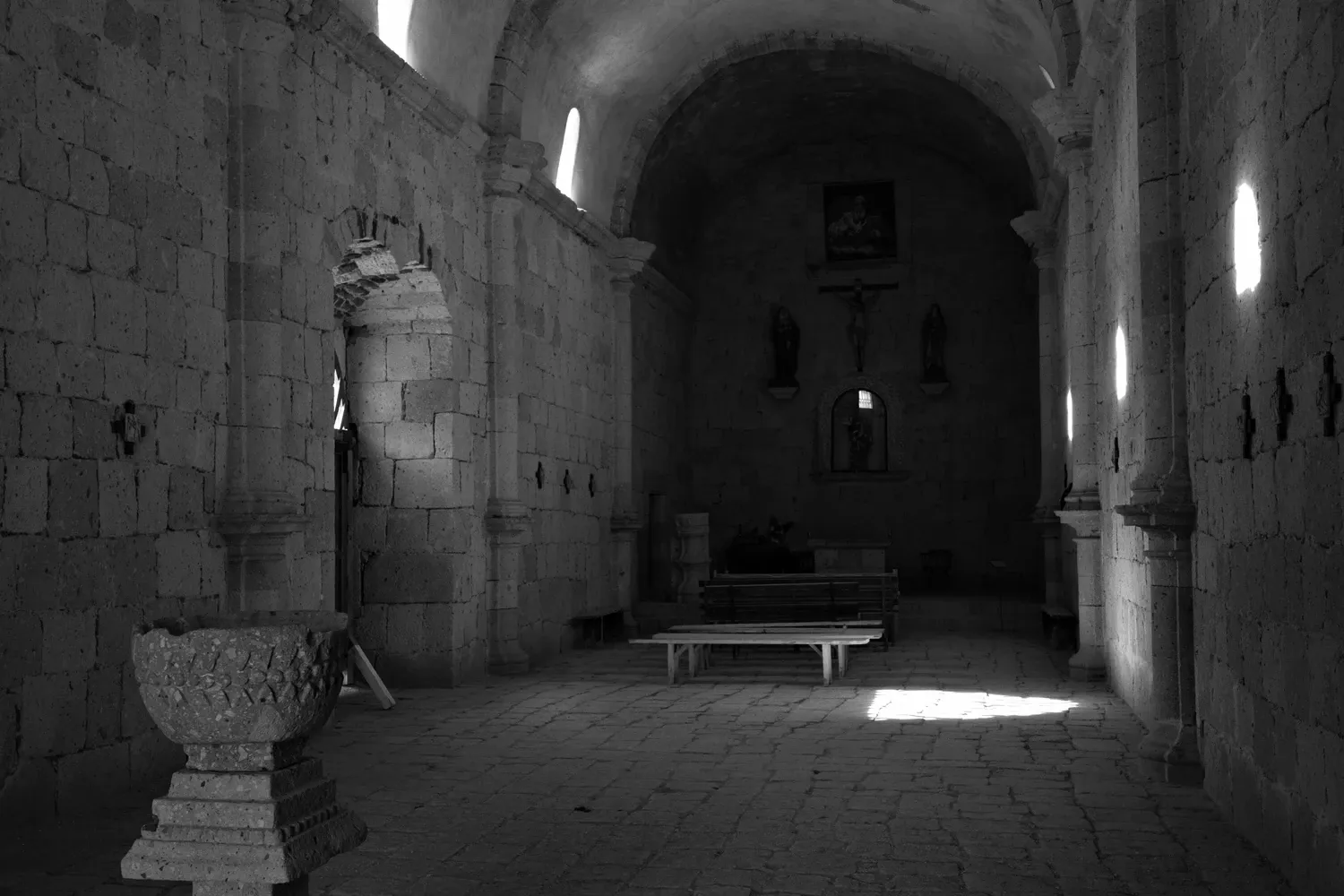
Inside are thick stone walls, high ceilings, and a wonderfully cool darkness. There's a small museum with relics from the 1800s like cutlery, tile shards, nails, and arrowheads. We read an informational display about the mission's history. We explore the other rooms and even walk up a small spiral staircase, through the choir loft, and out onto the rooftop. The original structure was adobe, later rebuilt in stone. Our host casually mentions a donation to help fund the preservation of the building. Leah misinterprets this and shrugs at me, saying "nah". I laugh while feeling slightly horrified at the same time. She quickly realizes and we contribute.
We remember reading about hot springs nearby. Leah asks our host, and she provides us great directions along a narrow path behind the buildings. The water is warm, not hot, but relaxing. We both go in naked. It's crystal clear until we stir up the algae. Leah slips getting out and soaks her towel, but we dry off quickly enough.
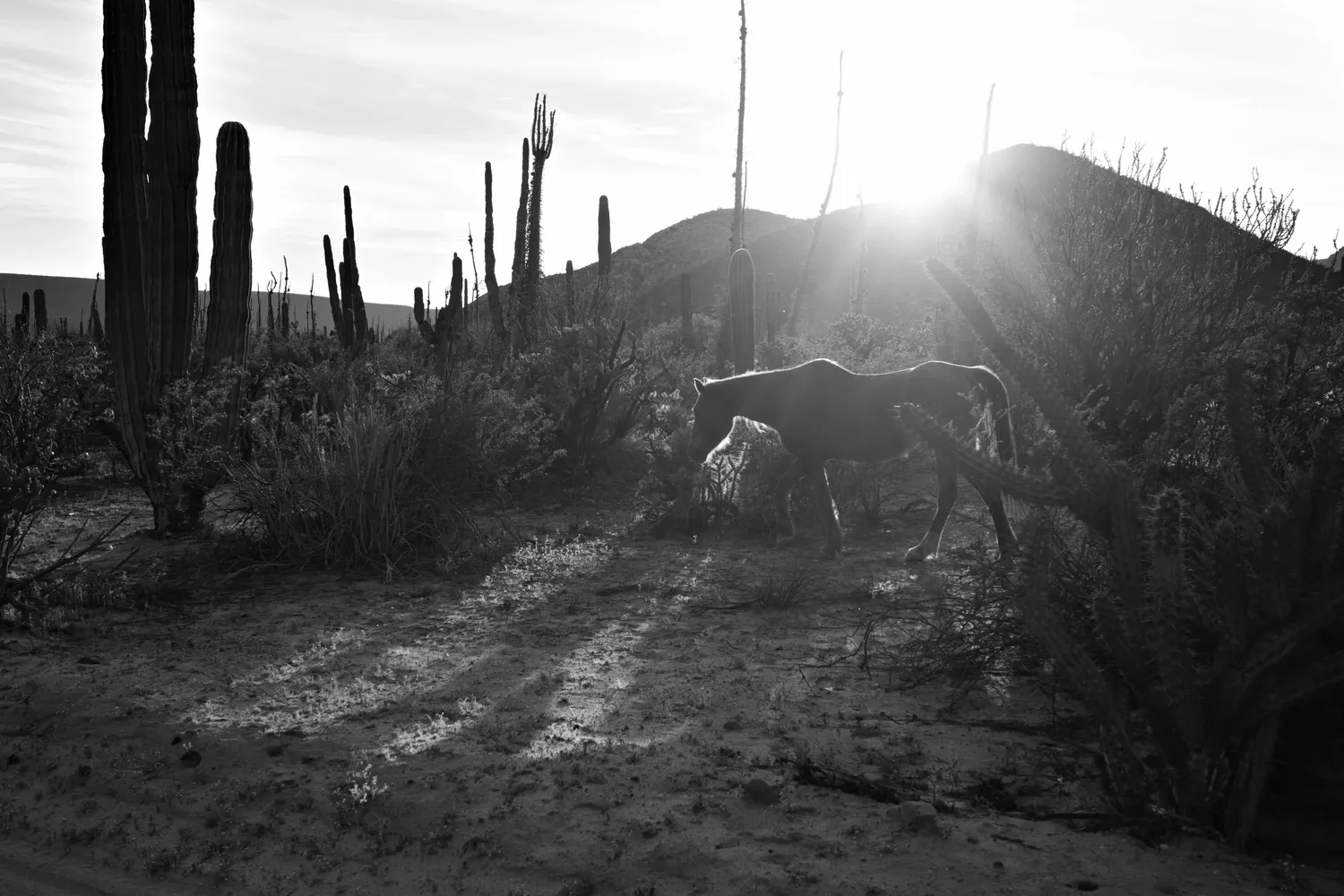
We ride for another half hour. A lone horse slowly clops toward us, steps off the road to give us space, then continues on. I have no idea where it came from. We wander off the road looking for a campsite, but there's a lot of cryptobiotic soil we don't want to disturb, so we head back to the other side. I suddenly feel a sharp pain and look down to see a spiky ball of cactus lodged in my ankle. I instinctively try to pull it out, but the spines cut my hand. It's really stuck. I use my multitool to pull each spine out of my ankle with pliers. They are dug in surprisingly deep. Even the slightest touch and they stick to skin like glue. The pokey things here are on another level compared to those back home in New Mexico.
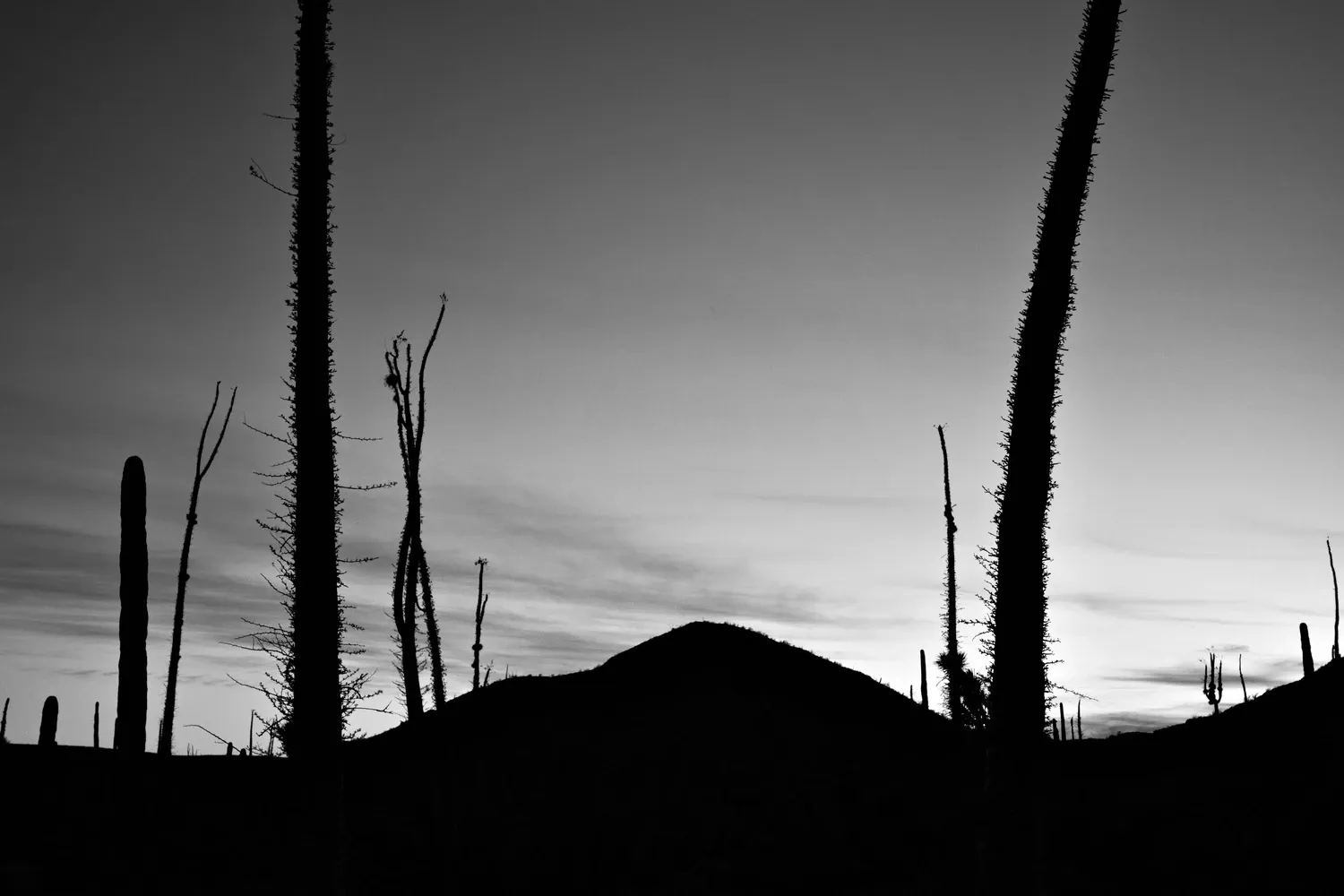
Birds circle overhead. Vultures, maybe twenty of them, float and drop silently. We stop and watch. Sunset through the desert is brilliant. The tortillas we've been carrying since Nueva Odisea have started to mold. We scrape and pick off the bad spots with a knife and our fingers. A few missed bits ruin some bites of dinner.
February 22
We awake to a dry tent. Hooray! My rear tire is almost totally flat (un-horray!), but I just pump it up and it ends up holding all day. Tubeless tires are a miracle.
As I pump up my tire, Larry passes us again, zooming by before I yell and he stops in surprise. Our detour to Guerrero Negro has put us back in front of him. His two days on the coast were tough, but he did 60 miles each day and got some great food at El Cactus, so he feels the section after Cataviña was still worth it. He presses on after a quick chat, eager to make miles and get into Bahía de los Ángeles early.
We climb for seven more miles, mostly fine with intermittent river rock crossings. Some of the cacti are spraypainted a darker shade of green, just across their midsections. Curious. The reward for the climb is a long, gradual downhill that ends all too quickly. We're back to flat, sandy stretches and a headwind for five miles until the highway.
More headwind from the east and a gradual ascent. We're moving at a good pace, but it feels like I'm in molasses. The highway is perfectly straight and the pavement is pretty new. My butt hurts. I ride in front, breaking the wind (heh) for Leah. I hope her memory of this part is less frustrating than mine. Near the high point I see a coyote crossing the road in front of us, and then two more a few miles later. These are the first ones we've seen, though we've heard plenty howling at night. They seem wary — stepping off the road before we pass, then disappearing completely into the underbrush. I stare as long as I can, but there's no sign of them once they leave the road. We detour around a large bridge and a section of new highway. A military truck flies by, then pulls off at a checkpoint shortly after. They start unloading some things from the back, so I just wave and we roll through.
The Sea of Cortez suddenly appears in front of us — both huge and small at the same time. The far shore of mainland Mexico looks surprisingly close. (Note: it is not mainland Mexico, but Isla Ángel de la Guarda). There are several large islands just offshore, appearing like cardboard cutouts through a telephoto lens. It's beautiful and a little overwhelming.
We pull off at a small dirt turnout for a picture. Heading back to the road, I notice a phone on the ground. Leah swipes to the widget screen — it's Larry's. We bomb the last few miles into town and make a plan: she'll go into town to look for him, ask around at hotels, and try emergency contacts. I'll go to the campground, get us a spot, and check if he's there. I stumble through some Spanish before the host, a young guy, just says, "hey we speak English, it's cool." Camping sites are on the beach and it's very windy, so I set up the tent as securely as I can and brace myself for repercussions when I return. The phone feels like the priority. As I go to pay, I almost bump into Larry on the campground path. He's staying in one of the palapas. It's beyond serendipity, again. I ride into town, meet Leah, and share the news. We grocery shop at two markets (the second one is much better, of course), then return to camp at sunset and return his phone.
A couple emerges in wetsuits and we chat for a bit. They mention how cold the water is. This reminds me I need to do my annual family polar plunge (remotely), and the Sea of Cortez seems like a good place for it. The water isn't too chilly, but I still went straight to the shower afterward. The lone lightbulb inside the bathroom flickers sporadically like something out of a horror movie. I wash up, warm up, and we head to the café for dinner. Larry shows up soon after, and we join him along with a younger guy, Lucca, who has been riding from Argentina to Alaska for 2.5 years.
The food is amazing (cerdo ahumado quesadilla), and the beers and lively conversation are refreshing.